
Spatial Audio Earbuds Explained: 3D Sound, Head Tracking & Immersive Wireless Audio
Amazon Affiliate Disclosure
Earsbud may earn a commission when you click certain product links and make a qualifying purchase. This does not change the price you pay, and it does not affect how this page explains spatial audio, wireless earbuds, Dolby Atmos, head tracking, or sound quality. The goal is simple: help each person understand what matters before choosing earbuds.
Updated July, 2026.
Spatial Audio Is Changing Wireless Earbuds
At Earsbud, wireless earbuds are treated as more than small music devices. They are personal screens for sound: tools for music, movies, calls, gaming, workouts, travel, focus, and daily entertainment. Spatial audio is one of the most important features in that shift because it changes not only how earbuds sound, but where the sound feels as if it is coming from.
Spatial audio is the technology behind the feeling of three-dimensional sound. Instead of hearing everything as a flat left-right signal inside your ears, spatial audio tries to create a listening space around your head. A voice may feel as if it sits in front of you. A movie explosion may spread beyond the earbuds. A live recording may feel wider and more atmospheric. A game may become easier to read because footsteps, movement, and environmental cues seem to come from more specific directions.
That is the promise. The reality is more complicated.
Not every pair of wireless earbuds with spatial audio delivers the same experience. Some earbuds provide genuine head tracking. Some only add a wide virtual surround effect. Some depend on Dolby Atmos content. Some work best only inside a specific phone ecosystem. Some make movies thrilling but music unnatural. Some sound impressive for five minutes and tiring after half an hour.
This guide explains spatial audio earbuds clearly: what is spatial audio, what does spatial audio mean, how head tracking works, how spatial audio vs Dolby Atmos should be understood, who needs it, what benefits matter, and what the latest immersive wireless audio trends mean for TWS earbuds.
Quick Picks
- Introduction: Spatial Audio Is Changing Wireless Earbuds
- What Is Spatial Audio?
- What Does Spatial Audio Mean?
- What Spatial Audio Is For
- Best Spatial Audio Earbuds of 2026 🤖
- How Spatial Audio Works in TWS Earbuds
- Head Tracking in Spatial Audio Earbuds
- Benefits of Spatial Audio Earbuds
- Who Needs Spatial Audio Earbuds?
- Wireless Earbuds with Spatial Audio: Feature Checklist
- Spatial Audio vs Dolby Atmos
- 3D Sound vs Traditional Stereo Earbuds
- Lossless Audio and Spatial Audio
- Noise Cancelling Earbuds and Spatial Audio
- The EARS Framework for Evaluating Spatial Audio Earbuds
- Spatial Audio Earbuds Comparison Chart
- Common Mistakes with Spatial Audio Earbuds
- Upcoming Trends and Latest Spatial Audio Tech
- Editorial Insights: The Future of Spatial Audio Earbuds
- FAQ: Spatial Audio Earbuds
What Is Spatial Audio?
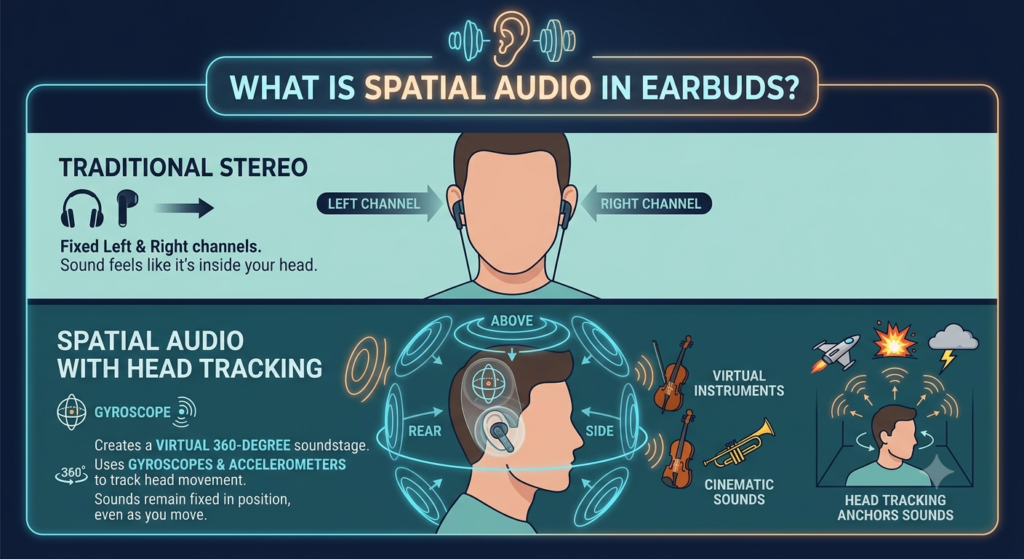
Spatial audio is a sound technology that makes audio feel as if it exists around the listener instead of only inside the left and right earbuds. It is often described as 3D sound, immersive audio, virtual surround sound, or 360 audio.
Traditional stereo uses two main channels: left and right. Good stereo can still sound beautiful, detailed, and emotionally powerful. Spatial audio adds another layer. It tries to give sound height, depth, direction, distance, and movement.
In practical terms, spatial audio answers this question: can earbuds make sound feel less like it is trapped inside your head and more like it is happening around you?
| Audio Type | How It Works | Listening Feel | Best Use |
|---|---|---|---|
| Mono | One centered sound signal | Narrow and direct | Voice, calls, simple audio |
| Stereo | Left and right channels | Wide but mostly horizontal | Music, podcasts, casual listening |
| Surround Sound | Multiple speaker positions | Directional and cinematic | Home theaters, gaming rooms |
| Spatial Audio | Digital 3D sound rendering through earbuds or headphones | Immersive, spacious, room-like | Movies, Atmos music, gaming, video calls |
| Spatial Audio with Head Tracking | 3D sound field reacts to head movement | More physical and screen-anchored | Movies, XR, gaming, remote meetings |
Spatial audio is not automatically better than stereo. It is a different presentation of sound. The quality depends on the earbuds, the phone, the app, the content, the algorithm, the fit, and the listener’s ear shape.
A well-made spatial audio mode can feel natural and cinematic. A weak one can sound hollow, stretched, phasey, or artificial. The difference matters because the phrase “spatial audio” is now used widely in earbud marketing, but the experience behind the label can vary dramatically.
What Does Spatial Audio Mean?
Spatial audio means sound is being processed or mixed so it can feel more three-dimensional to the listener. In earbuds, that usually means the system is trying to create the illusion of sound coming from different positions around your head.
When someone asks, “what does spatial audio mean,” the simplest answer is this: it means your earbuds are trying to create a sound space, not just a sound signal.
For example, in standard stereo, a singer may appear in the center of your head, with instruments spread left and right. In spatial audio, that singer may feel slightly in front of you, the drums may feel wider, the room ambience may feel more open, and background effects may feel as if they sit farther away.
In earbuds, spatial audio can mean several different things:
| Spatial Audio Meaning | What It Usually Refers To | What to Watch For |
|---|---|---|
| Immersive music playback | Music mixed or processed for 3D listening | Not every track sounds better spatialized |
| Dolby Atmos support | Playback of Atmos music, movies, or shows | Needs compatible content and app support |
| Virtual surround mode | Software widening standard stereo | Can sound artificial if poorly tuned |
| Head tracking | Sound changes when your head moves | Latency must be low to feel natural |
| Personalized spatial audio | Spatial cues adjusted to your ear or hearing profile | Can improve realism if implemented well |
| Game audio positioning | Directional cues for footsteps, movement, and effects | Low latency matters more than dramatic width |
This is why spatial audio should not be judged by the label alone. A product page may say “spatial audio,” but the real question is: does it support native immersive content, does it include head tracking, does it work with your phone, and does it sound natural after longer listening?
What Spatial Audio Is For
Spatial audio is for making wireless sound feel more dimensional, more directional, and more connected to the content you are watching or hearing. It is most useful when audio has a sense of space: films, shows, games, concerts, live recordings, video calls, and immersive music.
For movies and shows, spatial audio can make dialogue feel as if it is coming from the screen rather than from the middle of your head. Background effects can spread outward. Rain, traffic, wind, crowds, and cinematic sound design can feel more environmental.
For music, spatial audio can create a larger soundstage. Some tracks feel more open, especially live recordings, acoustic performances, orchestral music, cinematic scores, and songs mixed specifically for Dolby Atmos or other immersive formats. However, not every song benefits. Some tracks sound more focused, punchy, and emotionally direct in stereo.
For gaming, spatial audio can help with positional awareness. Footsteps, reloads, engines, movement, and ambient cues may become easier to locate. For competitive play, the key is not simply bigger sound. The key is accurate direction with low latency—a standard that the best tws earbuds for gaming prioritize by utilizing specialized gaming modes to eliminate audio lag.
For video calls, spatial audio can reduce the feeling that every voice is stacked in the same tiny center point. When voices are slightly separated in space, longer meetings may feel less mentally crowded.
For travel, spatial audio can make a small airplane seat, hotel room, or train compartment feel less boxed-in, especially when combined with strong active noise cancellation.
How Spatial Audio Works in TWS Earbuds
Spatial audio in TWS earbuds is a mix of software, sensors, acoustics, and psychoacoustics. The earbuds are not physically placing speakers around you. They are using digital processing to persuade your brain that sound is coming from different directions.
Your brain locates sound by reading tiny differences between what reaches the left ear and what reaches the right ear. It notices timing differences, loudness differences, frequency changes, reflections, and how your head and outer ear shape the incoming sound. Spatial audio systems try to recreate those cues digitally.
| Technology Layer | Role in Spatial Audio | Why It Matters in Earbuds |
|---|---|---|
| Binaural rendering | Creates 3D cues using left and right earbud playback | Essential because earbuds only have two drivers |
| HRTF processing | Simulates how sound reaches human ears from different directions | Helps create height, depth, and direction |
| Motion sensors | Track head movement | Needed for dynamic head tracking |
| DSP chip | Processes spatial effects in real time | Affects latency, battery life, and realism |
| App support | Controls spatial modes and content compatibility | Determines where the feature actually works |
| Earbud seal | Keeps bass and imaging stable | A poor seal weakens the spatial illusion |
| Codec and Bluetooth connection | Transmit audio wirelessly | Latency and compression can affect realism |
The hardest part is externalization. That means making sound feel outside your head. Many earbuds can make audio wider. Fewer can make it feel genuinely placed in front of you, beside you, or around you.
A weak spatial audio mode often sounds big but vague. A strong one sounds spacious but controlled.
Head Tracking in Spatial Audio Earbuds
Head tracking is one of the most important features in advanced spatial audio earbuds. It uses sensors inside the earbuds to detect how your head moves. The audio system then adjusts the sound field in real time.
Imagine watching a movie on your phone. Without head tracking, the whole sound field moves with your head. If you turn left, the sound turns with you. With head tracking, the sound can stay anchored to the screen. If a character is speaking from the center of the screen and you turn your head, the voice may still seem to come from the phone rather than shifting with your ears.
| Mode | How It Feels | Best For |
|---|---|---|
| Spatial audio without head tracking | Sound feels wider or more 3D but moves with your head | Music, casual listening, walking |
| Fixed head tracking | Sound stays anchored to the device or screen | Movies, shows, video calls |
| Dynamic head tracking | Sound field responds continuously to head movement | XR, gaming, immersive video |
| Personalized head tracking | Spatial cues adapt more closely to the individual listener | Premium listening and long sessions |
Head tracking must be fast. If the sound reacts even slightly late, your brain notices. The result can feel floaty, disconnected, or distracting.
For music, head tracking is more personal. Some listeners enjoy the feeling of a stage in front of them. Others prefer the music to move naturally with their head. That is why good earbuds should let you turn spatial audio and head tracking on or off separately.
Benefits of Spatial Audio Earbuds
Spatial audio earbuds can make wireless listening feel more open, cinematic, and realistic. The benefit is not only louder or wider sound. The deeper benefit is spatial organization.
When sound is arranged in a more dimensional way, the brain can sometimes separate elements more easily. Dialogue can sit in front. Background ambience can sit around. Effects can move across the scene. Music can breathe.
| Benefit | Why It Matters | Best Use Case |
|---|---|---|
| More immersive listening | Sound feels less flat and more environmental | Movies, shows, immersive music |
| Better dialogue anchoring | Voices can feel connected to the screen | Streaming, video calls, lectures |
| Wider soundstage | Music may feel more open and spacious | Live recordings, Atmos tracks |
| Directional awareness | Sounds can appear to come from specific positions | Gaming and XR |
| Less cramped call audio | Voices may feel more separated | Remote meetings |
| Stronger travel experience | Spatial audio plus ANC can make small spaces feel larger | Flights, trains, hotels |
| Premium entertainment feel | Earbuds become more like a private cinema | Daily streaming and mobile viewing |
The most valuable benefit depends on listening habits. A person who watches films on a tablet may care about dialogue anchoring. A gamer may care about direction and latency. A music listener may care about whether spatial mixes sound emotional rather than artificial.
Spatial audio is strongest when it serves the content, not when it overwhelms it.
Who Needs Spatial Audio Earbuds?
Spatial audio is not essential for every person, but it is highly useful for people who use earbuds as entertainment, work, or gaming devices.
| Listener Type | Spatial Audio Value | Why It Matters |
|---|---|---|
| Movie and TV listener | Very high | Creates a more cinematic sound field |
| Music listener using Atmos content | High | Can make compatible tracks feel wider and more expressive |
| Mobile gamer | Medium to high | Directional cues may improve awareness |
| Remote worker | Medium | Spatial voice placement can reduce call fatigue |
| Traveler | High | Spatial audio with ANC can make small spaces feel less closed |
| Podcast listener | Low to medium | Voice clarity matters more than 3D effects |
| Critical stereo listener | Selective | Some tracks sound better in pure stereo |
| Fitness listener | Medium | Can add energy, but outdoor awareness still matters |
| XR or AR user | Very high | Spatial sound is central to believable mixed reality |
A person who mainly listens to podcasts may not need spatial audio as a priority. A person who watches Netflix, YouTube, Apple TV, Disney+, Prime Video, plays games, joins video calls, or listens to Dolby Atmos music will likely find more value.
Spatial audio also matters more as earbuds become part of daily screen life. Most people no longer use wireless earbuds only for songs. They use them for everything. That is why immersive wireless audio is becoming a serious feature instead of a luxury gimmick.
Wireless Earbuds with Spatial Audio Checklist
Wireless earbuds with spatial audio should be judged carefully. A spatial audio label alone does not tell you how good the experience will be.
Use this checklist before choosing:
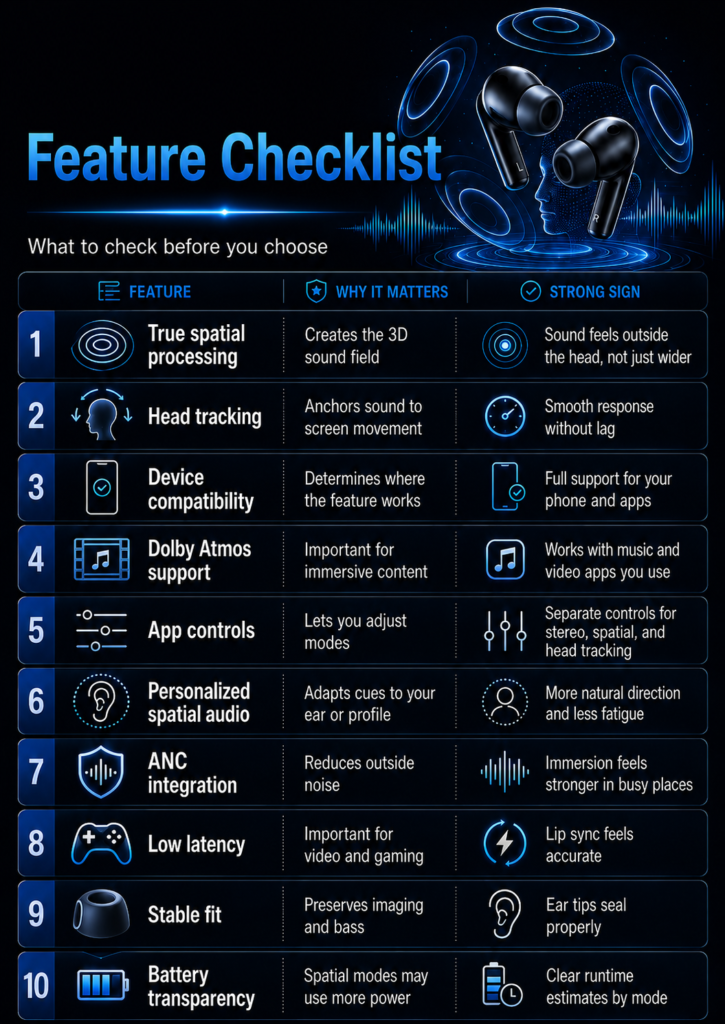
The best wireless earbuds with spatial audio do not treat the feature as decoration. They integrate it into the whole listening system: fit, sound tuning, noise cancellation, codec support, app control, phone compatibility, and battery management.
For serious use, look for earbuds that sound good in normal stereo first. Spatial audio should add another dimension, not hide weak tuning.
Spatial Audio vs Dolby Atmos
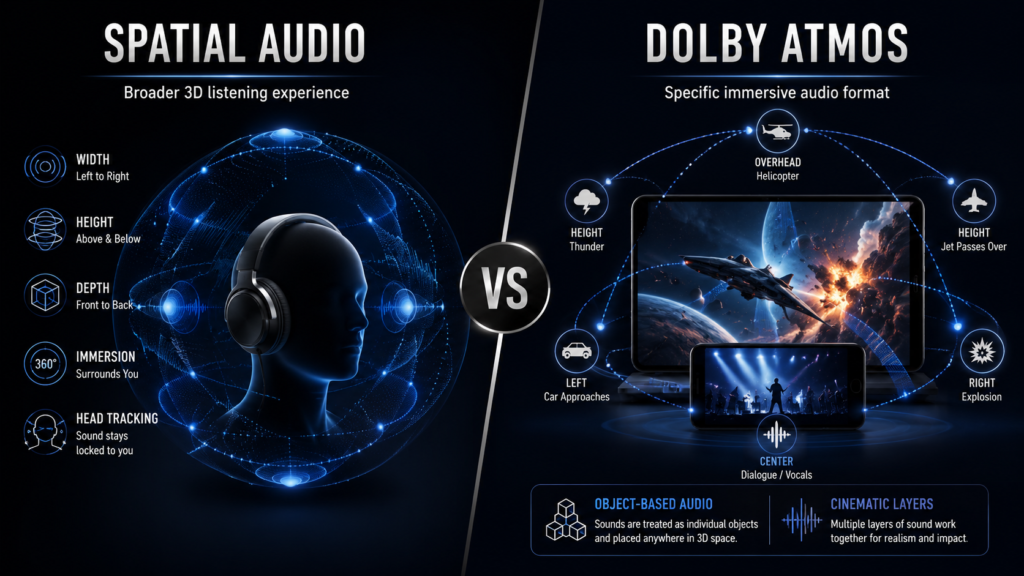
Spatial audio vs Dolby Atmos is one of the most important comparisons in modern wireless audio. The two terms are often used together, but they are not the same thing.
Spatial audio is the broad listening experience: sound feels positioned around the listener.
Dolby Atmos is a specific immersive audio format and technology that can carry sound information in a more three-dimensional way.
A simple way to understand it:
| Term | Meaning | Simple Explanation |
|---|---|---|
| Spatial audio | The experience of 3D sound | How the audio feels around your head |
| Dolby Atmos | An immersive audio format | One major way content is created for spatial playback |
| Head tracking | Motion-based adjustment | Sound reacts when your head moves |
| Binaural rendering | Earbud/headphone processing | Converts spatial information into two-ear playback |
Not all spatial audio is Dolby Atmos. Some earbuds can spatialize ordinary stereo. Some games use their own 3D engines. Some phone ecosystems apply spatial processing at the system level. Some apps use Dolby Atmos tracks. Some earbuds add virtual surround even when the source is not an Atmos mix.
| Question | Spatial Audio | Dolby Atmos |
|---|---|---|
| Is it a listening experience? | Yes | Yes, when played through compatible systems |
| Is it a content format? | Not always | Yes |
| Does it need special content? | Sometimes | Usually, for true Atmos playback |
| Can earbuds use it? | Yes | Yes |
| Does it always include head tracking? | No | No |
| Can stereo be spatialized? | Yes, on some devices | Not the same as native Atmos |
| Is it always better than stereo? | No | No |
The key point: Dolby Atmos can power a spatial audio experience, but spatial audio is the larger idea. A great Dolby Atmos mix can sound excellent on good earbuds. A weak Atmos mix can sound strange. A well-mastered stereo track may still sound better than a forced spatial version.
3D Sound vs Traditional Stereo Earbuds
3D sound and stereo sound should not be treated as enemies. They are different ways of presenting audio.
Stereo is direct, focused, and still extremely important. Most music is built around stereo. A strong stereo mix can deliver punch, intimacy, vocal presence, and instrument separation with excellent clarity.
3D sound tries to create a larger listening scene. It can add depth, height, width, and movement. It is often more effective for films, games, live performances, cinematic music, and immersive formats.
| Category | Traditional Stereo Earbuds | 3D Sound Earbuds |
|---|---|---|
| Main strength | Clarity and focus | Immersion and space |
| Best for | Music, podcasts, calls | Movies, gaming, Atmos music |
| Sound image | Left-right stage | Wider, deeper, more dimensional |
| Processing level | Usually lower | Usually higher |
| Risk | Can feel narrow | Can feel artificial |
| Battery use | Usually lower | May be higher |
| Listener control | Simple | Needs better settings |
The best earbuds should not force a choice. They should provide strong stereo performance and spatial audio as an optional mode. If the original recording sounds better in stereo, use stereo. If the content benefits from space, use spatial audio.
That flexibility is what separates useful immersive audio from a marketing feature.
Lossless Audio and Spatial Audio
Lossless audio and spatial audio are different upgrades. They are often discussed together, but they do not do the same job.
Lossless audio is about preserving more audio data. It focuses on fidelity, compression, and how much of the original recording is retained.
Spatial audio is about sound placement. It focuses on immersion, direction, distance, and the feeling of a 3D listening space.
| Feature | Main Purpose | What It Improves |
|---|---|---|
| Lossless audio | Preserves more original audio data | Detail, clarity, fidelity |
| Spatial audio | Creates a 3D sound field | Immersion, atmosphere, direction |
| Head tracking | Reacts to head movement | Screen anchoring and realism |
| ANC | Reduces outside noise | Focus and travel comfort |
| Personalized audio | Adjusts sound to the listener | Tonal and spatial accuracy |
A person can have lossless audio without spatial audio. A person can have spatial audio without lossless audio. The ideal premium experience may combine both: cleaner signal quality and better spatial placement.
The challenge is that wireless earbuds have limits. Bluetooth bandwidth, battery capacity, processing power, ANC, microphone use, head tracking, and app features all compete for resources. This is why premium earbuds rely heavily on custom chips and optimized software.
Lossless audio answers: how clean is the signal?
Spatial audio answers: where does the signal feel like it exists?
They are not replacements for each other. They are separate parts of the modern wireless audio experience.
Noise Cancelling Earbuds and Spatial Audio
Noise Cancelling Earbuds and spatial audio work well together because immersion becomes easier when outside noise is controlled.
Spatial audio creates a virtual sound space. Noise cancellation reduces real-world sound that can interrupt that space. If you are listening in an airplane cabin, train, café, office, or busy home, external noise competes with the earbud’s spatial illusion. Strong ANC gives spatial audio a quieter canvas.
| Combination | Listening Result |
|---|---|
| Spatial audio without ANC | Immersive in quiet spaces, weaker in noisy places |
| ANC without spatial audio | Quiet and focused, but not necessarily dimensional |
| Spatial audio with strong ANC | More cinematic, private, and stable |
| Spatial audio with transparency mode | Useful outdoors, but less sealed and less cinematic |
There is a balance. ANC can affect tonal balance, pressure feel, and bass perception. Spatial audio also changes how sound is presented. If both systems are poorly tuned, the result can feel over-processed. If both are tuned well, the experience can feel polished and deeply immersive.
This is especially important for travel. Spatial audio can make a film feel bigger. ANC can make the environment disappear. Together, they turn small wireless earbuds into a private entertainment space.
Best Spatial Audio Earbuds of 2026
Spatial audio has moved from a “nice extra” to a defining layer of premium listening and in 2026 the gap between good and great is mostly about how convincingly each earbud builds space, direction, and motion inside a tiny in-ear stage. The strongest models don’t just widen sound—they anchor it, letting dialogue, instruments, and effects feel positioned in a stable 3D field even as you move your head.
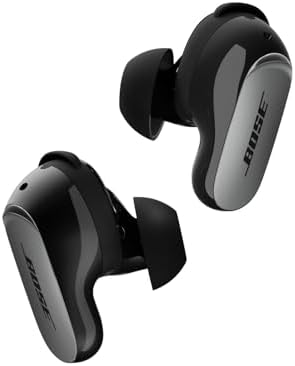
Bose QuietComfort Ultra Earbuds (2nd Gen)
- WORLD-CLASS NOISE CANCELLATION: The best noise cancellation of any Bose wireless earbuds is now even better than before….
- CUSTOMTUNE TECHNOLOGY: CustomTune technology analyses your ears and adapts your in-ear headphones to their shape. The re…
- NOISE CONTROL: Quickly adjust the level of noise cancellation without using Modes, including turning it off completely t…
Among current flagships, the Bose QuietComfort Ultra Earbuds (2nd Gen) still set the benchmark for immersion. Their spatial implementation is less about flashy positioning and more about stability and scale—sound feels glued to a virtual front stage while remaining expansive and cinematic. What separates them is how effortlessly they combine that spatial effect with class-leading noise isolation, making them especially effective for films, commuting, or any environment where outside noise would otherwise collapse the illusion.
Technics EAH-AZ100

- Next-Level Innovation: Technics AZ100 earbuds wireless bluetooth give an unrivaled listening experience using AI technol…
- Dolby Atmos Earbuds with Head Tracking: Bluetooth earbuds with advanced spatial audio for total immersion; head tracking…
- Mind-Blowing Hi-Res Sound from Technics Technologies: Hear new detail and clarity; magnetic fluid drivers provide low di…
The Technics EAH-AZ100 approach spatial audio from a more audiophile angle. Instead of exaggerating width, they prioritize precision and layering. The result is a more “studio-like” spatial field where instrument separation feels deliberate rather than dramatic. They tend to reward careful tuning and higher-quality sources, making them feel closer to miniature reference monitors than entertainment-first earbuds.
Sennheiser Momentum True Wireless 4

- Seamless Connectivity & Smart Features: Sennheiser MOMENTUM 4 earbuds wireless Bluetooth 5.4 with multipoint connectivit…
- Adaptive Noise Cancellation & Transparency Mode: The wireless Bluetooth earbuds block distractions with optimized ANC an…
- All-Day Comfort & Secure Fit: The true wireless earbuds have an ergonomic design with extra soft silicone ear tips for l…
With the Sennheiser Momentum True Wireless 4, spatial performance is anchored by tonal balance. The spatial image is not the widest in class, but it is one of the most natural. Vocals sit convincingly forward, instruments occupy believable depth, and nothing feels artificially stretched. This makes them particularly strong for acoustic music, podcasts, and mixed-genre listening where realism matters more than theatrical width.
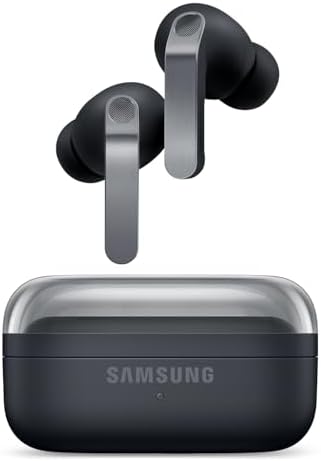
Samsung Galaxy Buds 4 Pro
- EXCEPTIONAL AUDIO: Catch details like never before. Designed with a High-Res Audio¹ 24-bit hi-fi codec, the latest Galax…
- TWO-WAY SPEAKER: Enjoy every audio experience to the fullest with two speakers in both Buds, including a tweeter for ric…
- HD VOICE: Enjoy clear phone calls with Galaxy Buds4 Pro and Galaxy S26 Series² —they work together to deliver crisp and …
The Samsung Galaxy Buds 4 Pro lean heavily into ecosystem-driven spatial processing. On compatible devices, their 360-style audio presentation becomes more dynamic and movement-sensitive, with head tracking that emphasizes positional shifts in a noticeable way. The effect is engaging and entertaining, especially for video and mobile gaming, though it can feel slightly processed compared to more neutral competitors.
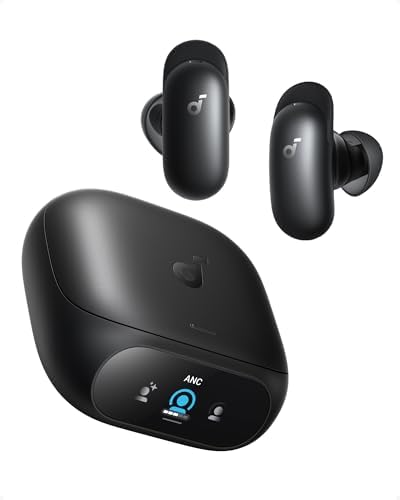
Soundcore Liberty 5 Pro
- Guinness World Records: soundcore Liberty 5 Pro was certified by Guinness World Records in April 2026 as the “Highest sp…
- Whisper-Clear Calls: Equipped with 10 sensors and the Thus AI Chip, enjoy crystal-clear calls in 100 dB+ noisy environme…
- Instant Pure Silence: 100% more effective noise cancellation than our previous flagship model. Powered by 8 sensors and …
The Soundcore Liberty 5 Pro sits in that modern “AI-flagship” category where spatial audio is no longer a standalone feature but part of a tightly integrated listening system. Instead of chasing an exaggerated 3D effect, it focuses on creating a controlled, cinematic sound field that stays stable across music, video, and calls.
Spatial audio here is shaped by Dolby Atmos processing and adaptive tuning, giving the presentation a forward-anchored stage rather than an overly wide or artificial surround effect. The result is more about depth and placement than dramatic movement—voices remain centered and consistent, while background elements gain a subtle sense of layering that improves immersion without becoming distracting.
Where it stands out most is how spatial audio interacts with its broader system. Strong active noise cancellation helps preserve the illusion of space by removing environmental interference, while personalized sound profiling (via Soundcore’s HearID system) subtly refines how directionality and separation are perceived. This makes the experience feel more tailored than purely technical.
It doesn’t aim to outperform audiophile-first models in precision or ultra-wide staging. Instead, it prioritizes comfort listening over long sessions, especially for users who want spatial audio that enhances content rather than analyzing it. Movies feel more engaging, dialogue remains locked in place, and music gains a smooth sense of expansion without losing balance.
Overall, the Liberty 5 Pro is best understood as a practical spatial audio flagship—less about showcasing what spatial audio can do in theory, and more about delivering a consistent, immersive experience that works across everyday use cases.
Taken together, these five represent the current spectrum of spatial audio design: Bose focuses on cinematic immersion, Technics on precision, Sennheiser on realism, Samsung on interactive ecosystem depth, and Soundcore on accessible spatial enhancement. The “best” choice depends less on raw specs and more on whether the goal is realism, entertainment, or pure immersion.
The EARS Framework for Evaluating Spatial Audio Earbuds
The EARS framework helps evaluate spatial audio earbuds beyond marketing claims. It stands for Externalization, Anchoring, Realism, and Switching.
| EARS Factor | What It Means | How to Test It |
|---|---|---|
| Externalization | Does sound feel outside your head? | Play a film scene with ambience and dialogue |
| Anchoring | Does the center image stay connected to the screen? | Turn your head during dialogue |
| Realism | Does the space feel natural or fake? | Listen for hollow vocals or exaggerated reverb |
| Switching | Can you easily move between stereo, spatial, and head tracking? | Check the app and device controls |
Externalization is the hardest test. Many earbuds make audio wider, but not truly external. If the sound still feels trapped in the middle of your head, the spatial effect is limited.
Anchoring is critical for video. Dialogue should feel connected to the screen, not floating around vaguely.
Realism matters because an impressive demo can become tiring. Spatial audio should not make every song feel like it was played inside a glass dome.
Switching matters because spatial audio is not always the right mode. Serious earbuds should make it easy to choose stereo, spatial audio, head tracking, ANC, transparency, and custom sound modes without confusion.
Spatial Audio Earbuds Comparison Chart
| Feature | Basic Earbuds | Spatial Audio Earbuds | Premium Spatial Audio Earbuds |
|---|---|---|---|
| Stereo playback | Yes | Yes | Yes |
| 3D sound effect | Usually no | Yes | Yes, with better control |
| Dolby Atmos support | Limited or app-based | Possible | More likely with ecosystem support |
| Head tracking | No | Sometimes | Usually stronger |
| Personalized spatial audio | No | Rare | More common |
| ANC integration | Basic or absent | Varies | Stronger and more refined |
| Gaming value | Limited | Moderate | Better if latency is low |
| Movie experience | Standard | More immersive | More screen-anchored |
| Music experience | Direct stereo | Wider, sometimes artificial | More controlled and adjustable |
| Best for | Simple listening | Entertainment-focused use | Films, gaming, travel, premium music |
This chart shows why spatial audio should be evaluated in context. A basic earbud may sound excellent in stereo but offer no immersive features. A mid-range spatial earbud may add width but lack strong head tracking. A premium spatial earbud may combine tuning, ANC, head tracking, personalization, and app control into a more complete experience.
Common Mistakes with Spatial Audio Earbuds
The first mistake is assuming spatial audio always means better sound. It does not. Spatial audio is a presentation style. It can be excellent, average, or poor.
The second mistake is confusing spatial audio with Dolby Atmos. Dolby Atmos is one immersive format. Spatial audio is the broader experience.
The third mistake is turning spatial audio on for every song. Some tracks benefit. Others lose punch, intimacy, or vocal focus.
The fourth mistake is ignoring fit. A weak seal can damage bass response, imaging, and spatial accuracy. Even the best spatial processing struggles if one earbud sits loosely.
The fifth mistake is forgetting battery life. Spatial processing, head tracking, ANC, microphones, and high-quality codecs all use power.
The sixth mistake is expecting identical performance across every phone and app. Spatial audio often depends on ecosystem support. An earbud may offer deeper features on one operating system than another.
The seventh mistake is choosing earbuds only because the product page says “spatial audio.” A smart decision considers sound quality, comfort, ANC, call quality, app controls, latency, and compatibility.
Upcoming Trends and Latest Spatial Audio Tech
Spatial audio is moving from a premium novelty to a standard part of wireless audio. The next wave will focus less on dramatic effects and more on natural, personalized, low-latency immersion.
| Trend | What It Means | Why It Matters |
|---|---|---|
| Personalized spatial profiles | Spatial cues adapt to the listener | More realistic direction and less fatigue |
| Faster head tracking | Lower delay between movement and sound | Better movies, gaming, and XR |
| Spatial audio in calls | Voices placed more naturally | Less meeting fatigue |
| OS-level spatialization | Phones and laptops handle more processing | Wider app compatibility |
| LE Audio improvements | More efficient Bluetooth audio | Better battery and possible latency gains |
| Spatial gaming growth | More mobile games use directional audio | Better awareness and immersion |
| Mixed reality audio | Earbuds support AR and XR environments | Sound becomes part of the interface |
| Adaptive ANC with spatial audio | Noise control changes around the listening scene | Better immersion in real environments |
| Spatial recording | Phones capture more immersive sound | More user-generated spatial content |
| Premium DSP chips | More processing inside earbuds | Stronger features with less battery drain |
Personalization may become the most important trend. Everyone’s ears are shaped differently. Generic spatial audio can impress, but personalized spatial audio can feel more believable because it better matches how a specific person hears direction.
Another major trend is spatial communication. Today, many people think of spatial audio as a music or movie feature. In the future, calls, remote work, education, virtual events, and mixed reality may be just as important.
The future of spatial audio earbuds is not only bigger sound. It is more believable sound.
FAQ: Spatial Audio Earbuds
What is spatial audio in wireless earbuds?
Spatial audio in wireless earbuds is a technology that makes sound feel more three-dimensional. Instead of hearing audio as a flat left-right signal, the earbuds or connected device process the sound so voices, instruments, effects, and ambience can feel as if they are placed around your head. It can make films more cinematic, games more directional, music more spacious, and calls less cramped. The quality depends on the earbuds, device, app, content, fit, and whether head tracking is supported.
Are wireless earbuds with spatial audio worth it?
Wireless earbuds with spatial audio are worth it for people who watch movies, stream shows, listen to Dolby Atmos music, play mobile games, use video calls, or want a more immersive entertainment experience. They are less essential for someone who mainly listens to podcasts or simple background music. The feature is most valuable when paired with good stereo tuning, strong fit, low latency, effective ANC, and easy app controls.
Is spatial audio the same as Dolby Atmos?
Spatial audio is not exactly the same as Dolby Atmos. Spatial audio is the broad experience of sound feeling three-dimensional around the listener. Dolby Atmos is a specific immersive audio format that can help create that experience. A Dolby Atmos track can be played through spatial audio rendering, but some earbuds can also spatialize ordinary stereo content. Dolby Atmos is one major path into immersive audio, while spatial audio is the wider category.
Does spatial audio work with all songs?
Spatial audio does not work equally well with all songs. Tracks mixed specifically for immersive formats usually benefit more. Live recordings, cinematic music, acoustic performances, and Atmos mixes can sound larger and more atmospheric. Some traditional stereo tracks may lose punch or focus when spatialized. For music, spatial audio should be used selectively rather than automatically.
Does head tracking matter for spatial audio earbuds?
Head tracking matters most for movies, shows, gaming, video calls, and mixed reality. It helps the sound field respond to head movement, often making dialogue feel anchored to the screen. For music, head tracking is more personal. Some listeners enjoy the stage-like feeling, while others prefer standard spatial audio or stereo. The best earbuds allow separate control over spatial audio and head tracking.
People Also Ask: Spatial Audio Earbuds
What does spatial audio mean on earbuds?
Spatial audio on earbuds means the sound is processed to feel as if it has position, direction, and distance around your head. Instead of hearing audio only between the left and right earbud, spatial audio tries to create a wider and deeper listening field. In movies, this can make dialogue feel closer to the screen. In music, it can create a more open stage. In games, it can help with directional cues.
Is spatial audio better than stereo?
Spatial audio is better than stereo for some content, but not all. Movies, games, Dolby Atmos music, and immersive media often benefit from spatial audio. Podcasts, traditional music recordings, and voice-focused content may sound clearer in stereo. Stereo is still important because it can deliver strong focus, punch, and original mix accuracy. The best choice depends on the content.
Can normal earbuds play spatial audio?
Normal earbuds may play spatialized audio if the phone or app creates the effect, but the experience is usually stronger with earbuds designed for spatial audio. Advanced earbuds may include motion sensors, head tracking, app controls, personalized audio, and better processing. Basic earbuds can reproduce the processed signal, but they may not deliver the same realism, stability, or control.
Does spatial audio drain battery faster?
Spatial audio can drain battery faster because it may use extra processing, motion sensors, head tracking, ANC coordination, and app-level features. The exact impact depends on the earbud chip, codec, volume, ANC mode, and software design. Standard stereo playback often lasts longer than spatial audio with dynamic head tracking and active noise cancellation.
Should I keep spatial audio on all the time?
You should not keep spatial audio on all the time unless you genuinely prefer it for everything. Spatial audio works beautifully for some films, shows, games, and immersive music tracks. But some songs, podcasts, and voice content may sound cleaner in stereo. A good habit is to use spatial audio when it improves space and immersion, and use stereo when you want focus, punch, and directness.
Editorial Insights
Spatial audio is not just another earbud feature. It is part of a larger shift in personal listening. Earbuds are becoming private cinemas, gaming companions, work tools, travel shields, fitness audio systems, and eventually mixed-reality interfaces. Flat stereo will remain essential, but immersive wireless audio will keep growing because people now use earbuds for far more than music.
The strongest spatial audio earbuds will not be the ones with the most dramatic demo. They will be the ones that make the feature useful every day: clear dialogue, stable head tracking, believable space, strong stereo tuning, low fatigue, simple controls, and sensible battery life.
Spatial audio should be judged by restraint as much as spectacle. If an earbud makes everything sound huge, it may impress quickly and tire quickly. If it creates space only where space belongs, it becomes a genuine upgrade.
For anyone choosing wireless earbuds with spatial audio, the practical advice is simple: do not chase the label alone. Look for the full listening system. Fit, tuning, ANC, codec support, app control, head tracking, content compatibility, and comfort all matter. Spatial audio is powerful, but it performs best when the rest of the earbud is already strong.
To continue comparing wireless earbud features, listening technologies, and premium TWS options, return to the Earsbud Homepage and treat spatial audio as part of the complete earbud experience, not as a standalone promise.