
TWS Earbuds (True Wireless Earbuds) | The New Standard for Wireless Listening | Complete 2026 Guide
Last Updated: July 2026 — latest models reviewed and ranked
Affiliate Disclosure: To keep Earsbud.com running, we may earn a commission from qualifying purchases made through our links, as an Amazon Associate.
True Wireless Stereo earbuds, more commonly known as TWS earbuds, have become the default choice for modern personal audio. What began as a simple move away from tangled wired earphones has evolved into a serious category of compact audio engineering. Today’s TWS ear buds are no longer just small wireless headphones. They are intelligent, pocket-sized sound systems built for music, calls, gaming, fitness, commuting, travel, remote work, and everyday listening.
The appeal is simple: no wires, no neckband, no friction. Each earbud works independently while staying synchronized through Bluetooth, allowing users to move freely without sacrificing convenience. But the best true wireless earbuds now go far beyond basic wireless playback. They combine miniature drivers, beamforming microphones, low-latency Bluetooth chips, adaptive audio tuning, touch controls, app customization, voice assistant support, water resistance, fast charging, and increasingly advanced battery management inside a case small enough to fit in a pocket.
One of the biggest shifts in this category is the rise of true wireless earbuds with active noise cancelling. Active noise cancellation, often called ANC, uses built-in microphones and digital signal processing to reduce unwanted background noise before it reaches your ears. This has made TWS earbuds more useful in real-world environments such as airplanes, offices, gyms, cafés, public transport, and noisy streets. Instead of simply playing louder audio to overpower outside sound, modern noise cancelling earbuds analyze external noise and produce an opposing signal to help create a quieter listening experience.
This is why TWS earbuds now sit at the center of several fast-growing audio categories: noise cancelling earbuds, Bluetooth earbuds, wireless earbuds for calls, premium earbuds, budget true wireless earbuds, sports earbuds, gaming earbuds and high resolution audio earbuds. The right pair depends on how you listen. Some users need strong ANC for travel. Some need crystal-clear microphones for calls. Others prioritize deep bass, small-ear comfort, sweat resistance, battery life, codec support, multipoint connection, or a stylish charging case that feels as premium as the earbuds themselves.
The technology inside TWS earbuds has also become more refined. Bluetooth standards have improved connection stability. Audio codecs such as AAC, LDAC, LHDC, and aptX variants have expanded wireless sound quality options. Transparency mode lets outside sound pass through when needed. Spatial audio can create a wider, more immersive listening field. Multipoint pairing allows some earbuds to stay connected to a phone and laptop at the same time. Even budget TWS earbuds now often include features that were once limited to flagship models.
Still, not every pair of true wireless earbuds is built equally. A product may advertise active noise cancelling but perform poorly in wind. It may claim long battery life but drain quickly with ANC turned on. It may sound powerful but feel uncomfortable after thirty minutes. It may support advanced codecs but only work at full quality with certain Android phones. That is why choosing the best TWS earbuds requires looking beyond marketing language and understanding how design, fit, microphones, Bluetooth performance, sound tuning, ANC strength, battery life, and app support work together.
This guide is designed as a complete resource for anyone comparing TWS ear buds, and true wireless earbuds with active noise cancelling. It explains what TWS earbuds are, how they work, which features matter most, how to compare different models, and what to look for before buying. Whether you want affordable earbuds for daily use, premium ANC earbuds for travel, call-focused earbuds for work, workout earbuds for the gym, or stylish true wireless earbuds that match your personal aesthetic, this guide will help you understand the category clearly and choose with confidence.
Explore the Complete TWS Earbuds Guide
Jump directly to the section you need, from how TWS ear buds work and what features matter to battery life, ANC, buying mistakes, and the best TWS earbuds overview.
What Are TWS Earbuds?
TWS earbuds are fully wireless in-ear audio devices that use Bluetooth to deliver separate left and right stereo channels without any physical cable between them. TWS stands for True Wireless Stereo, which means each earbud operates as part of a synchronized wireless audio system rather than as a wired pair connected through a neckband or cable.
In simple terms, TWS ear buds are the compact earbuds people use for music, phone calls, video streaming, workouts, gaming, commuting, and everyday listening. They sit directly in the ear, connect to a smartphone, tablet, laptop, smartwatch, or Bluetooth audio source, and usually come with a charging case that stores, protects, recharges, and often helps manage pairing.
Unlike older Bluetooth earphones, which often had a wire running between the left and right earpieces, true wireless earbuds are completely cable-free. Each bud contains its own battery, speaker driver, microphone system, wireless antenna, control chip, and audio processing components. This is what allows modern TWS earbuds to feel small and minimal on the outside while functioning like advanced miniature audio computers on the inside.
A standard pair of TWS earbuds usually includes three core parts:
1. Two independent earbuds
Each earbud contains its own internal electronics, audio driver, battery, Bluetooth radio, microphone array, and control surface. One earbud may handle more communication tasks depending on the chipset design, but both work together to create a stereo listening experience.
2. A Bluetooth wireless connection
TWS earbuds connect to your device through Bluetooth. The connection transmits audio, call data, control signals, and sometimes app-based settings such as equalizer adjustments, noise control modes, firmware updates, and touch-control customization.
3. A smart charging case
The charging case is more than a storage box. It recharges the earbuds, protects them when not in use, helps trigger pairing, extends total battery life, and may include features such as fast charging, wireless charging, LED indicators, magnetic docking, reset controls, or app-based battery reporting.
This fully wireless architecture is the main reason TWS earbuds have become so popular. They remove cable friction while adding features that traditional wired earphones cannot easily provide. Modern Bluetooth earbuds can automatically connect when the case opens, pause music when removed from the ear, switch between listening modes, improve call clarity in noisy spaces, and adapt sound based on fit or environment.
The most advanced models now include true wireless earbuds with active noise cancelling, which use external and internal microphones to detect background noise and reduce it through digital signal processing. This makes ANC TWS earbuds especially useful for travel, public transport, offices, gyms, cafés, and other environments where surrounding noise can interfere with music, podcasts, videos, or calls.
TWS earbuds can also support features such as transparency mode, spatial audio, low-latency gaming mode, multipoint Bluetooth pairing, water resistance, voice assistant access, wear detection, custom EQ, and real-time call enhancement. These features depend on the quality of the chipset, microphones, drivers, battery system, software tuning, and overall acoustic design.
The key difference between basic wireless earbuds and high-quality TWS earbuds is integration. Good TWS earbuds do not simply play sound without wires. They manage wireless stability, stereo synchronization, power efficiency, microphone pickup, audio tuning, comfort, noise control, and device compatibility in real time. That is why two pairs of true wireless earbuds can look similar but perform very differently in sound quality, call clarity, active noise cancellation, battery life, and everyday reliability.
In short, TWS earbuds are compact, cable-free Bluetooth earbuds designed to combine stereo sound, portability, smart controls, and advanced wireless audio features in one small form factor. They have become the modern standard for personal listening because they offer the freedom of wireless movement with the intelligence of app-connected audio technology.
For a broader overview of categories, comparisons and real-world buying guides across all earbud types, explore our Homepage.
Internal Architecture of TWS Earbuds
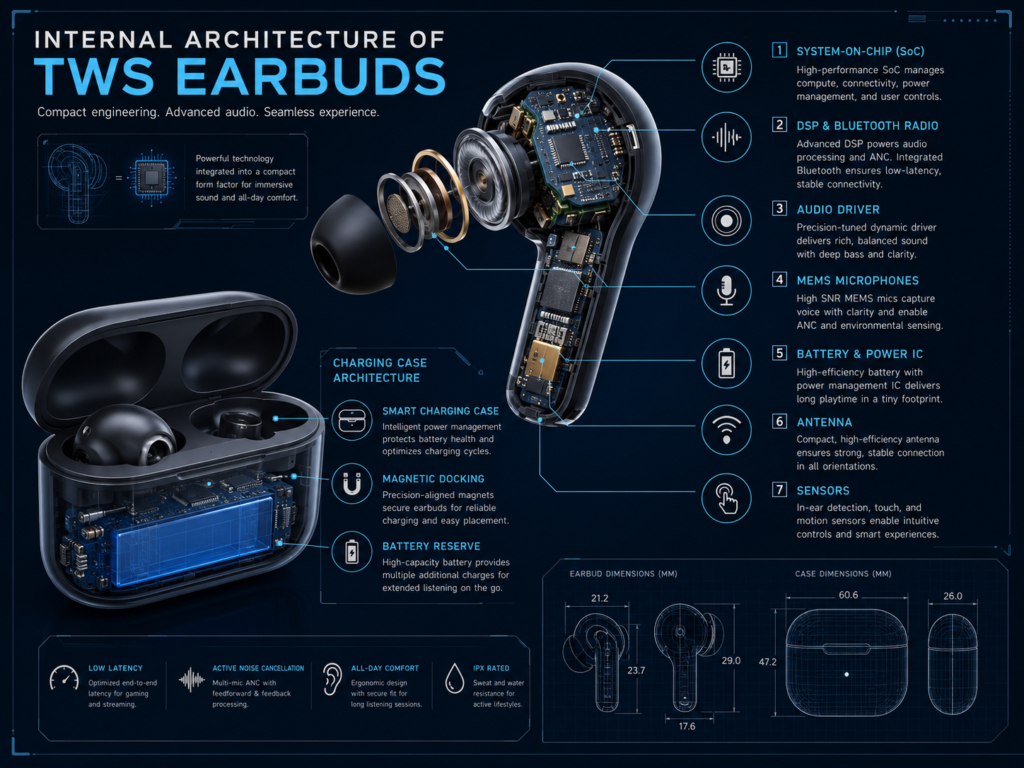
The performance of modern TWS earbuds depends on how much technology can be packed into a very small wireless form factor. A pair of true wireless earbuds may look simple from the outside, but inside each earbud is a tightly integrated system of processors, microphones, batteries, antennas, drivers, sensors, and acoustic chambers working together in real time.
This internal architecture is what separates basic Bluetooth earbuds from premium true wireless earbuds with active noise cancelling. Sound quality, wireless stability, call clarity, battery life, noise cancellation strength, gaming latency, comfort, and smart features all depend on the quality of the components inside the earbuds and how well they are tuned by the manufacturer.
System-on-Chip: The Brain of TWS Earbuds
At the center of most TWS ear buds is a System-on-Chip, commonly called an SoC. This is the low-power processing platform that controls the most important functions of the earbuds. In simple terms, the SoC is the brain of the wireless earbud.
A TWS earbud SoC may combine a CPU, DSP, Bluetooth radio, memory, audio codec support, power management logic, and wireless synchronization features into one compact chip. This allows the earbuds to decode audio, maintain a stable Bluetooth connection, process microphone input, manage active noise cancellation, control touch gestures, and communicate with the charging case or companion app.
The quality of the SoC strongly affects real-world performance. Better chipsets can support more efficient battery use, stronger Bluetooth stability, improved call processing, lower latency, smoother multipoint pairing, and more advanced ANC algorithms. This is why two pairs of TWS earbuds may have similar-looking specifications but feel completely different during daily use.
For users, the SoC matters because it influences how quickly the earbuds pair, how reliably they stay connected, how well they switch between devices, how smoothly video audio stays in sync, and how intelligently features like transparency mode or adaptive noise cancelling respond to the environment.
DSP: The Audio Processing Engine
Inside the SoC, the Digital Signal Processor, or DSP, plays a major role in sound performance. The DSP handles audio correction, equalization, noise reduction, microphone processing, active noise cancellation, and sometimes spatial audio effects.
In high-quality TWS earbuds, DSP tuning is one of the biggest reasons the sound feels balanced, clean, powerful, or immersive. The physical driver creates the sound, but the DSP shapes how that sound is delivered. It can adjust bass response, reduce distortion, control vocal clarity, smooth harsh treble, and compensate for the small acoustic space inside the earbud shell.
DSP is also essential for ANC earbuds. For active noise cancellation to work, microphones must capture unwanted external sound, the processor must analyze that noise, and the earbud must generate a counter-signal almost instantly. This requires fast, efficient, low-latency processing. Poor DSP tuning can make ANC feel weak, unnatural, or pressure-heavy. Strong DSP tuning can make noise cancelling TWS earbuds feel quieter, more stable, and more comfortable for long listening sessions.
Bluetooth Radio and Wireless Synchronization
A true wireless earbud does not just connect to your phone. It also needs to keep the left and right earbuds synchronized with each other. This is one of the most important engineering challenges in TWS earbuds.
The Bluetooth radio handles the wireless link between the earbuds and the source device. Depending on the design, one earbud may act as the primary receiver while the other mirrors the audio stream, or both earbuds may receive synchronized signals more directly through newer wireless architectures. The goal is to deliver stereo audio without dropouts, delay, imbalance, or desynchronization between the left and right channels.
This is especially important for video streaming, gaming, calls, and spatial audio. If synchronization is weak, users may notice audio lag, connection drops, uneven battery drain, or one earbud disconnecting before the other. Premium wireless earbuds usually use stronger antennas, better chipsets, smarter firmware, and improved Bluetooth protocols to reduce these issues.
Audio Drivers: The Sound-Producing Core
The audio driver, also called a transducer, is the component that converts electrical signals into sound. In TWS earbuds, drivers must be extremely small while still producing convincing bass, clear mids, detailed treble, and enough volume for daily listening.
Most true wireless earbuds use dynamic drivers because they are efficient, durable, and capable of strong bass response. A dynamic driver uses a diaphragm, voice coil, and magnet system to move air and create sound. Larger or better-designed dynamic drivers often provide fuller low-end performance, but size alone does not guarantee better sound. Tuning, materials, chamber design, and DSP correction all matter.
Some premium TWS earbuds use hybrid driver systems, combining dynamic drivers with balanced armature drivers or other specialized transducers. These designs aim to improve detail, separation, and frequency balance. Hybrid systems can produce excellent sound, but they also require careful tuning. Poorly tuned hybrid earbuds may sound sharp, uneven, or unnatural.
For buyers, driver quality affects bass depth, vocal presence, instrument separation, clarity, loudness, and overall listening fatigue. The best TWS earbuds are not simply the loudest. They deliver controlled sound that remains enjoyable across music, podcasts, calls, films, and games.
Acoustic Chamber and Earbud Shell Design
The physical shape of the earbud is part of the audio system. Inside every TWS earbud is a tiny acoustic chamber that influences resonance, airflow, bass response, pressure control, and soundstage. Even small changes in vent placement, nozzle length, internal cavity shape, and silicone ear tip fit can change how the earbuds sound.
This is why fit is so important for in-ear TWS earbuds. A poor seal can reduce bass, weaken active noise cancellation, and make audio sound thin. A strong seal improves low-frequency response and helps ANC microphones work more effectively. However, too much pressure can feel uncomfortable, so premium earbuds often include vents or pressure-relief systems to make long listening easier.
The earbud shell also affects microphone placement, touch control accuracy, wind resistance, water resistance, and comfort. Lightweight earbuds may feel better for workouts, while larger premium earbuds may offer stronger batteries, better microphones, and more advanced ANC hardware.
MEMS Microphones: Voice Pickup and Noise Control
Modern TWS earbuds use MEMS microphones, which are tiny, low-power microphones built for compact electronics. These microphones are essential for calls, active noise cancellation, transparency mode, voice assistants, and environmental sound detection.
A single earbud may include multiple microphones. Some face outward to capture external noise. Some face inward toward the ear canal to monitor sound inside the ear. Others are positioned to focus on the user’s voice during calls. Together, these microphones allow the earbuds to separate speech from background sound, reduce wind noise, and support real-time audio processing.
For true wireless earbuds with active noise cancelling, microphone quality is critical. External microphones detect noise from the environment, while internal microphones help measure what the listener actually hears. The processor then uses this data to adjust the cancellation signal. This is why premium ANC earbuds usually perform better in airplanes, traffic, offices, and crowded places.
Microphones also determine call quality. The best TWS earbuds for calls use beamforming microphone arrays, noise suppression, voice isolation, and AI-based enhancement to make speech sound clearer in busy environments. Poor microphone tuning can make the user sound distant, muffled, robotic, or overwhelmed by background noise.
Battery and Power Management
Every TWS earbud contains a small rechargeable lithium-ion battery. Because the earbuds are compact, battery capacity is limited, so efficiency becomes extremely important. The chipset, Bluetooth radio, amplifier, microphones, sensors, and ANC system all compete for power.
Battery life depends on several factors: volume level, codec type, active noise cancellation, transparency mode, call usage, gaming mode, temperature, and battery age. A pair of earbuds may offer strong playback time with ANC off but drain faster when active noise cancellation is enabled.
The power management IC controls charging, energy distribution, voltage regulation, sleep states, and battery protection. Good power management helps the earbuds last longer between charges, avoid overheating, charge safely, and preserve battery health over time.
Fast charging has become an important feature in modern TWS earbuds. Many models can provide an hour or more of playback from a short charge inside the case. Premium charging cases may also support USB-C charging, wireless charging, LED battery indicators, or app-based battery monitoring for each earbud and the case.
Charging Case Electronics
The charging case is a major part of the TWS earbud system. It is not only a storage accessory. It contains its own battery, charging contacts, magnets, power control circuitry, pairing logic, and sometimes wireless charging coils or display features.
When the earbuds are placed inside the case, the case recharges them through metal contact pins or similar charging points. Magnets help align each earbud correctly so charging remains stable. The case also protects the earbuds from dust, scratches, and accidental loss.
A well-designed charging case improves the entire user experience. It should open smoothly, hold the earbuds securely, show battery status clearly, and provide enough extra charge cycles for real-world use. Poor case design can lead to charging failures, loose earbuds, weak hinges, slow pairing, or inconsistent battery reporting.
Sensors and Smart Controls
Many modern TWS earbuds include sensors for wear detection, touch input, motion control, and voice interaction. These sensors help the earbuds respond naturally to the user.
Wear detection sensors can pause audio when an earbud is removed and resume playback when it is placed back in the ear. Touch or pressure sensors allow users to play music, answer calls, change volume, switch ANC modes, or activate a voice assistant. Motion sensors may support spatial audio head tracking, workout detection, or gesture-based controls.
These smart controls make true wireless earbuds more convenient, but they also require careful tuning. Overly sensitive touch panels can trigger accidental commands, while poorly placed controls can be difficult to use during workouts or cold weather. The best TWS earbuds balance responsiveness with reliability.
Antennas and Signal Stability
Because TWS earbuds are small and sit close to the human body, antenna design is difficult. The wireless signal must pass between the phone, earbuds, and sometimes the opposite earbud while dealing with movement, clothing, walls, crowded radio environments, and interference from other devices.
Premium TWS earbuds use careful antenna placement and optimized firmware to improve Bluetooth stability. This matters in gyms, airports, offices, trains, and city streets where many wireless devices are active at the same time. Stable antennas help reduce dropouts, crackling, channel imbalance, and random disconnections.
Signal stability is especially important for multipoint Bluetooth earbuds, where the earbuds may stay connected to a phone and laptop at once. It also matters for high-bitrate codecs, low-latency gaming, and video calls.
Why Internal Architecture Matters
The internal architecture of TWS earbuds determines how they perform beyond the spec sheet. A strong driver can be limited by poor tuning. Good microphones can be weakened by bad placement. A large battery can still drain quickly if the chipset is inefficient. Active noise cancellation can sound impressive in marketing but fail in real environments if the microphones, DSP, seal, and acoustic design are not working together.
This is why the best TWS earbuds are built as complete systems. The SoC, Bluetooth radio, DSP, audio drivers, MEMS microphones, battery, sensors, antennas, acoustic chamber, and charging case must all operate as one integrated platform.
For buyers, understanding this architecture makes it easier to compare true wireless earbuds, ANC earbuds, Bluetooth earbuds, wireless ear buds, and premium audio models. The most reliable earbuds are not always the ones with the longest feature list. They are the ones where the internal engineering supports clear sound, stable connectivity, comfortable fit, effective active noise cancelling, strong call quality, and dependable battery life in everyday use.
Bluetooth & Wireless Audio Transmission
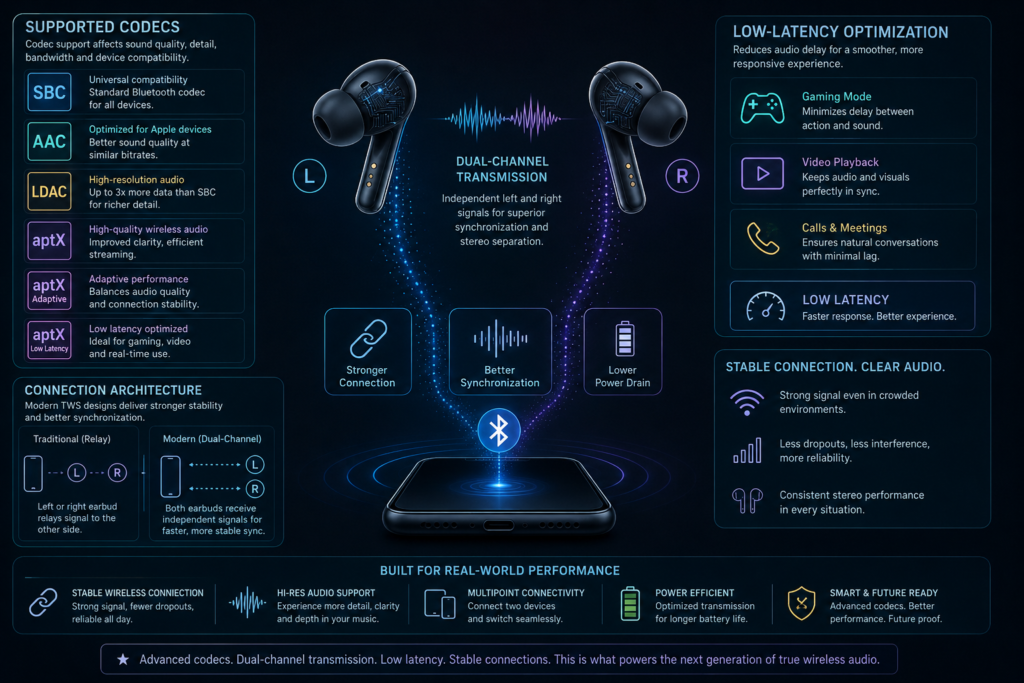
Every pair of TWS ear buds depends on Bluetooth to receive audio, communicate with the source device, and keep the left and right earbuds synchronized. This wireless connection is one of the most important parts of the true wireless experience because it affects sound quality, connection stability, latency, battery life, call performance, and how smoothly the earbuds work with phones, laptops, tablets, smart TVs, and gaming devices.
At a basic level, TWS earbuds receive a digital audio signal from a Bluetooth-enabled device. That signal is compressed, transmitted wirelessly, decoded inside the earbuds, processed by the onboard chipset, and then converted into sound through the audio drivers. The process happens quickly enough that most users never notice it, but the quality of that transmission can vary greatly from one pair of true wireless earbuds to another.
This is why two products with similar driver sizes or similar battery claims can perform very differently in real life. A premium pair of Bluetooth earbuds may deliver cleaner sound, fewer dropouts, better video sync, clearer calls, and stronger multipoint performance because its wireless transmission system is more advanced. A cheaper pair may sound acceptable in quiet conditions but struggle with lag, weak signal stability, or inconsistent left-right synchronization.
Bluetooth Codecs: How TWS Ear Buds Handle Sound Quality
Bluetooth audio relies on codecs to compress and transmit sound from the source device to the earbuds. A codec is the method used to encode audio before transmission and decode it inside the earbuds. Codec support plays an important role in wireless sound quality, especially for users who care about music detail, high-bitrate streaming, video sync, and device compatibility.
The most common Bluetooth audio codecs found in TWS ear buds include SBC, AAC, LDAC, and aptX variants. Each codec has different strengths, limitations, and compatibility requirements.
SBC is the basic Bluetooth audio codec supported by nearly all Bluetooth earbuds and source devices. It provides broad compatibility, but it is not usually the best option for high-detail music listening.
AAC is widely used on iPhones, iPads, and many true wireless earbuds. For Apple users, AAC is often more important than LDAC or aptX because iOS does not fully support many advanced Android-focused Bluetooth codecs. A well-tuned AAC earbud can sound excellent when the hardware, fit, and DSP tuning are strong, which is why codec performance should be considered alongside Spatial Audio, device switching, microphone quality, and ecosystem integration when choosing the best wireless earbuds for iPhone.
LDAC is a higher-bitrate codec often associated with Android devices and hi-res wireless audio. It can transmit more audio data than basic codecs under ideal conditions, which may improve detail and clarity. However, LDAC performance depends on signal strength, source device support, and how the earbuds manage battery consumption and connection stability.
aptX is a codec family used on many Android devices and supported earbuds. Depending on the version, aptX may focus on improved audio quality, adaptive bitrate control, lower latency, or near-lossless wireless transmission. Compatibility varies by phone, chipset, and earbud model, so users should always check both the earbuds and the source device before assuming support.
For listeners, codec support matters most when it matches the device ecosystem. The best TWS ear buds for iPhone may not need LDAC if they are well optimized for AAC. The best TWS earbuds for Android may benefit from LDAC, LHDC, aptX Adaptive, or aptX Lossless depending on the phone. Codec quality also depends on tuning, driver performance, fit, and Bluetooth stability, so a codec alone does not guarantee better sound.
Connection Architecture: How Left and Right Earbuds Stay Synchronized
A key engineering challenge in true wireless earbuds is keeping the left and right channels synchronized without a physical wire. Traditional wired earphones receive left and right audio through a cable. TWS ear buds must manage stereo separation, timing, pairing, and playback entirely through wireless communication.
Older TWS designs often used a primary-secondary architecture. One earbud connected directly to the phone and then relayed audio to the second earbud. This approach worked, but it could create uneven battery drain, occasional dropouts, and synchronization issues between the two earbuds.
Modern TWS earbuds increasingly use more advanced dual-channel transmission or improved left-right communication systems. In these designs, the earbuds can receive more independent or better-synchronized audio signals, reducing delay and improving stability. This helps create a smoother stereo image, better video sync, and more reliable performance during calls, workouts, commuting, and gaming.
Strong left-right synchronization is especially important for active noise cancelling earbuds, spatial audio, and transparency mode. These features require fast communication between microphones, processors, and drivers in both earbuds. If synchronization is weak, users may notice phase issues, uneven noise cancellation, shifting sound balance, or occasional audio interruptions.
Low-Latency Optimization for Gaming, Calls, and Video
Latency is the invisible hurdle of wireless audio. It represents the distinct millisecond delay between the exact moment sound is generated by your source device and the moment it physically reaches your ears. With TWS ear buds, this lag is an inherent engineering challenge because data must be encoded at the source, transmitted over the air, received by the internal antennas, decoded by miniature chipsets, and finally played through tiny physical drivers.
When you are simply streaming music, a minor latency delay is usually not a major problem because your media player automatically syncs the audio track with no real-time consequences. However, when switching to specialized True Wireless Earbuds for Gaming, intense video streaming, fast-paced online meetings, or critical phone calls, keeping that lag to an absolute minimum becomes much more important.
Why latency matters: If your audio delay is too high, dialogue will fail to match on-screen lip movements, game-winning sound effects (like enemy footsteps or weapon reloads) will feel disjointed, and the natural rhythm of real-time phone conversations will feel choppy and unnatural.
Audio Latency Breakdown (Bluetooth vs. Gaming Mode)
Standard Bluetooth Connection:  [========== 150ms - 250ms Delay ==========]
Low-Latency Gaming Mode:       [=== 30ms - 60ms Delay ===]
How Modern Earbuds Fight Lag
To combat this processing lag, many premium TWS earbuds now include a dedicated low-latency mode or gaming mode designed to drastically reduce wireless delay. When toggled on, these specialized modes make several instant adjustments:
- Codec Behavior Tweaks: They swap to high-efficiency compression paths to send data packets faster.
- Reduced Buffering: They trim down the data queue inside the earbud processor to favor raw speed.
- Speed Over Ultra-High Resolution: They prioritize tight timing synchronization over maximum, uncompressed audio bitrate.
- Optimized Bluetooth Transmission: They harden the wireless connection to react with lightning-fast responsiveness.
These software optimizations significantly improve the user experience, making your earbuds feel instantly responsive whether you are tracking opponents in mobile games, watching high-definition videos, or jumping onto real-time communication apps like Discord or Zoom.
The Catch: Cross-Device Compatibility
It is important to remember that true low-latency performance depends entirely on a two-way street between the earbuds and your playback device. A high-performance gaming mode on your earbuds will yield the best results when paired with compatible smartphones, specific apps, and modern Bluetooth chipsets.
Furthermore, advanced hardware codecs such as aptX Low Latency or aptX Adaptive offer the ultimate defense against audio lag—but they will only unlock their full potential when both the earbuds and the source device natively support them.
Bluetooth Stability and Real-World Performance
Wireless audio performance is not only about codec names. Bluetooth stability is just as important. Even high-end TWS ear buds can perform poorly if the signal is unstable or easily interrupted by interference.
In real-world use, earbuds must deal with crowded wireless environments, body blocking, phone placement, walls, public transport, office networks, gym equipment, and nearby Bluetooth devices. A good pair of wireless earbuds should maintain a stable connection while walking outdoors, moving through busy areas, switching between apps, or keeping the phone in a pocket or bag.
A stable Bluetooth connection helps prevent crackling, cutouts, one-earbud dropouts, sudden pauses, audio imbalance, and delayed pairing. It also supports better call quality, smoother ANC performance, and more reliable multipoint pairing.
Premium true wireless earbuds often use improved antennas, stronger chipsets, updated Bluetooth versions, smart reconnection logic, and refined firmware to reduce these problems. This is why real-world testing is important. A specification sheet may list the same Bluetooth version as another product, but actual stability can still be very different.
Multipoint Bluetooth and Device Switching
Many modern TWS earbuds now support multipoint Bluetooth, which allows the earbuds to stay connected to two devices at the same time. For example, a user may connect the earbuds to a laptop for work calls and a phone for incoming calls or music playback.
Multipoint pairing is especially useful for remote work, online meetings, students, commuters, and users who move between devices throughout the day. Instead of manually disconnecting and reconnecting, the earbuds can switch audio priority based on what is playing or which device receives a call.
Not all multipoint systems are equally smooth. Some earbuds switch instantly, while others take a few seconds or require manual control through an app. Multipoint can also affect codec selection, battery drain, and connection stability, depending on the earbud chipset and firmware.
Bluetooth Version and Power Efficiency
The Bluetooth version can influence connection efficiency, range, and feature support, although it does not tell the whole story by itself. Newer Bluetooth versions may support better power management, stronger reliability, improved pairing behavior, and newer audio technologies when combined with compatible hardware and software.
Power efficiency is especially important because TWS ear buds have tiny batteries. The Bluetooth radio must stay connected while using as little energy as possible. Efficient wireless transmission helps improve battery life, reduce heat, and extend listening time between charges.
This matters even more when using features like active noise cancellation, transparency mode, high-bitrate codecs, spatial audio, or multipoint pairing. Each of these features can increase power demand. A strong chipset and efficient Bluetooth architecture help balance performance with battery life.
Why Wireless Transmission Matters When Choosing TWS Ear Buds
Bluetooth transmission is the hidden foundation of every TWS earbud experience. It affects how music sounds, how calls perform, how quickly videos sync, how stable the connection feels, how long the battery lasts, and how easily the earbuds switch between devices.
When comparing TWS ear buds, buyers should look beyond the phrase “Bluetooth earbuds” and check the full wireless audio system: supported codecs, device compatibility, Bluetooth version, dual-channel transmission, low-latency mode, multipoint support, antenna stability, app control, and firmware update support.
The best TWS earbuds are not just earbuds without wires. They are complete wireless audio platforms designed to balance sound quality, speed, stability, battery efficiency, and smart connectivity. A well-engineered pair of true wireless earbuds should connect quickly, stay stable, keep audio in sync, support the right codecs for your device, and deliver reliable performance across music, calls, video, gaming, travel, and everyday listening.
For people searching best Bluetooth earbuds for Android or iPhone, codec compatibility plays a major role in audio quality.
Audio Processing Pipeline (How Sound Is Produced)
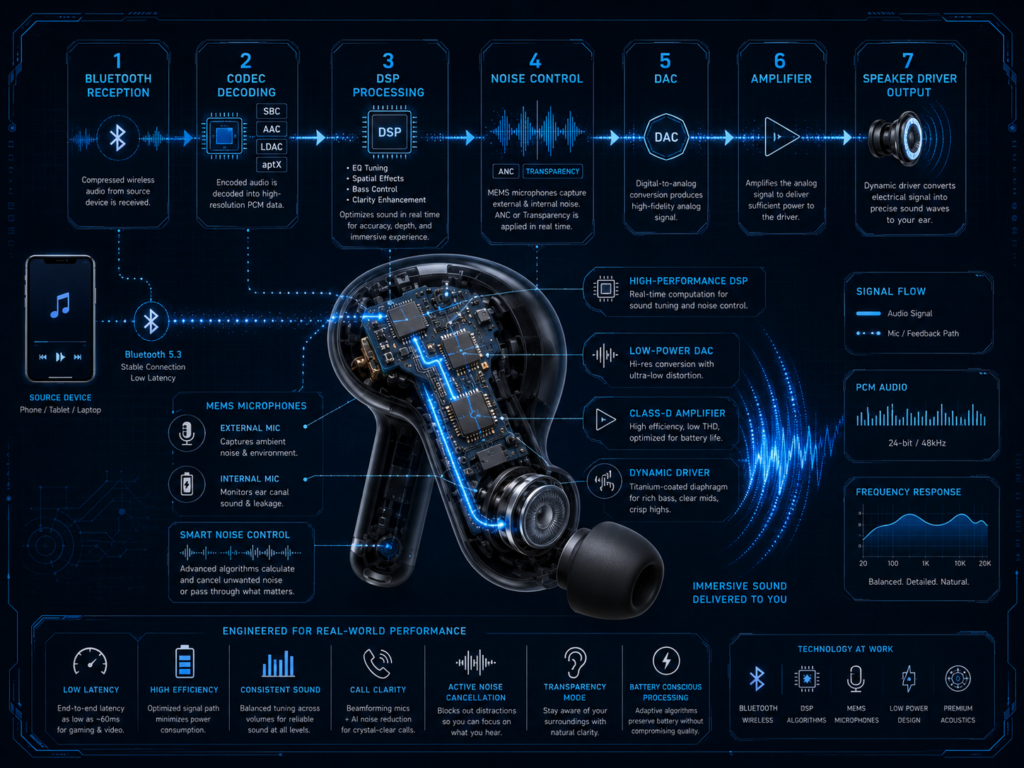
The sound you hear from TWS earbuds is not produced by the speaker driver alone. Before music, speech, game audio, or video sound reaches your ear, it passes through a compact but highly sophisticated audio processing pipeline inside each earbud. This real-time chain is responsible for receiving the wireless signal, decoding the audio, shaping the sound, reducing noise, converting the digital signal into an analog waveform, and finally driving the miniature speaker.
This is one of the biggest differences between basic Bluetooth earbuds and premium true wireless earbuds. A good pair of TWS ear buds does not simply play audio from a phone. It processes that audio continuously to improve clarity, stability, timing, loudness, bass control, vocal presence, active noise cancellation, call quality, and listening comfort.
1. Bluetooth Reception: The Wireless Audio Signal Arrives
The audio pipeline begins when the source device, such as a smartphone, laptop, tablet, smartwatch, or gaming device, sends a compressed audio stream through Bluetooth. This stream carries the music, podcast, call, movie, or game sound to the earbuds wirelessly.
In TWS ear buds, the Bluetooth radio must receive this signal while maintaining stable communication between the source device and both left and right earbuds. A weak connection can cause audio dropouts, crackling, one-earbud disconnection, channel imbalance, or delay between video and sound.
This is why Bluetooth stability matters so much in true wireless earbuds. The earbuds must handle wireless audio transmission efficiently while the user is walking, exercising, commuting, working, or moving the phone between pocket, bag, desk, and hand. Premium TWS earbuds use better chipsets, antenna design, firmware, and connection logic to keep the wireless audio stream consistent.
2. Codec Decoding: Compressed Audio Becomes Digital Sound
Once the Bluetooth signal reaches the earbuds, the audio codec must decode it. Bluetooth audio is usually compressed before transmission because wireless bandwidth and battery life are limited. The codec is the method used to compress and decompress the audio stream.
Common codecs in TWS earbuds include SBC, AAC, LDAC, LHDC, aptX, aptX Adaptive, and aptX Lossless, depending on the earbuds and source device. After reception, the earbud decodes the compressed Bluetooth audio into digital audio data, often referred to as PCM audio.
PCM is the usable digital audio format that the earbud’s processor can work with before it becomes audible sound. The quality of this decoding stage can affect detail, dynamic range, timing, clarity, and compression artifacts. However, codec support alone does not guarantee excellent sound. A pair of true wireless earbuds also needs strong driver design, DSP tuning, fit, acoustic chamber control, and power-efficient processing.
For example, LDAC or aptX Adaptive may support higher-bitrate wireless audio on compatible Android devices, while AAC is often important for iPhone users. The best TWS ear buds match codec support with real-world stability and tuning rather than relying only on impressive codec names.
3. DSP Processing: The Earbud Shapes the Sound
After decoding, the audio passes through the Digital Signal Processor, or DSP. This is where much of the sound character of TWS earbuds is created. The DSP can adjust frequency balance, apply equalization, control bass response, smooth treble, improve vocal clarity, reduce distortion, and optimize playback for the tiny acoustic space inside the earbud.
This stage is why two earbuds with similar driver sizes can sound completely different. One may deliver deep but controlled bass, while another may sound boomy. One may make vocals sound clear and centered, while another may push voices backward. One may handle high volume without harshness, while another may distort when pushed.
In premium wireless earbuds, DSP tuning may also support:
- Custom EQ profiles
- Bass boost modes
- Adaptive sound adjustment
- Hearing-based sound personalization
- Spatial audio processing
- Dynamic range control
- Volume normalization
- Wind noise reduction
- Voice enhancement during calls
DSP is especially important because TWS earbuds are physically small. A miniature driver and compact acoustic chamber cannot behave like a full-size speaker. Digital processing helps compensate for these physical limits and creates a more balanced, fuller, and more controlled sound.
4. Spatial Audio and Sound Enhancement
Many modern true wireless earbuds now include spatial audio or immersive audio features. These effects are also handled in the processing pipeline. Spatial audio attempts to create a wider, more three-dimensional listening field by adjusting timing, frequency cues, and channel positioning.
Some earbuds use basic spatial widening, while premium models may include head tracking, virtual surround effects, or personalized ear-shape calibration. These features can make movies, games, and certain music tracks feel more expansive, although quality depends heavily on the algorithm and content source.
Sound enhancement features can also include adaptive EQ, loudness compensation, vocal enhancement, and genre-based tuning. In practical terms, this means the earbuds are not simply reproducing audio passively. They are constantly interpreting and reshaping the signal to suit the hardware, the listener, and sometimes the surrounding environment.
5. Noise Control Systems: ANC and Transparency Processing
For true wireless earbuds with active noise cancelling, the audio pipeline becomes even more complex. The earbuds must process not only the incoming music or voice audio, but also microphone input from the outside world and the ear canal.
ANC earbuds usually use external microphones to detect environmental noise and internal microphones to monitor what is happening near the ear. The noise control system analyzes these signals and creates an anti-noise signal designed to reduce unwanted background sound.
This process must happen extremely quickly. If the system reacts too slowly, the cancellation becomes weak, unstable, or unnatural. If the algorithm is too aggressive, it may create pressure, hiss, distortion, or a strange blocked-ear sensation.
Transparency mode works in the opposite direction. Instead of reducing external sound, it uses microphones to pass outside sound into the earbud so the listener can hear speech, traffic, announcements, or surroundings without removing the earbuds. High-quality transparency mode should sound natural, clear, and low-noise rather than metallic or delayed.
This noise control stage is one of the biggest reasons premium ANC TWS earbuds feel different from budget models. Good active noise cancelling depends on microphone quality, microphone placement, DSP speed, ear tip seal, acoustic design, and software tuning.
6. Call Processing and Voice Enhancement
When using TWS ear buds for calls, the processing pipeline also handles microphone input from the user’s voice. This is separate from the music playback chain but often runs at the same time during phone calls, video meetings, voice notes, gaming chats, and voice assistant commands.
The earbuds must identify the user’s voice, suppress background noise, reduce wind interference, and transmit speech clearly to the other person. Premium TWS earbuds for calls may use beamforming microphones, AI noise reduction, bone-conduction sensors, voice pickup algorithms, and real-time speech enhancement.
This is why call quality is not determined by microphone count alone. Two earbuds may both have six microphones, but the better-tuned model may sound clearer in traffic, wind, cafés, offices, or gym environments. The processing chain matters as much as the hardware.
7. Digital-to-Analog Conversion: The DAC Creates an Analog Signal
After the digital audio has been decoded, tuned, enhanced, and processed, it must be converted into an analog electrical signal. This is handled by the Digital-to-Analog Converter, commonly called the DAC.
The DAC takes the processed digital audio data and turns it into a continuous electrical waveform that can be amplified and sent to the speaker driver. In full-size audio systems, DAC quality is often discussed separately. In TWS earbuds, the DAC is usually integrated into the audio chipset or amplifier system to save space and power.
Even though the DAC is tiny, it still matters. A clean conversion stage helps preserve detail, reduce noise, and maintain a stable signal before amplification. Poor conversion and output design can contribute to hiss, distortion, weak dynamics, or uneven sound.
8. Amplifier Stage: Powering the Earbud Driver
Once the signal becomes analog, it passes to a miniature amplifier. The amplifier provides enough power to move the speaker driver and produce audible sound.
In TWS earbuds, the amplifier must be small, efficient, and carefully controlled. It has to deliver enough output for volume and dynamics while conserving battery life. It also needs to avoid distortion when bass hits hard, volume rises, or complex music is playing.
The amplifier works closely with the driver and DSP tuning. A well-matched amplifier can make the earbuds sound cleaner, more controlled, and more energetic. A weak or poorly tuned amplifier may make the sound feel thin, compressed, harsh, or distorted at higher volume.
9. Speaker Driver Output: Digital Processing Becomes Real Sound
The final stage is the audio driver, also called the transducer. This component converts the amplified electrical signal into physical sound waves.
Most TWS earbuds use dynamic drivers, while some premium models use hybrid driver systems with balanced armature drivers or other specialized components. The driver produces the audible bass, mids, and treble that reach your ear.
However, driver performance depends on the entire pipeline before it. A good driver cannot perform at its best if Bluetooth transmission is unstable, codec decoding is weak, DSP tuning is poor, the amplifier is underpowered, or the ear tip seal is bad. Likewise, strong processing can help a small driver sound more refined, but it cannot completely overcome poor physical design.
This is why the best true wireless earbuds are judged as complete systems rather than by driver size alone.
Why the Audio Processing Pipeline Matters
The audio processing pipeline is the hidden system that determines how TWS ear buds actually sound and feel in daily use. It affects music quality, podcast clarity, video sync, gaming responsiveness, call performance, ANC strength, transparency mode, battery efficiency, and long-term listening comfort.
A strong pipeline should be optimized for:
- Low latency, so gaming, calls, and video playback stay synchronized
- High efficiency, so battery life remains strong even with ANC or high-bitrate codecs
- Stable Bluetooth audio, so the connection does not drop or crackle
- Consistent sound quality, so music remains balanced across volume levels and listening modes
- Clear voice processing, so calls sound natural in real environments
- Accurate noise control, so active noise cancellation and transparency mode feel useful rather than artificial
When comparing TWS earbuds, TWS ear buds, Bluetooth earbuds, and true wireless earbuds with active noise cancelling, the audio pipeline explains why specifications alone are not enough. Codec support, driver size, microphone count, and battery claims all matter, but they only become valuable when the processing chain works smoothly from Bluetooth reception to final sound output.
In simple terms, the better the pipeline, the better the listening experience. A well-engineered pair of TWS earbuds receives audio cleanly, decodes it efficiently, shapes it intelligently, controls noise in real time, converts it accurately, amplifies it cleanly, and delivers sound through the driver with balance, clarity, and timing.
Noise Control & Smart Audio Features
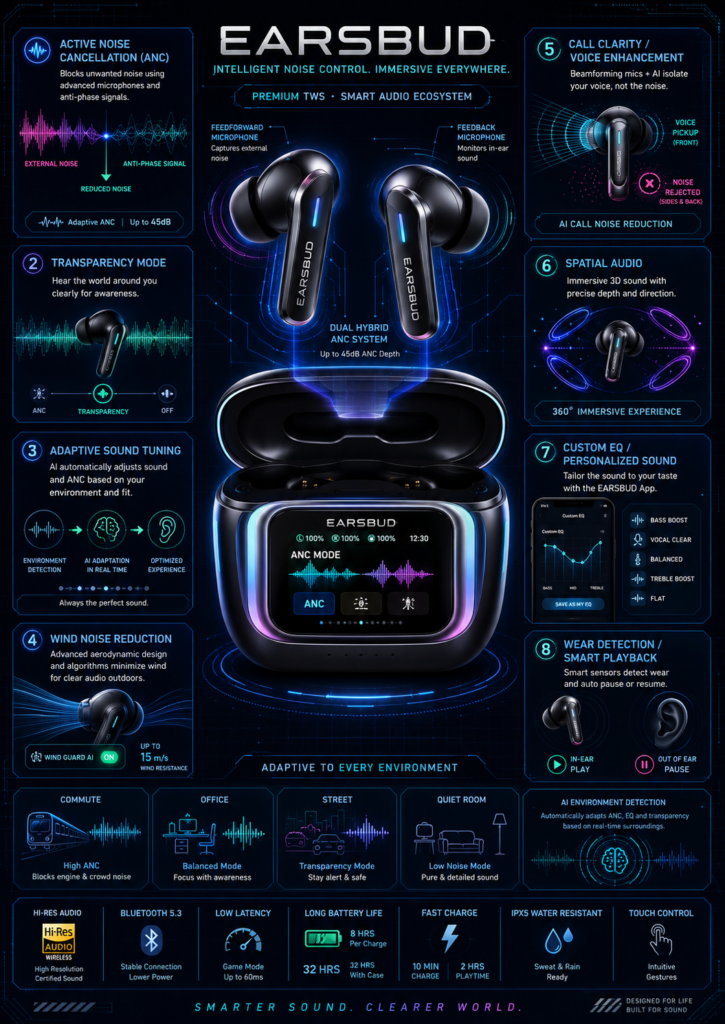
The most advanced TWS earbuds are no longer judged by sound quality alone. Premium models now combine wireless audio, microphone arrays, digital signal processing, environmental sensing, and app-based personalization to create a smarter listening experience. These features are especially important in true wireless earbuds with active noise cancelling, where the earbuds must constantly analyze outside noise, voice input, ear-canal sound, and user movement in real time.
Noise control is one of the biggest differences between basic TWS ear buds and premium wireless earbuds. A simple pair may only play music and handle calls. A more advanced pair can reduce engine noise during travel, soften office chatter, improve voice clarity in calls, let outside sound pass through when needed, adjust tuning based on your environment, and switch between listening modes automatically.
Active Noise Cancellation: How ANC Reduces External Noise
Active Noise Cancellation, often called ANC, is one of the most valuable features in modern TWS earbuds. It uses built-in microphones to detect unwanted external sound, then the earbud’s processor creates an opposite sound wave, known as an anti-phase signal, to reduce the noise before it reaches your ear.
In simple terms, ANC earbuds listen to the noise around you and create a counter-signal to cancel part of it. This is especially effective against steady low-frequency sounds such as airplane cabin rumble, train noise, air conditioners, fans, traffic hum, and background machinery. This is why noise cancelling TWS earbuds are popular for commuting, travel, offices, studying, and focused work.
Premium true wireless earbuds with active noise cancelling often use multiple microphones in each earbud. External microphones detect surrounding noise, while internal microphones monitor what sound is actually reaching the ear canal. This combination helps the earbuds adjust cancellation more accurately and reduce the feeling of pressure or artificial silence.
However, ANC performance depends on more than microphone count. The quality of the microphones, the ear tip seal, the DSP algorithm, the earbud shape, wind handling, and adaptive tuning all affect the result. A well-engineered ANC system should reduce noise without damaging music quality, creating excessive hiss, or making the listener feel uncomfortable during long sessions.
Transparency Mode: Hearing the World Without Removing Earbuds
Transparency mode, also called ambient mode or hear-through mode, does the opposite of active noise cancellation. Instead of blocking outside sound, it uses external microphones to pass environmental sound into the earbuds. This allows the user to stay aware of conversations, traffic, announcements, office surroundings, or gym activity without removing the earbuds.
For daily use, transparency mode can be just as important as ANC. It helps make TWS ear buds more practical in real-world situations. You can listen to music while walking, hear a coworker speak, order coffee, notice public transport announcements, or stay alert near roads without constantly taking the earbuds out.
The best transparency mode sounds natural and balanced. Voices should feel clear, nearby sounds should not be harsh, and the audio should not feel delayed or robotic. Lower-quality transparency systems can make the world sound metallic, amplified, or noisy. Premium Bluetooth earbuds use better microphone tuning and processing to make ambient sound feel closer to normal hearing.
Some true wireless earbuds also include adjustable transparency levels. This lets users choose how much outside sound they want to hear. For example, a lower transparency setting may be useful in an office, while a higher setting may be better for walking outdoors or listening for announcements.
Adaptive Sound Tuning: Earbuds That Respond to Your Environment
Adaptive sound tuning allows TWS earbuds to adjust audio and noise control automatically based on the listening environment. Instead of requiring the user to manually switch between ANC, transparency mode, and normal listening, the earbuds analyze surroundings and change settings in real time.
For example, adaptive ANC may increase noise cancellation on a train, reduce it in a quiet room, adjust for wind outdoors, or soften sudden background noise. Adaptive sound may also change EQ balance depending on volume level, ear tip seal, content type, or ambient noise.
This feature is especially useful because everyday listening environments change constantly. A user may move from home to street traffic, then to a bus, office, gym, café, or airport. Smart TWS earbuds can make those transitions smoother by adjusting sound behavior automatically.
Adaptive tuning can also improve comfort. Constant maximum ANC is not always necessary and may drain battery faster. A well-designed adaptive system can use strong noise cancellation only when needed, preserving battery life while maintaining a more natural listening experience.
Personalized Audio and Custom EQ
Many premium TWS earbuds now offer custom EQ, hearing personalization, and app-based sound profiles. These features let users adjust bass, mids, treble, vocal clarity, soundstage, or genre-specific tuning based on preference.
Custom EQ is important because not every listener wants the same sound. Some users prefer deep bass for workouts. Others want clear vocals for podcasts and calls. Some want balanced tuning for acoustic music, while others want a wider sound for movies and gaming.
Personalized audio features may use a hearing test, ear-canal analysis, or preference-based setup inside the companion app. The earbuds then adjust the sound profile to match the user’s hearing or listening taste. This can make true wireless earbuds feel more refined and less generic.
For SEO and buying intent, this matters because users searching for the best TWS earbuds are often looking for more than wireless convenience. They want earbuds that can be tuned for music, calls, gaming, workouts, travel, and daily comfort.
Spatial Audio and Immersive Listening
Spatial audio is another smart feature found in many premium TWS ear buds. It uses signal processing to create a wider, more three-dimensional sound experience. Instead of audio feeling like it is coming only from inside the ears, spatial audio can make movies, games, and supported music feel more open and immersive.
Some earbuds include basic spatial effects, while others offer head tracking. With head tracking, the sound field can remain positioned as the user turns their head, creating a more cinema-like experience. This is most useful for video streaming, gaming, virtual meetings, and immersive content.
Spatial audio quality varies widely. When done well, it can make dialogue, effects, and instruments feel more spacious. When done poorly, it may sound artificial or hollow. As with ANC, the feature depends heavily on DSP quality, tuning, and content compatibility.
Wind Noise Reduction
Wind noise is one of the hardest problems for wireless earbuds because microphones are exposed to moving air. During outdoor calls, cycling, running, or walking in windy conditions, wind can overwhelm the microphones and make speech difficult to hear.
Premium TWS earbuds may use wind noise reduction algorithms, microphone shielding, vent design, and intelligent mic selection to reduce this problem. Some models automatically detect wind and reduce ANC strength or switch microphone behavior to preserve comfort and call clarity.
This is important for users who want TWS earbuds for calls, outdoor workouts, commuting, or travel. Strong ANC indoors does not always mean strong performance outdoors. A good smart audio system should handle both environmental noise and wind turbulence without making the voice sound muffled.
Voice Pickup and Real-Time Call Enhancement
Smart audio features also improve call quality. During phone calls, video meetings, gaming chats, and voice recordings, TWS earbuds must separate the user’s voice from surrounding noise. This is done through microphone arrays, beamforming, noise suppression, and voice enhancement algorithms.
Premium Bluetooth earbuds for calls can focus on the user’s speech while reducing keyboard clicks, traffic, office noise, fans, and nearby conversations. Some models use AI-based noise reduction to make the voice clearer in busy environments.
Call enhancement is closely connected to the same technology used for ANC and transparency mode. The earbuds are constantly collecting sound through microphones, analyzing it through DSP, and deciding what to reduce, amplify, or transmit. This is why microphone quality and software tuning matter as much as speaker sound quality.
Wear Detection and Smart Playback
Many modern true wireless earbuds include in-ear detection sensors. These sensors can pause music when an earbud is removed and resume playback when it is placed back in the ear. This small feature improves convenience and helps save battery.
Smart playback may also include automatic mode switching, touch controls, squeeze controls, voice assistant access, and app-based button customization. These features make TWS earbuds easier to use during workouts, commuting, studying, and multitasking.
The best implementations feel natural and reliable. Poorly tuned touch controls can trigger accidental commands, while weak wear detection may pause music at the wrong time. Premium earbuds usually combine better sensors with cleaner software control.
Why Smart Audio Features Matter
Noise control and smart audio features make TWS earbuds more useful in real life. Active noise cancellation helps create focus. Transparency mode improves awareness. Adaptive sound tuning reduces manual adjustments. Custom EQ improves personal listening. Spatial audio adds immersion. Call enhancement improves communication. Wind reduction makes outdoor use more reliable.
When comparing TWS earbuds, TWS ear buds, ANC earbuds, and true wireless earbuds with active noise cancelling, buyers should look at how these smart features work together rather than treating them as separate marketing claims. Strong ANC is less useful if transparency mode sounds unnatural. Great sound quality is less practical if call microphones are weak. Long battery life matters less if adaptive features drain power too quickly.
A well-designed pair of premium TWS earbuds should balance noise reduction, awareness, comfort, sound quality, call clarity, and battery efficiency. The goal is not only to block noise or boost bass. The goal is to make the earbuds intelligently adapt to the way people actually listen throughout the day.
Battery Life & Charging System
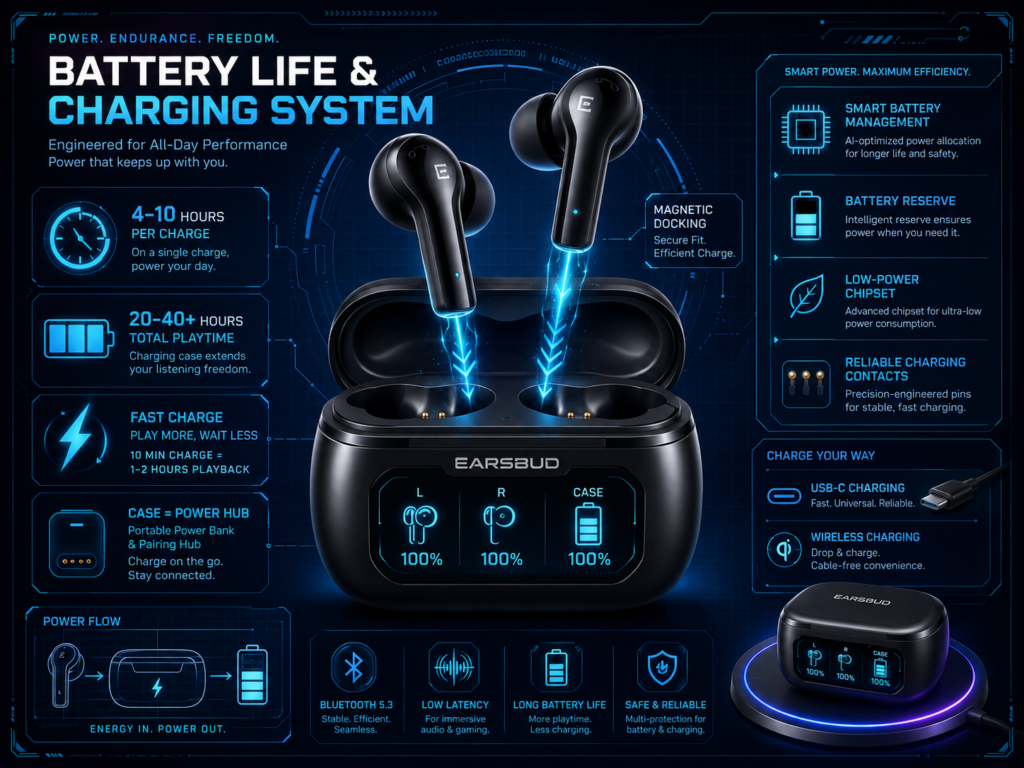
Battery life is one of the most important ranking factors when comparing the best TWS earbuds, because true wireless audio depends entirely on compact internal batteries. Unlike wired earphones, TWS ear buds cannot draw power from a phone or laptop. Every feature—Bluetooth connection, audio playback, active noise cancellation, transparency mode, microphones, touch controls, spatial audio, and call processing—uses energy from the tiny batteries inside each earbud.
This makes the battery and charging system a major part of the overall user experience. A pair of true wireless earbuds may sound excellent, but if the earbuds die too quickly, charge inconsistently, or depend on a weak case, they become frustrating for daily use. Strong battery performance is especially important for commuters, office workers, students, travelers, gamers, gym users, and anyone who wears Bluetooth earbuds for long listening sessions.
How Long Do TWS Earbuds Last Per Charge?
Most modern TWS earbuds offer around 4 to 10 hours of playback per charge, depending on the model, volume level, codec, battery size, and active features. Budget wireless earbuds may sit closer to the lower end of that range, while premium models often deliver longer listening time through better battery optimization and more efficient chipsets.
However, the advertised battery life does not always reflect real-world use. Many brands quote playback time with active noise cancellation turned off, volume set at a moderate level, and standard codec settings. Once ANC, transparency mode, LDAC, spatial audio, multipoint Bluetooth, or heavy call usage is enabled, battery life can drop noticeably.
For example, true wireless earbuds with active noise cancelling usually consume more power because microphones and DSP algorithms are constantly analyzing environmental sound. High-bitrate codecs such as LDAC or aptX Adaptive may also use more energy than basic SBC or AAC playback. Phone calls drain battery faster than music because microphones, voice processing, and wireless transmission are working at the same time.
This is why buyers should look at both numbers: battery life with ANC off and battery life with ANC on. The best TWS ear buds are not only those with the longest advertised hours, but those that provide stable, predictable battery performance during real listening conditions.
Charging Case: The Portable Power Bank for TWS Ear Buds
The charging case is one of the defining parts of the TWS earbud system. It protects the earbuds, stores them, triggers pairing, and recharges them between listening sessions. In practice, the case acts as a miniature portable power bank designed specifically for the left and right earbuds.
Most charging cases extend total listening time to around 20 to 40+ hours, depending on case battery capacity and earbud efficiency. This means the earbuds may provide 6 to 8 hours per charge, while the case supplies several additional full or partial recharges before it needs to be plugged in again.
For daily users, case battery life matters just as much as earbud battery life. A strong case makes the earbuds easier to use throughout the week. A weak case creates battery anxiety, especially during travel, office work, long commutes, and back-to-back calls.
A good TWS earbuds charging case should offer reliable magnetic docking, clear battery indicators, secure lid design, strong charging contacts, efficient power transfer, and enough reserve power for multiple listening sessions. Premium models may also include app-based battery reporting, separate left/right battery levels, case battery status, LED displays, touchscreen controls, or smart charging optimization.
Fast Charging: Minutes of Charging, Hours of Playback
Fast charging has become one of the most practical features in modern TWS earbuds. Many wireless earbuds can deliver 1 to 2 hours of playback from only a few minutes of charging, depending on the battery system and manufacturer design.
This is useful for users who forget to charge their earbuds before leaving home, joining a call, going to the gym, or commuting. A short charge inside the case can often provide enough playback for a meeting, workout, walk, or short trip.
Fast charging performance depends on both the earbuds and the case. The earbuds must be able to safely accept rapid power, while the case must deliver that power without overheating or damaging battery health. Premium Bluetooth earbuds often include battery protection circuits, temperature monitoring, and smart charging logic to balance speed with long-term durability.
Fast charging is especially important for ANC earbuds because active noise cancellation can drain battery faster. A strong quick-charge system helps keep advanced features usable without forcing the user to constantly wait for a full recharge.
USB-C Charging and Wireless Charging
Most modern TWS ear buds now use USB-C charging, which is faster, more convenient, and more widely supported than older micro-USB charging. USB-C has become the standard for phones, tablets, laptops, power banks, and wireless earbuds, making it easier to use one cable across multiple devices.
Many premium true wireless earbuds also support wireless charging. With wireless charging, the case can be placed on a compatible charging pad instead of being plugged in directly. This is convenient for desks, bedside tables, travel setups, and users who already use wireless chargers for their phone or smartwatch.
Wireless charging is usually slower than wired USB-C charging, but it improves convenience. For many users, the best setup is to use USB-C for faster charging and wireless charging for everyday top-ups.
Some advanced charging cases may include screen-based controls, smart battery display, LED indicators, or app integration. These features help users see remaining charge more clearly and reduce the chance of leaving home with low battery.
Battery Life With ANC, Transparency Mode, and Smart Features
Battery life changes depending on which features are active. Active noise cancellation, transparency mode, spatial audio, high-bitrate codecs, multipoint Bluetooth, low-latency gaming mode, and call enhancement can all increase power consumption.
ANC uses microphones and digital signal processing to reduce outside noise. Transparency mode also uses microphones, but instead of cancelling sound, it passes ambient sound through. Spatial audio requires additional processing to create a wider sound field. Multipoint Bluetooth keeps the earbuds connected to two devices at once. Low-latency mode reduces buffering to improve response time. Each feature adds value, but each also draws power.
This is why premium TWS earbuds with long battery life need efficient chipsets and strong power management. A large battery helps, but efficiency is just as important. Well-engineered earbuds can deliver strong battery life while still supporting ANC, calls, and smart audio features. Poorly optimized earbuds may drain quickly even if the case looks large or the specification sheet sounds impressive.
Battery Management and Power Efficiency
Inside each earbud is a small lithium-ion battery supported by a power management IC. This system controls charging, voltage regulation, energy distribution, sleep mode, battery protection, and power delivery to different components.
Power efficiency is critical because true wireless earbuds are extremely small. The earbuds must power the Bluetooth radio, audio processor, microphones, amplifier, sensors, touch controls, and sometimes ANC and spatial audio systems. A well-designed power management system helps reduce energy waste and extend listening time.
Smart battery management may include automatic sleep mode when the earbuds are removed, case-triggered shutdown, adaptive ANC power adjustment, separate left/right battery balancing, safe charging limits, and temperature protection. These systems help protect battery health and improve daily reliability.
Over time, all rechargeable earbud batteries lose some capacity. This is normal for lithium-ion batteries. Better charging control can slow the decline, but no TWS earbud battery lasts forever. For long-term value, users should look for reliable charging behavior, good battery reporting, and consistent performance after months of use.
Left and Right Earbud Battery Drain
One issue some users notice with TWS ear buds is uneven battery drain between the left and right earbuds. This can happen when one earbud handles more Bluetooth communication, microphone processing, or control functions than the other.
Modern dual-channel transmission and improved chipsets help reduce this imbalance, but it can still appear during calls, ANC use, multipoint pairing, or single-earbud listening. If one earbud consistently drains much faster, it may indicate a firmware issue, aging battery, weak charging contact, or role imbalance in the connection architecture.
Premium earbuds usually manage left/right battery balance more intelligently. They may switch processing roles, optimize communication paths, or report separate battery levels through the app. This makes battery behavior more predictable during long listening sessions.
Charging Contacts, Magnetic Docking, and Case Reliability
The charging system is only useful if the earbuds dock correctly every time. Most TWS earbuds use small metal charging contacts inside the case. When the earbuds are placed into the case, magnets align them with the charging pins so power can flow reliably.
Poor docking design can cause one earbud not to charge, intermittent charging, or battery drain while stored. Dust, earwax, moisture, or misalignment can also affect charging contacts. This is why case design, magnet strength, and contact placement matter.
The best TWS earbuds charging cases make it easy to drop the earbuds into place without checking alignment repeatedly. A secure magnetic snap, clear LED confirmation, and reliable app battery status all improve trust in the system.
What Battery Specs Buyers Should Check
When comparing the best TWS earbuds, battery life should be evaluated beyond the headline number. A complete battery comparison should include earbud playback time, total case battery life, ANC-on battery life, call-time battery life, fast charging speed, USB-C support, wireless charging support, case battery indicator, and real-world charging reliability.
A strong battery system should answer these questions clearly:
- How many hours do the earbuds last per charge with ANC off?
- How many hours do they last with ANC on?
- How many total hours does the charging case provide?
- How fast can the earbuds charge in the case?
- Does the case support USB-C charging?
- Does it support wireless charging?
- Can the app show separate battery levels for each earbud and the case?
- Do the earbuds charge reliably every time they are placed in the case?
These details matter because battery life affects every listening situation: music, calls, gaming, workouts, travel, office use, study sessions, and sleep listening.
Why Battery Life Matters in the Best TWS Earbuds
Battery performance determines how dependable TWS earbuds feel in daily life. Strong sound quality is important, but it loses value if the earbuds cannot last through a commute, meeting, workout, flight, or workday. The best TWS ear buds combine efficient Bluetooth performance, smart power management, fast charging, a reliable case, and enough total battery life for real-world use.
For most users, a good target is at least 6 hours per charge with normal use and 24 hours or more total battery life with the charging case. Heavy users, travelers, and ANC-focused buyers may want more. Those who use earbuds for calls should also check call-time battery life, not only music playback time.
In simple terms, the battery and charging system is the foundation of true wireless convenience. A well-designed pair of TWS earbuds should play long enough, charge quickly enough, report battery levels clearly, and stay ready whenever the user opens the case.
Acoustic & Ergonomic Engineering
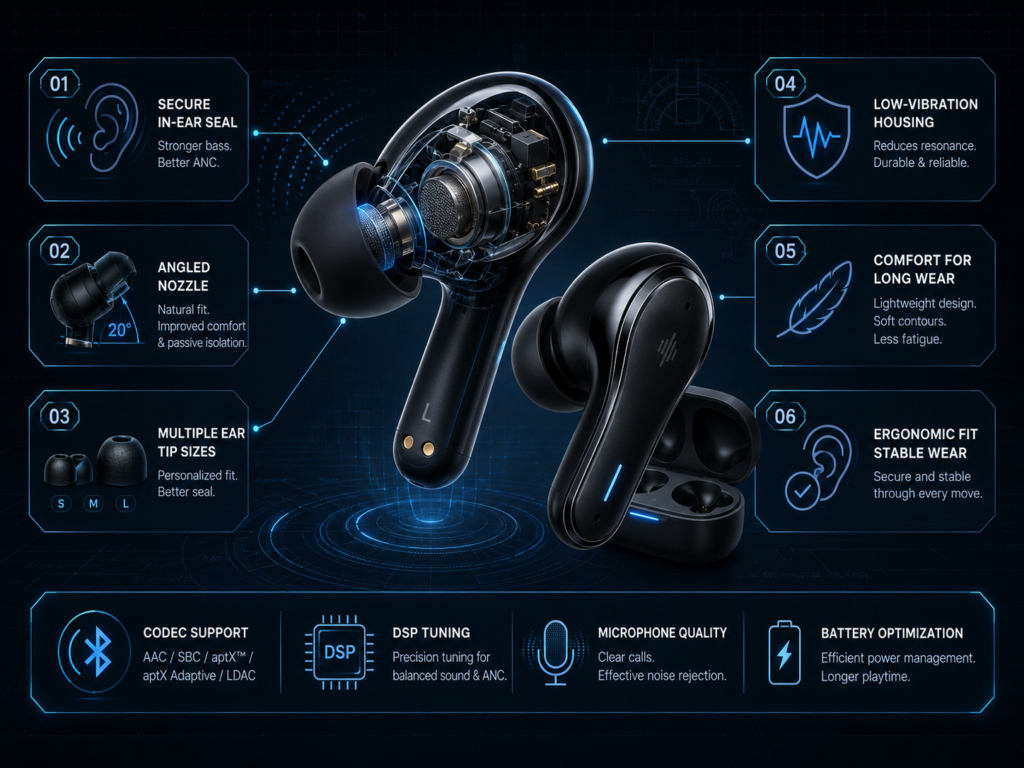
The performance of TWS earbuds is not determined only by chipsets, codecs, microphones, or battery life. Physical design matters just as much. The way an earbud sits in the ear, seals the ear canal, positions the speaker driver, controls vibration, and balances weight directly affects comfort, sound quality, passive noise isolation, bass response, active noise cancellation, and long-term usability.
This is why acoustic engineering and ergonomic design are major ranking factors when comparing the best TWS earbuds. Two pairs of TWS ear buds may look almost identical online, but one may feel secure and comfortable for hours while the other causes pressure, slips out during movement, weakens bass, or makes active noise cancellation less effective.
A well-designed pair of true wireless earbuds should feel stable, balanced, and natural in the ear. It should create a reliable seal without excessive pressure, keep the speaker driver properly aligned, reduce unwanted vibration, and support different ear shapes through multiple ear tip sizes. This is especially important for users searching for comfortable wireless earbuds for long use, TWS earbuds for small ears, workout earbuds, ANC earbuds, or Bluetooth earbuds for calls and travel.
In-Ear Seal: The Foundation of Bass and Noise Isolation
The in-ear seal is one of the most important parts of TWS earbud performance. When the silicone or foam ear tip seals the ear canal correctly, it helps preserve low-frequency sound, improves passive noise isolation, and allows active noise cancellation to work more effectively.
Bass response depends heavily on seal quality. If the earbud does not seal properly, low-end sound can leak out, making music feel thin, weak, or distant. This is why some users buy premium true wireless earbuds and still feel disappointed by the bass. The problem may not be the driver alone. It may be poor ear tip fit or a weak acoustic seal.
A good seal also improves ANC performance. Active noise cancelling earbuds use microphones and anti-noise processing to reduce external sound, but they still depend on physical isolation. If outside noise leaks around the ear tip, the ANC system has to work harder and may sound less effective. Strong passive isolation gives the noise cancelling system a better foundation.
However, a tight seal should not feel painful. The best comfortable TWS earbuds balance isolation with pressure relief. They block enough noise for better sound and ANC, while still allowing long listening sessions without ear fatigue.
Nozzle Shape and Ear Tip Design
The nozzle is the part of the earbud that directs sound into the ear canal. Its angle, width, length, and shape influence fit, comfort, sound delivery, and passive noise isolation. A poorly shaped nozzle may push awkwardly into the ear, reduce stability, or place the driver at the wrong angle.
Premium TWS ear buds often use angled nozzles to follow the natural shape of the ear canal. This helps the earbud sit more securely and improves acoustic alignment. When the driver output is aimed correctly, sound can feel clearer, fuller, and more balanced.
Ear tips are just as important. Most earbuds come with small, medium, and large silicone tips, while some premium models include extra sizes, oval tips, memory foam tips, or fit-test features in the companion app. Multiple ear tip sizes help users find the right balance between comfort, sound quality, and noise isolation.
For users searching for comfortable wireless earbuds for long use, the ability to change ear tips is essential. A tip that is too small may leak sound and weaken ANC. A tip that is too large may cause pressure and discomfort. The best fit should feel secure but not forced.
Passive Noise Isolation vs Active Noise Cancellation
Passive noise isolation and active noise cancellation are different, but they work together. Passive isolation comes from the physical seal created by the ear tip and earbud shape. Active noise cancellation comes from microphones and digital processing.
A well-designed earbud reduces noise mechanically before the ANC system even begins processing. This can improve performance in offices, cafés, public transport, gyms, and airplanes. It also helps reduce battery strain because the ANC system does not need to compensate for as much leakage.
This is why acoustic design matters when comparing true wireless earbuds with active noise cancelling. Strong ANC is not only about microphone count or marketing claims. It also depends on fit, ear tip design, nozzle shape, venting, acoustic chamber structure, and how securely the earbud sits in the ear.
Venting and Pressure Control
Many in-ear TWS earbuds include small vents to manage air pressure and acoustic behavior. Venting can help reduce the plugged-ear feeling that some users experience with sealed earbuds. It can also influence bass tuning, driver movement, and comfort during long listening sessions.
The challenge is balance. Too much venting may weaken passive isolation and reduce bass impact. Too little venting may create pressure buildup and listening fatigue. Premium ANC earbuds often use pressure-relief systems that allow comfort without sacrificing too much noise control.
For users who wear earbuds for hours during work, travel, studying, or sleep, pressure control can be as important as sound quality. Earbuds that sound powerful for ten minutes may become uncomfortable after an hour if the acoustic pressure is poorly managed.
Material Design and Vibration Control
The materials used in TWS earbuds affect durability, weight, resonance, vibration, and comfort. Lightweight plastics can improve comfort, while metal accents may add strength and a premium feel. Internal damping materials can reduce unwanted vibration and help the driver perform more cleanly.
Uncontrolled vibration can blur sound, reduce clarity, and make bass feel loose. Good acoustic engineering manages how the earbud shell reacts when the driver moves. The goal is to let the driver produce controlled sound without the housing adding unwanted resonance.
Material choice also affects long-term reliability. Earbuds are exposed to sweat, skin oils, dust, movement, heat, cold, and repeated charging cycles. Durable materials, sealed seams, water resistance, strong magnets, and reliable charging contacts all contribute to a better long-term experience.
For sports TWS earbuds and workout earbuds, material design also affects sweat resistance, grip, and stability. For premium earbuds, it affects visual quality, texture, and how expensive the product feels in daily use.
Weight Balance and Secure Fit
Comfort is not just about softness. It is also about weight distribution. A TWS earbud that is too heavy on the outer side may feel like it is pulling out of the ear. A stem that is too long or awkwardly angled may interfere with movement, masks, glasses, helmets, or pillows.
The best ergonomic TWS earbuds distribute weight close to the ear. They should feel stable during walking, commuting, light workouts, calls, and head movement. For running or gym use, some users may prefer earbuds with wings, fins, hooks, or deeper in-ear fit. For office and travel use, smaller and lighter earbuds may feel better for long wear.
Users looking for comfortable wireless earbuds should not judge comfort only by product photos. Ear shape varies widely. This is why multiple ear tip sizes, compact shell design, low weight, pressure relief, and secure fit matter so much.
Driver Placement and Acoustic Chamber Design
Inside each earbud is a tiny acoustic chamber that shapes how sound moves from the driver to the ear. The size and shape of this chamber can affect bass extension, vocal clarity, treble control, distortion, and soundstage.
Driver placement also matters. If the driver is poorly aligned with the nozzle, sound may feel less direct or less balanced. A well-engineered acoustic chamber helps the small driver produce a fuller, cleaner sound despite the limited space inside the earbud shell.
This is why driver size alone does not determine sound quality. A large driver in a poorly designed chamber can sound muddy, while a smaller driver in a better acoustic design can sound clearer and more controlled. The best TWS earbuds for sound quality combine driver quality, chamber design, DSP tuning, seal quality, and amplifier control.
Why Engineering Matters When Choosing TWS Earbuds
Not all TWS earbuds perform the same, even when they look similar. The outer shape may be small, glossy, and familiar, but the internal engineering can be completely different. Codec support, DSP tuning, microphone quality, driver design, battery optimization, antenna placement, acoustic chamber design, and ergonomic fit all directly affect the listening experience.
This matters because users do not experience specifications in isolation. They experience the whole system. Music quality depends on the Bluetooth codec, DSP tuning, driver design, ear tip seal, and acoustic chamber. Call quality depends on microphone placement, voice enhancement algorithms, wind noise reduction, and Bluetooth stability. Gaming performance depends on latency optimization, codec behavior, and wireless synchronization. Travel performance depends on ANC strength, passive isolation, comfort, and battery life.
Codec Support Affects Wireless Sound Quality
Codec support influences how audio is transmitted from the source device to the earbuds. SBC, AAC, LDAC, LHDC, and aptX variants can affect sound quality, latency, and device compatibility. But codec support only matters when the earbuds and source device both support the same codec.
For example, iPhone users usually depend heavily on AAC performance, while many Android users may look for LDAC, LHDC, aptX Adaptive, or aptX Lossless. However, a high-bitrate codec does not automatically make a pair of Bluetooth earbuds sound better. The driver, DSP, fit, and tuning still matter.
DSP Tuning Shapes the Listening Experience
The Digital Signal Processor controls EQ, bass tuning, vocal clarity, noise control, spatial effects, and sound enhancement. Strong DSP tuning can make TWS ear buds sound balanced, powerful, clear, and refined. Poor DSP tuning can make earbuds sound harsh, muddy, thin, or overly processed.
DSP also affects active noise cancellation, transparency mode, and call processing. This is why software tuning is just as important as hardware quality in modern true wireless earbuds.
Microphone Quality Affects Calls, ANC, and Transparency Mode
Microphones are used for calls, active noise cancellation, transparency mode, wind noise reduction, and voice assistant input. Better microphone quality and placement can improve voice pickup, reduce background noise, and make transparency mode sound more natural.
For users who take frequent calls, join online meetings, record voice notes, or commute in noisy areas, microphone engineering is essential. The best TWS earbuds for calls use beamforming microphones, AI noise reduction, wind control, and smart processing to keep the user’s voice clear.
Battery Optimization Determines Daily Reliability
Battery optimization affects how long earbuds last per charge, how efficiently the case extends total playtime, and how quickly the earbuds recharge. Premium models often combine low-power chipsets, smart battery management, fast charging, and efficient ANC processing.
A pair of earbuds may advertise long battery life, but real-world performance depends on volume, ANC, codec choice, call time, Bluetooth multipoint, and firmware efficiency. The best long battery life TWS earbuds balance power, features, and reliability.
The Complete System Matters More Than One Feature
The best TWS ear buds are not defined by one impressive feature. Strong ANC is valuable, but only if fit and comfort are good. High-resolution codec support is useful, but only if the driver and tuning are strong. Long battery life is helpful, but only if the charging case is reliable. A beautiful design is attractive, but only if the earbuds stay secure and comfortable.
When choosing TWS earbuds, people should evaluate the complete engineering system: fit, seal, comfort, driver design, DSP tuning, codec support, ANC, microphones, battery life, charging case, Bluetooth stability, app control, and durability.
In short, acoustic and ergonomic engineering turns wireless earbuds from small gadgets into dependable daily audio tools. A well-engineered pair of true wireless earbuds should feel comfortable, seal properly, sound balanced, reduce noise effectively, handle calls clearly, last long enough, and stay reliable across music, calls, gaming, workouts, commuting, and travel.
1st Insight
True wireless earbuds are essentially compact embedded systems combining Bluetooth engineering, real-time audio processing and acoustic design.
Understanding how they work helps you choose the best TWS earbuds for your needs, whether your priority is sound quality, gaming or advanced features like active noise cancellation.
For readers comparing low-latency wireless models beyond this section, our complete guide to the Best earbuds for gaming explains how gaming earbuds differ by platform, latency mode, microphone quality, comfort, and everyday audio performance.
How TWS Earbuds Work?
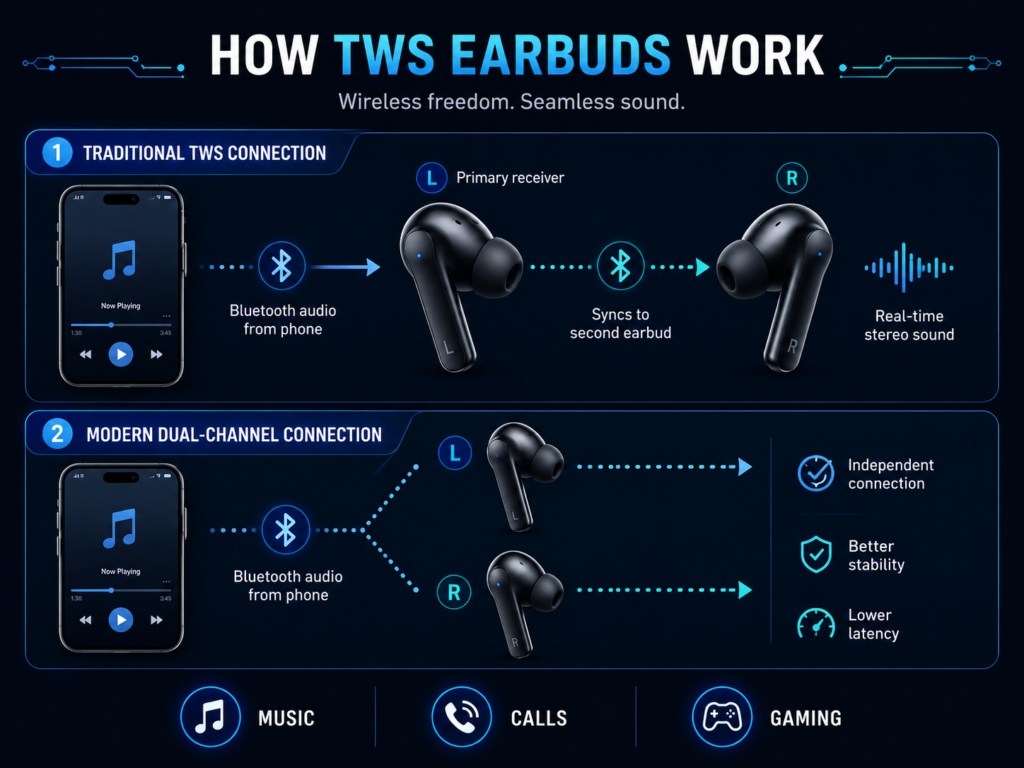
TWS earbuds work by using Bluetooth wireless technology to send audio from a source device—such as a smartphone, laptop, tablet, smartwatch, or gaming device—to two separate earbuds without any physical cable between them. TWS stands for True Wireless Stereo, which means the left and right earbuds work together to create a synchronized stereo sound experience while staying completely wire-free.
At a basic level, your device sends a compressed digital audio signal through Bluetooth. The earbuds receive that signal, decode it, process it through internal audio circuitry, and convert it into sound through tiny speaker drivers. While this happens, the earbuds also manage battery power, microphone input, touch controls, active noise cancellation, transparency mode, and left-right synchronization in real time.
This is why modern TWS ear buds are more than simple wireless speakers. They are compact audio systems with Bluetooth radios, processors, microphones, sensors, batteries, antennas, codecs, DSP tuning, and acoustic chambers built into a very small form factor.
Step 1: Your Device Sends Audio Through Bluetooth
The process begins with your phone, laptop, tablet, or other source device. When you play music, answer a call, watch a video, or join an online meeting, the source device converts the audio into a Bluetooth signal and transmits it wirelessly.
Because Bluetooth has limited bandwidth compared with a wired connection, the audio is usually compressed before being sent. This compression is handled by Bluetooth audio codecs such as SBC, AAC, LDAC, LHDC, aptX, aptX Adaptive, or similar formats, depending on the device and earbuds.
The codec affects wireless sound quality, latency, stability, and device compatibility. For example, AAC is commonly important for iPhone users, while LDAC or aptX variants may matter more for some Android users. However, codec support is only one part of how true wireless earbuds work. The final experience also depends on Bluetooth stability, driver quality, DSP tuning, fit, and battery efficiency.
Step 2: The Earbuds Receive and Decode the Signal
Once the Bluetooth signal reaches the earbuds, the internal chipset receives and decodes the audio. Inside each earbud, a System-on-Chip, or SoC, manages wireless communication, codec decoding, audio processing, power control, microphone input, and feature behavior.
After the compressed Bluetooth audio is received, it is decoded into usable digital audio data. The earbuds then process that signal through the onboard DSP, which can apply EQ tuning, bass control, sound enhancement, spatial effects, active noise cancellation, and call clarity algorithms.
This is one reason why two pairs of Bluetooth earbuds can sound very different even if they support the same codec. One model may have better tuning, stronger DSP, cleaner amplification, and more accurate drivers. Another may have weaker processing and produce thin, muddy, harsh, or delayed sound.
Step 3: The Left and Right Earbuds Stay Synchronized
The defining challenge of TWS earbuds is that the left and right channels are physically separate. Traditional wired earphones use a cable to deliver left and right audio. TWS ear buds must keep both sides synchronized wirelessly.
In older true wireless designs, one earbud often acted as the primary receiver. This primary earbud connected directly to the phone, received the Bluetooth audio signal, and then relayed the second channel to the other earbud. The second earbud worked as the secondary unit.
This design made early true wireless earbuds possible, but it had limitations. The primary earbud could drain battery faster because it handled more communication. Signal dropouts could happen more easily if the relay connection was weak. Latency and synchronization could also become more noticeable during video playback, gaming, or calls.
Modern TWS earbuds are much better at managing this left-right communication. Improved chipsets, stronger antennas, better Bluetooth protocols, and smarter firmware help both earbuds stay synchronized with less delay and fewer connection issues.
Step 4: Dual-Channel Transmission Improves Stability
Many newer true wireless earbuds now use more advanced dual-channel transmission. Instead of relying only on one earbud to receive and relay audio, each earbud can connect more independently to the source device or maintain a more direct synchronized data stream.
This improves real-world performance in several ways. It can reduce latency, improve left-right balance, lower the risk of one earbud disconnecting, reduce uneven battery drain, and make stereo audio feel more stable. Dual-channel transmission is especially important for video calls, mobile gaming, streaming, spatial audio, and active noise cancellation.
For users, the benefit is simple: the earbuds connect faster, stay stable longer, and keep audio better synchronized. This matters when watching videos, playing games, taking calls, commuting, walking outdoors, or switching between devices.
Step 5: The Earbuds Process Sound in Real Time
After receiving and synchronizing the audio, the earbuds process the sound before it reaches the speaker driver. This real-time processing can include:
- Equalizer tuning for bass, mids, and treble
- Vocal clarity enhancement for calls and podcasts
- Dynamic range control for smoother listening
- Spatial audio processing for a wider sound field
- Active noise cancellation using microphone input
- Transparency mode for environmental awareness
- Wind noise reduction for outdoor calls
- Low-latency optimization for games and video
Premium TWS earbuds with active noise cancelling are constantly processing both incoming audio and microphone input from the environment. External microphones detect surrounding noise, internal microphones monitor sound near the ear canal, and the processor adjusts cancellation or transparency behavior in real time.
This is why good ANC earbuds require more than strong microphones. The earbuds need accurate processing, fast response time, a secure in-ear seal, and careful tuning to reduce noise without creating distortion, hiss, or uncomfortable pressure.
Step 6: The Driver Produces the Final Sound
Once the audio has been decoded and processed, it passes through a digital-to-analog conversion stage and amplifier before reaching the speaker driver. The driver then converts the electrical signal into physical sound waves that travel into your ear.
Most TWS ear buds use dynamic drivers because they are compact, efficient, and capable of producing strong bass. Some premium models use hybrid driver systems for more detail, separation, or clarity. But driver type alone does not determine sound quality. The final sound depends on the entire system: codec, DSP, amplifier, driver, acoustic chamber, nozzle angle, ear tip seal, and fit.
A good pair of true wireless earbuds should deliver balanced sound, stable stereo imaging, clear vocals, controlled bass, and low distortion across different volume levels and listening modes.
How TWS Earbuds Work During Calls
During calls, TWS earbuds perform an additional process. Instead of only receiving audio, they also capture your voice through built-in microphones and transmit it back to the phone or computer.
Premium TWS earbuds for calls use microphone arrays, beamforming, noise suppression, and voice enhancement algorithms to separate your speech from background noise. The earbuds may reduce keyboard clicks, traffic, wind, office chatter, gym noise, or café sounds so your voice remains clearer.
This two-way communication is more demanding than music playback because the earbuds must receive audio, capture voice, process background noise, maintain Bluetooth stability, and manage battery power at the same time. That is why call quality depends heavily on microphone design, processing power, Bluetooth connection quality, and firmware tuning.
How TWS Earbuds Work With the Charging Case
The charging case is also part of how TWS earbuds work. It stores the earbuds, recharges them, triggers pairing behavior, protects the charging contacts, and often acts as the central reset and power-management hub.
When the earbuds are placed inside the case, magnets align them with charging pins. The case transfers power to each earbud and may also help disconnect them from the source device. When the lid opens, many earbuds wake up, reconnect to the paired device, and prepare for playback.
Premium charging cases may include USB-C charging, wireless charging, LED indicators, smart displays, app battery reporting, fast charging support, and separate battery tracking for the left earbud, right earbud, and case.
Why TWS Earbuds Feel Instant When They Work Well
The best TWS earbuds feel simple because the technology works quietly in the background. You open the case, the earbuds wake up, Bluetooth connects, left and right channels sync, audio is decoded, DSP tuning is applied, microphones monitor the environment, and the drivers produce sound—all within moments.
When the engineering is strong, the experience feels seamless. When the engineering is weak, users notice problems: delayed pairing, audio lag, one earbud cutting out, poor ANC, low call clarity, weak bass, unstable multipoint switching, or uneven battery drain.
Why This Matters When Choosing TWS Ear Buds
Understanding how TWS earbuds work makes it easier to choose the right pair. The best model is not always the one with the biggest driver, longest spec sheet, or loudest marketing claim. A strong pair of TWS ear buds should combine stable Bluetooth transmission, efficient codec decoding, low-latency synchronization, good DSP tuning, reliable microphones, strong battery management, and ergonomic acoustic design.
For music, this means cleaner sound and better stereo balance. For calls, it means clearer voice pickup and less background noise. For gaming, it means lower latency and better timing. For travel, it means stronger ANC and longer battery life. For daily use, it means fast pairing, stable connection, and fewer interruptions.
In simple terms, TWS earbuds work by turning a Bluetooth signal into synchronized stereo sound through a compact chain of wireless communication, digital processing, acoustic engineering, and power management. The better that chain is engineered, the better the earbuds feel in real life.
Why TWS Earbuds Became Dominant
The rise of TWS earbuds was not only a product trend. It changed how people listen, work, travel, exercise, communicate, and move through the day. The shift from wired earphones to true wireless earbuds was not simply about removing a cable. It turned earbuds into everyday smart audio tools that are always nearby, always charging, and always ready to connect.
For years, wired earphones were the default choice because they were simple, affordable, and reliable. But they also came with friction: tangled cables, damaged connectors, limited movement, cable noise, awkward pocket storage, and the constant need to plug and unplug. TWS ear buds removed that friction almost completely. Once users experienced opening a charging case, placing two earbuds in their ears, and instantly connecting to music, calls, podcasts, videos, or meetings, wired listening started to feel less convenient.
Today, the question for most buyers is no longer whether wireless earbuds are practical. The question is which pair of wireless earbuds fits their lifestyle: noise cancelling earbuds for travel, comfortable earbuds for long use, workout earbuds for fitness, premium earbuds for sound quality, budget TWS earbuds for daily listening, gaming earbuds for low latency, or true wireless earbuds with active noise cancelling for focused listening.
Zero Cable Friction Changed Everyday Listening
The biggest reason TWS earbuds became dominant is convenience. Removing the cable changed the user experience immediately. With TWS ear buds, there is no wire running to a phone, no cable between the left and right earbud, no cord catching on clothing, and no tangled knot to undo before listening.
This matters more than it sounds. Earbuds are used in small moments throughout the day: walking, commuting, working, cooking, exercising, studying, answering calls, watching short videos, joining meetings, or listening before sleep. Wired earphones make those moments slightly more complicated. True wireless earbuds make them almost effortless.
A good pair of TWS earbuds can be taken out of the case, placed in the ears, and connected within seconds. This low-friction experience is one reason people use them more often than older earphones. They are not just audio accessories. They become part of a daily routine.
Compact Charging Cases Made Wireless Practical
Early wireless audio had one major weakness: battery anxiety. Users worried about running out of power. TWS earbuds solved much of that problem through the charging case.
The charging case acts as a storage box, battery reserve, pairing hub, and portable power bank. Instead of plugging the earbuds into a wall charger after every use, users simply place them back in the case. The case recharges them automatically and keeps them ready for the next session.
This small design change made true wireless earbuds far more practical. Most modern TWS earbuds provide several hours of playback per charge, while the case extends total use to 20, 30, or 40+ hours depending on the model. Fast charging also means a short top-up can provide enough playback for a commute, meeting, workout, or call.
For buyers comparing the best TWS earbuds, battery life and charging case quality are major ranking factors. A good case should charge reliably, dock the earbuds magnetically, show battery status clearly, support USB-C, and ideally offer fast charging or wireless charging.
Smart Features Turned Earbuds Into Daily Tools
TWS earbuds became dominant because they evolved beyond simple music playback. Premium models now include smart audio features that make them useful in many environments.
The biggest feature is active noise cancellation, or ANC. True wireless earbuds with active noise cancelling use microphones and digital signal processing to reduce background noise from traffic, offices, airplanes, trains, gyms, cafés, and other busy environments. This changed the role of earbuds from casual listening devices into focus tools.
Transparency mode added the opposite ability: hearing the outside world without removing the earbuds. This is useful when walking outdoors, speaking to someone, hearing announcements, or staying aware of traffic.
Other smart features made Bluetooth earbuds more valuable: spatial audio, custom EQ, wear detection, low-latency gaming mode, multipoint Bluetooth, voice assistant support, app controls, adaptive ANC, wind noise reduction, and personalized sound tuning. These features made TWS earbuds feel more like compact smart devices than traditional earphones.
Better Microphones Made TWS Earbuds Useful for Calls
One of the early weaknesses of true wireless earbuds was call quality. Many older models sounded distant, thin, or noisy during phone calls. As microphone technology improved, TWS earbuds for calls became far more dependable.
Modern earbuds use multiple microphones, beamforming, noise suppression, wind reduction, and AI voice enhancement to separate speech from background noise. This made them useful for work calls, video meetings, voice notes, gaming chats, and daily communication.
The rise of remote work and mobile communication made this even more important. People no longer use earbuds only for music. They use them for Zoom meetings, WhatsApp calls, online classes, voice messages, podcasts, phone calls, and social media recording. A pair of wireless earbuds with strong microphones can now replace basic headset use for many people.
This is why microphone quality is a major factor when choosing the best wireless earbuds. Good sound is not enough if the person on the other end cannot hear you clearly.
Sound Tuning Improved Enough to Rival Headphones
TWS earbuds also became dominant because sound quality improved dramatically. Early wireless earbuds were often judged as convenient but sonically limited. Today, premium true wireless earbuds can deliver impressive bass, clear vocals, detailed treble, spatial effects, and balanced tuning that satisfies most everyday listeners.
This improvement came from better dynamic drivers, stronger amplifiers, refined acoustic chambers, improved ear tip design, advanced DSP tuning, and higher-quality Bluetooth codecs such as AAC, LDAC, LHDC, aptX Adaptive, and aptX Lossless where supported.
While full-size headphones can still offer advantages in soundstage, battery capacity, and driver size, the gap has narrowed for many users. A well-tuned pair of TWS ear buds can sound rich, powerful, and immersive while being far smaller and more convenient than over-ear headphones.
For daily music, podcasts, videos, calls, workouts, and commuting, many users now prefer the portability of TWS earbuds over the bulk of headphones.
TWS Earbuds Fit Modern Device Behavior
Another reason TWS earbuds became dominant is that they match how modern devices are used. Phones became thinner. Headphone jacks disappeared from many flagship smartphones. People started switching between phones, laptops, tablets, smartwatches, and TVs more often. Streaming became the default way to listen.
Bluetooth earbuds fit naturally into that ecosystem. They connect wirelessly, support app controls, update through firmware, pair with multiple devices, and work across different forms of content. A user can listen to music on a phone, join a meeting on a laptop, take a call, watch a video, and return to music without dealing with cables.
Multipoint Bluetooth made this even more useful by allowing some earbuds to stay connected to two devices at once. For productivity-focused users, this turned TWS earbuds into everyday work tools.
Fitness, Travel and Commuting Accelerated Adoption
TWS earbuds are especially useful during movement. For workouts, running, walking, cycling, commuting, and travel, removing cables improves comfort and freedom. A wire can bounce, pull, rub against clothing, or get caught during activity. True wireless earbuds remove that problem.
Many sports TWS earbuds also include sweat resistance, secure ear tips, lightweight shells, touch controls, and stable Bluetooth connectivity. For travel, ANC earbuds reduce cabin noise, engine rumble, and public transport distractions. For commuting, transparency mode helps users stay aware when needed.
This made TWS earbuds attractive across multiple lifestyles: fitness users, office workers, travelers, students, gamers, commuters, creators, and casual listeners.
Design and Aesthetic Tech Also Matter
TWS earbuds became dominant not only because of function, but also because of design. Earbuds are visible wearable technology. Their shape, color, finish, case design, and comfort influence how people feel using them.
The charging case became part of the product identity. Premium cases now include smooth hinges, magnetic docking, LED indicators, wireless charging, compact pocketable shapes, and in some models, smart screens or advanced controls. Earbuds themselves have become more stylish, compact, and brand-defining.
This is why users now search not only for the best sound, but also for stylish earbuds, premium earbuds, comfortable wireless earbuds, small earbuds, and aesthetic tech earbuds. TWS earbuds sit at the intersection of audio, fashion, productivity, and personal technology.
The Buying Question Has Changed
The dominance of TWS earbuds means the market has matured. Most people no longer ask, “Should I buy wireless earbuds?” Wireless has already become the default for everyday personal audio.
The better question is:
What are the best wireless earbuds for my needs?
For one user, the answer may be true wireless earbuds with active noise cancelling for travel and work. For another, it may be budget TWS ear buds for everyday music. Someone else may need call-focused earbuds for meetings, low-latency earbuds for gaming, workout earbuds with secure fit, or premium earbuds with high-resolution audio support.
That is why choosing TWS earbuds now requires looking at the complete experience: sound quality, ANC, transparency mode, microphone clarity, Bluetooth stability, battery life, charging case design, comfort, water resistance, codec support, app controls, and price.
Why TWS Earbuds Are Now the Default
TWS earbuds became dominant because they solved real everyday problems. They removed cable friction, added portable charging, improved sound, enabled smart features, supported calls, reduced noise, worked across devices, and fit modern lifestyles better than wired earphones.
Their strength is not one single feature. It is the complete package: small size, wireless freedom, daily convenience, smart audio, strong portability, and increasingly premium performance.
In short, TWS earbuds won because they made personal audio easier to use. They turned listening from something you connect into something you carry, open, wear, and use instantly. For most people, that convenience has become difficult to give up.
Best TWS Earbuds (2026 Overview)
If you are searching for the best TWS earbuds in 2026, the smartest approach is not to look for one universal winner. The true wireless earbuds market has become too specialized for that. Some models are built around AI-powered smart features, some focus on pure audio quality, some are designed for calls and comfort, some win on value and style, and others stand out because of smart charging cases and deep customization.
The best TWS ear buds are the ones that match your actual use case. A frequent traveler may care most about active noise cancellation and battery life. A Samsung Galaxy user may want seamless ecosystem features. An audiophile may prioritize high-resolution sound and tuning. A remote worker may need microphone quality and multipoint Bluetooth. A style-focused buyer may want transparent design and good ANC without flagship pricing.
Below are five standout models that represent different strengths in the modern true wireless earbuds category.
1. Samsung Galaxy Buds 4 Pro — The Tech King
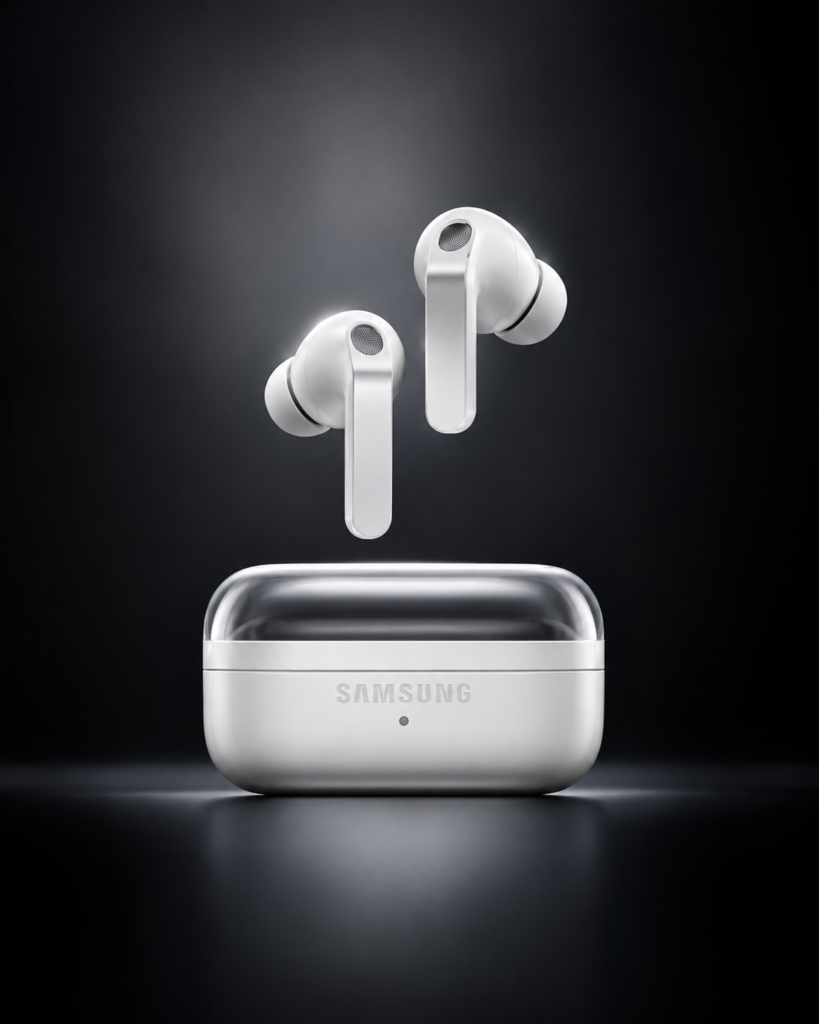
The Samsung Galaxy Buds 4 Pro are positioned as one of the most advanced TWS earbuds for users who want smart audio, premium ANC, AI-powered features, and deep Samsung ecosystem integration. These earbuds are not only designed for music playback. They are built as intelligent wireless audio devices that work closely with Galaxy phones, One UI features, voice assistants, calls, spatial sound, and adaptive listening modes.
For Samsung users, the biggest advantage is ecosystem convenience. The Galaxy Buds 4 Pro are designed to pair quickly, switch smoothly, and unlock the strongest feature set inside the Samsung Galaxy environment. This makes them especially attractive for users who already own a Galaxy phone, Galaxy tablet, Galaxy Watch, or Samsung laptop.
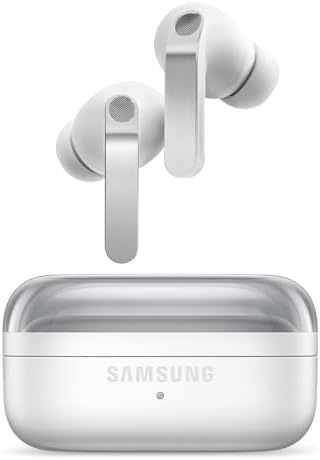
- EXCEPTIONAL AUDIO: Catch details like never before. Designed with a High-Res Audio¹ 24-bit hi-fi codec, the latest Galax…
- TWO-WAY SPEAKER: Enjoy every audio experience to the fullest with two speakers in both Buds, including a tweeter for ric…
- HD VOICE: Enjoy clear phone calls with Galaxy Buds4 Pro and Galaxy S26 Series² —they work together to deliver crisp and …
The Galaxy Buds 4 Pro also stand out for advanced audio processing. Their premium speaker system, ANC performance, ambient sound modes, and AI-assisted listening features make them a strong choice for users who want earbuds that adapt intelligently to daily conditions. Whether you are commuting, walking outdoors, joining a call, watching video, or listening in a quiet room, these earbuds are built to adjust the experience around you.
Their spatial audio experience is another major selling point. For movies, gaming, immersive music, and video content, the Galaxy Buds 4 Pro are designed to create a wider, more dimensional sound field than basic Bluetooth earbuds. This makes them one of the strongest options for users who want Samsung TWS earbuds, Galaxy Buds 4 Pro review content, Samsung earbuds with ANC, and true wireless earbuds with AI audio features.
Best for: Samsung Galaxy users, smart audio features, seamless Android connectivity, spatial audio, AI listening tools, and premium ANC.
2. Bowers & Wilkins Pi8 — The Audiophile King
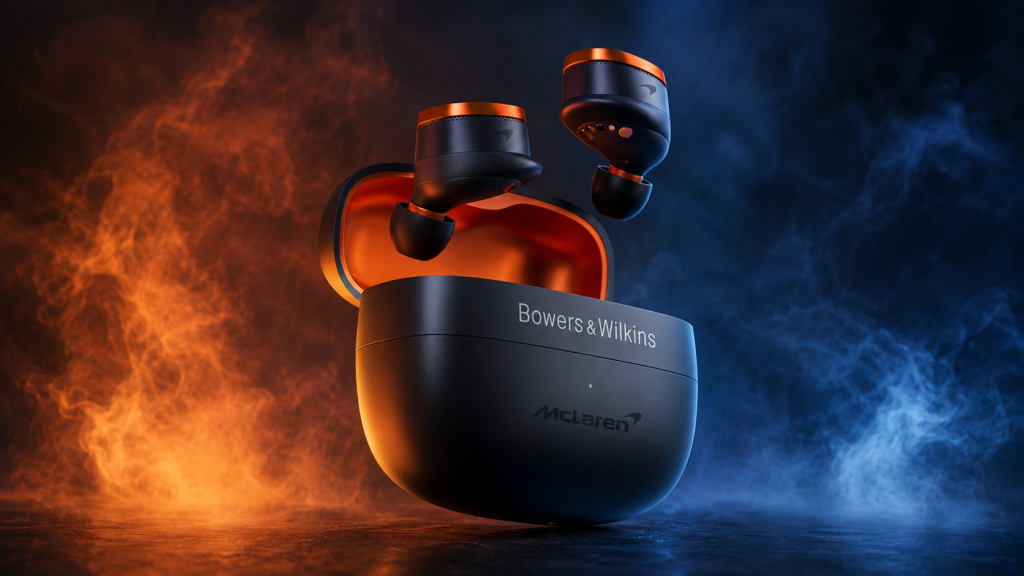
The Bowers & Wilkins Pi8 are built for listeners who care most about sound quality. While many TWS earbuds compete on app features, smart modes, or ecosystem tricks, the Pi8 focus heavily on premium audio performance, refined tuning, luxury build quality, and a more serious listening experience.
These are the kind of premium true wireless earbuds that appeal to users who want detail, balance, texture, and musicality rather than just loud bass or aggressive ANC. The Pi8 are designed for people who listen closely: vocals, acoustic instruments, layered production, bass control, treble detail, and stereo separation all matter here.
The sound profile is best described as polished and controlled. Instead of pushing one frequency range too hard, the Pi8 aim for a more balanced and high-resolution presentation. This makes them a strong choice for users comparing audiophile TWS earbuds, best wireless earbuds for sound quality, premium Bluetooth earbuds, and luxury true wireless earbuds.

- REFERENCE-QUALITY SOUND FROM CARBON DRIVERS — Pi8 TrueWireless earbuds are built around 12mm carbon cone drive units ada…
- TRUE 24-BIT LOSSLESS AUDIO, WIRELESS — Pi8 delivers high-resolution audio via Qualcomm aptX Lossless and aptX Adaptive, …
- IMMERSIVE LISTENING, WHEREVER YOU ARE — Bespoke adaptive noise cancellation (ANC) automatically adjusts to your environm…
Build quality is also part of the appeal. Bowers & Wilkins products usually carry a more refined audio-brand identity than mainstream tech earbuds. The Pi8 feel less like a disposable gadget and more like a compact premium audio product. For buyers who want excellent wireless sound in a small form factor, they are one of the strongest contenders in the high-end TWS earbuds category.
Best for: pure sound quality, premium tuning, audiophile listening, luxury build, high-resolution wireless audio, and balanced music performance.
3. Jabra Elite 10 Gen 2 — The Comfort & Call King
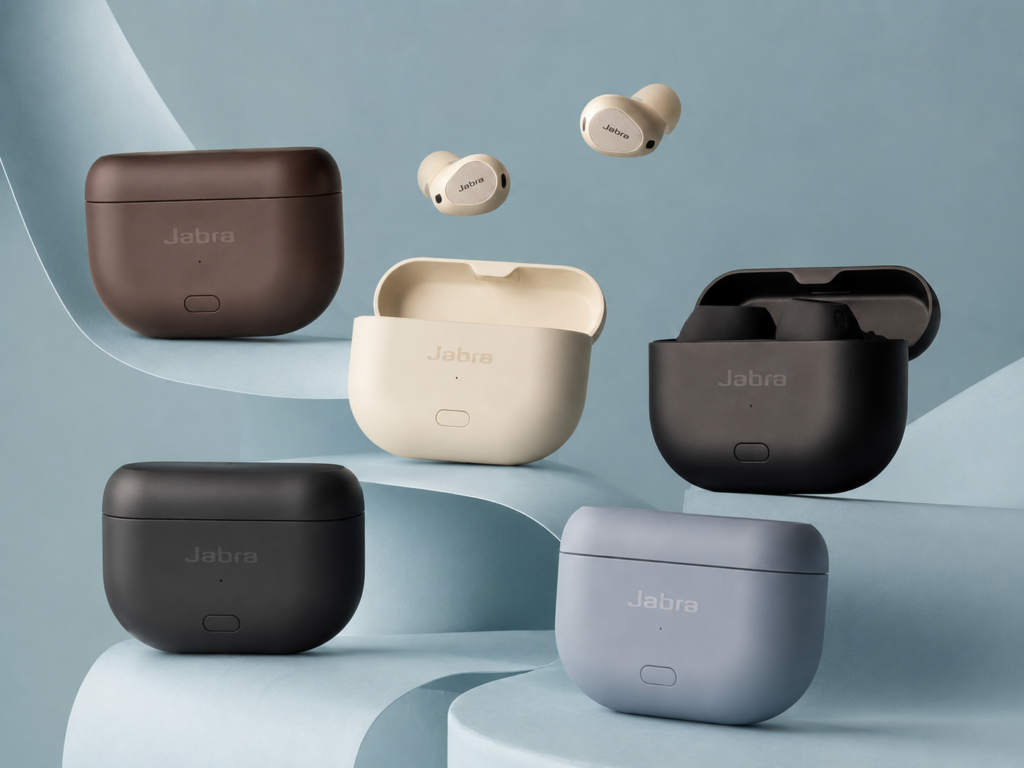
The Jabra Elite 10 Gen 2 remain one of the most practical TWS earbuds for people who care about comfort, call quality, and daily reliability. They are especially strong for users who wear earbuds for long sessions, switch between work and personal devices, and need dependable microphones for calls, meetings, voice notes, and online communication.
Jabra has long been known for communication-focused audio, and the Elite 10 Gen 2 continue that identity. These earbuds are built around call clarity, microphone performance, comfort-focused fit, and reliable everyday use. For remote workers, office users, commuters, students, and frequent callers, that combination matters more than flashy design.
Comfort is one of their biggest strengths. Some premium ANC earbuds create pressure or fatigue after extended use, but the Elite 10 Gen 2 are designed for longer listening sessions. This makes them a strong option for users searching for comfortable wireless earbuds, TWS earbuds for calls, earbuds for long wear, and Bluetooth earbuds for meetings.
Multipoint connectivity also makes them practical. Users who move between a phone and laptop can benefit from smoother device switching, especially during workdays filled with calls, music, video meetings, and notifications. They may not be the most glamorous earbuds on the list, but they are among the most functional for real daily use.
Best for: calls, long wear comfort, work meetings, multipoint Bluetooth, daily reliability, and practical everyday listening.
4. Nothing Ear (a) — The Value & Style King
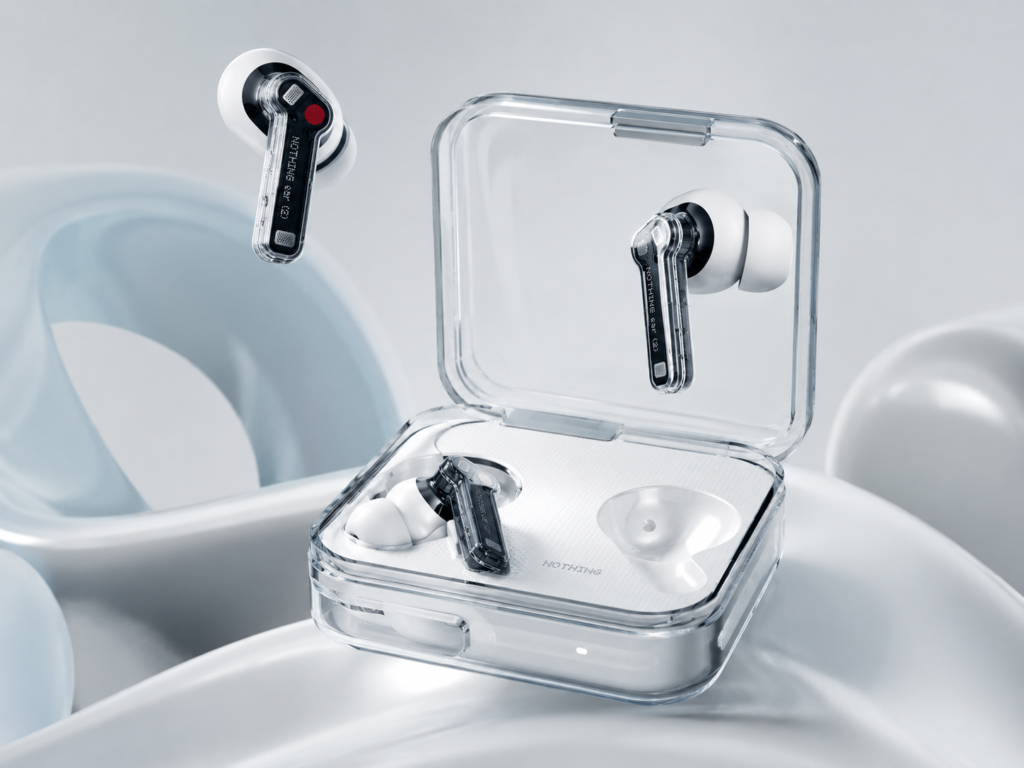
The Nothing Ear (a) stand out because they combine recognizable transparent design, strong mid-range performance, and accessible pricing. They are not trying to be the most expensive or most technically extreme earbuds. Instead, they offer a stylish, modern, high-value option for buyers who want good sound, active noise cancellation, and design personality without paying full flagship prices.
The transparent case and industrial-inspired look make the Nothing Ear (a) visually different from most TWS ear buds. For users who care about aesthetics, this matters. These are not generic black or white earbuds. They carry a design identity that fits the broader Nothing brand: minimal, transparent, playful, and tech-forward.
Performance is also strong for the price. The Nothing Ear (a) offer useful ANC, good app customization, solid sound quality, and practical everyday features. They are a strong choice for users searching for best budget TWS earbuds, stylish wireless earbuds, transparent earbuds, mid-range ANC earbuds, and best value true wireless earbuds.

- Powerful 11 mm Driver: We’ve engineered an even more compact driver that delivers twice the power of Ear (2). In Nothing…
- 45 dB Smart Active Noise Cancellation: Nothing Ear (a) earbuds continuously monitors the seal between the earbud and you…
- Clear Voice Technology: Crystal-clear calls, anytime, anywhere. Nothing Ear (a) ear buds isolates your voice from backgr…
They are especially appealing for students, casual listeners, design-conscious buyers, and users who want something more interesting than standard budget Bluetooth earbuds. While premium models may still offer stronger ANC, better microphones, or richer sound, the Nothing Ear (a) deliver an excellent balance of price, style, and performance.
Best for: budget-conscious buyers, transparent design lovers, mid-range ANC, stylish daily earbuds, and value-focused TWS ear buds.
5. JBL Tour Pro 3 — The Feature & Screen King
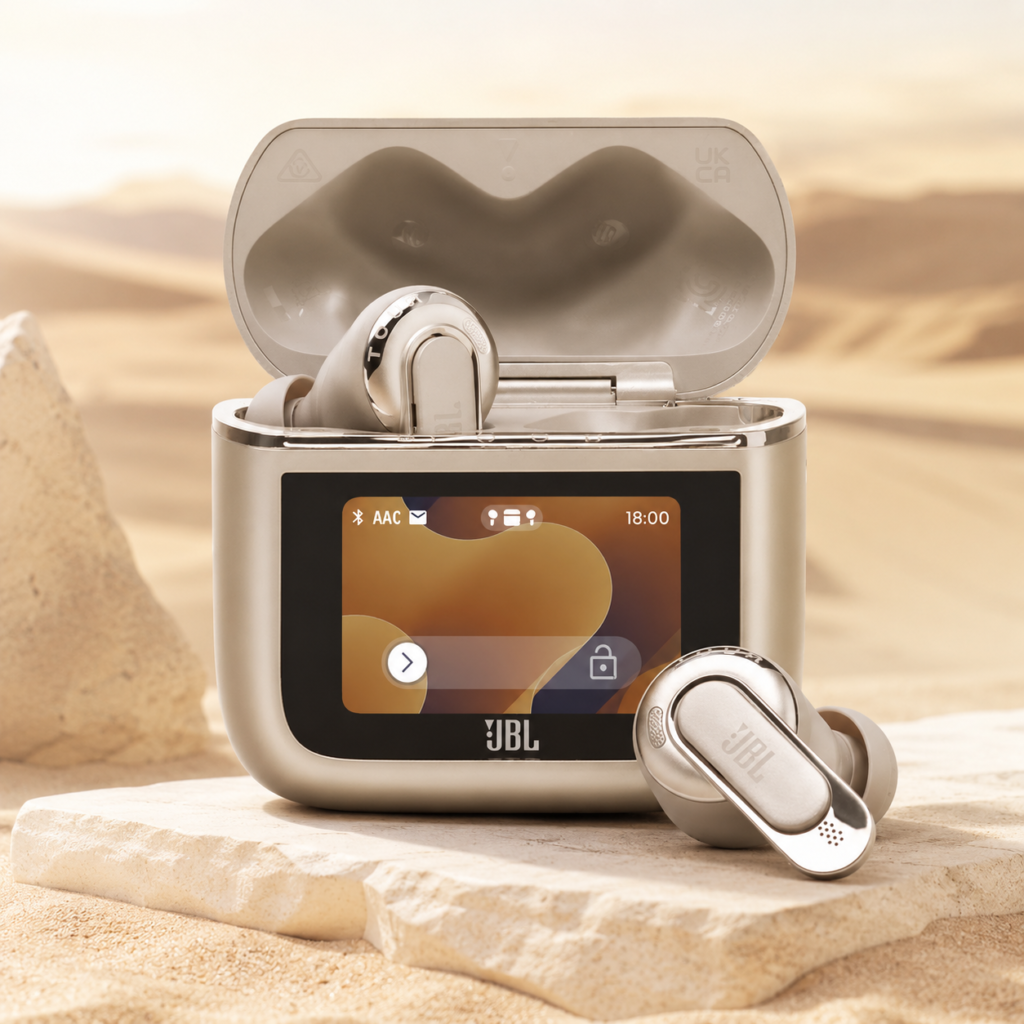
The JBL Tour Pro 3 are built for users who want control, customization, bass energy, and a smart charging case experience. Their biggest visual and functional differentiator is the touchscreen Smart Charging Case, which gives users direct access to settings without always opening the phone app.
This makes the Tour Pro 3 one of the most feature-rich TWS earbuds in the market. The case is not just a battery box. It becomes a control center for playback, ANC, battery status, customization, and other smart functions. For users who like quick control and gadget-style convenience, this is a major advantage.
Sound-wise, JBL usually appeals to listeners who enjoy energetic, bass-forward tuning. The Tour Pro 3 fit that identity while also offering advanced features such as adaptive noise cancellation, spatial audio functions, app customization, and strong device flexibility. They are especially relevant for users searching for JBL Tour Pro 3 review, TWS earbuds with screen case, smart charging case earbuds, bass wireless earbuds, and feature-rich true wireless earbuds.

- SMART CHARGING CASE: Leave your phone in your pocket. The 1.57″ touchscreen smart case lets you control music, check bat…
- ACTIVE NOISE CANCELLING: These true wireless earbuds listen to your surroundings and adapt in real time—True Adaptive No…
- SPATIAL AUDIO & HEAD TRACKING: JBL Spatial 360 transforms stereo sound into a fully immersive experience—music, movies, …
The JBL Tour Pro 3 are best for buyers who want more than just earbuds. They want an interactive case, deep settings control, smart features, and a more hands-on listening experience. If the Samsung Galaxy Buds 4 Pro are the ecosystem-tech option, the JBL Tour Pro 3 are the control-and-customization option.
Best for: smart charging case features, touchscreen control, bass-focused sound, ANC customization, spatial audio, and users who want maximum feature access.
Which Best TWS Earbuds Should You Choose?
The right choice depends on what you value most. The Samsung Galaxy Buds 4 Pro are the strongest pick for Samsung users who want AI features, spatial audio, and deep ecosystem integration. The Bowers & Wilkins Pi8 are better for listeners who care most about sound quality and luxury tuning. The Jabra Elite 10 Gen 2 are ideal for calls, comfort, and workday use. The Nothing Ear (a) deliver one of the best combinations of price, style, and mid-range ANC. The JBL Tour Pro 3 are best for users who want a smart case, customization, and feature control.
In 2026, the best TWS earbuds are not defined by one specification. They are defined by how well they fit your listening life. For music lovers, sound tuning matters most. For travelers, ANC and battery life matter more. For remote workers, call clarity and comfort are essential. For Android users, codec support and app features may matter. For style-focused buyers, design and case aesthetics can be part of the decision.
The smartest buying decision is to match the earbuds to your use case rather than chasing the most expensive model. That is how you find the best wireless earbuds for you.
For a deeper comparison of top-performing TWS models, see our guide on Best True Wireless Stereo Earbuds of 2026 and how it impacts real-world listening.
How to Choose the Right TWS Earbuds
Choosing TWS earbuds is no longer about finding a single “best” model. The real goal is finding earbuds that match your listening habits, daily environment, device ecosystem, and comfort expectations.
Different users prioritize different things:
- Audiophiles focus on soundstage and codec quality
- Casual listeners care more about comfort and convenience
- Remote workers prioritize microphones and connectivity
- Travelers need strong ANC and battery life
- Gamers want ultra-low latency wireless performance
That’s why modern TWS buying decisions should begin with usage behavior first—not marketing claims.
1. Sound Quality
Sound quality remains the foundation of the entire TWS experience, but in 2026, “good sound” means more than simply having louder bass or higher volume.
The best true wireless earbuds balance:
- Clarity across vocals and instruments
- Controlled bass response
- Natural mids
- Detailed treble without harshness
- Stable wireless audio transmission
Look for:
- Balanced tuning (not just bass-heavy)
- Codec support (AAC, aptX, LDAC)
- Good driver engineering and acoustic tuning
- Consistent performance at both low and high volumes
Many modern earbuds now market themselves using terms like:
- Hi-Res Audio
- Spatial Audio
- Adaptive Sound
- Lossless Wireless
- Personalized EQ
- Dynamic Driver Systems
But real-world listening quality often depends more on tuning and acoustic design than raw specifications alone.
Why Bluetooth Codecs Matter
Bluetooth codecs determine how audio data is compressed and transmitted wirelessly between your phone and earbuds.
Common codecs include:
- AAC → optimized for Apple devices and balanced streaming
- aptX Adaptive → improved latency and dynamic bitrate management
- LDAC → higher bandwidth audio transmission for compatible Android devices
Perceived Audio Quality=f(Tuning, Codec, Driver Quality, Seal)
However, codec support alone does not guarantee better sound. Poor tuning can still make expensive earbuds sound muddy, overly sharp or fatiguing during long listening sessions.
What Different Users Should Prioritize
For Music Lovers
Prioritize:
- Wide soundstage
- Instrument separation
- Detailed mids and highs
- Support for high-quality codecs
This is especially important for:
- Classical music
- Jazz
- Acoustic recordings
- High-resolution streaming platforms
For Bass Lovers
Look for:
- Deep sub-bass extension
- Controlled low frequencies
- Adjustable EQ profiles
Avoid earbuds with overly bloated bass that masks vocals and detail.
For Podcast & Voice Listening
Speech clarity matters more than aggressive bass.
Prioritize:
- Clean vocal reproduction
- Balanced mid-range frequencies
- Comfortable long-session listening
For Android Users
Many flagship Android phones support:
- LDAC
- aptX Adaptive
- Snapdragon Sound ecosystems
Choosing earbuds optimized for these standards can improve wireless audio consistency and reduce latency.
For iPhone Users
AAC optimization matters more than chasing unsupported codecs.
Apple ecosystem integration, audio stability, and tuning consistency usually provide a better real-world experience than purely specification-driven comparisons.
2. True Wireless Earbuds with Active Noise Cancelling (TWS + ANC)
Active Noise Cancellation (ANC) has become one of the defining technologies in modern true wireless earbuds. Instead of only blocking sound physically like traditional ear tips or passive isolation, ANC earbuds actively analyze environmental noise and generate opposing sound waves to reduce what reaches your ears.
In simple terms, the earbuds continuously “listen” to your surroundings using built-in microphones, then process and neutralize unwanted background noise in real time.
Effective Noise Reduction=f(Microphones, ANC Processing, Seal Quality)
This is especially effective against:
- Airplane engine hum
- Train and bus vibrations
- Air conditioning noise
- Office chatter
- Café background sound
- Urban traffic rumble
Strong ANC → Best for Travel & High-Noise Environments
High-end ANC earbuds are designed for environments where constant low-frequency noise creates fatigue and distraction.
Strong ANC is ideal for:
- Flights and airports
- Long commutes
- Busy offices
- Public transport
- Coworking spaces
- Frequent travelers
Premium ANC systems from brands like Bose, Sony, Apple, and Sennheiser now use:
- Adaptive environmental analysis
- AI-assisted noise filtering
- Hybrid feedforward + feedback microphones
- Pressure optimization systems
- Dynamic ANC adjustment based on surroundings
Modern flagship earbuds can significantly reduce the “mental load” caused by constant environmental noise, making them valuable not just for music—but also for focus, productivity, and cognitive comfort.
For deeper comparisons of flagship ANC performance, explore our complete guide to the Best Noise Cancelling Earbuds.
Moderate ANC → Best for Everyday Use
Not everyone needs maximum noise suppression.
Moderate ANC earbuds are often better for:
- Casual listening
- Walking outdoors
- Office use
- Studying
- Home environments
- Budget-conscious buyers
These models typically focus on:
- Balanced battery life
- Lower cost
- Lightweight comfort
- More natural environmental awareness
In many daily situations, moderate ANC can actually feel more comfortable than aggressive cancellation systems, especially for users sensitive to ear pressure or “vacuum effects”.
ANC vs Passive Noise Isolation
Many users confuse ANC with simple physical blocking.
Passive isolation depends on:
- Ear tip seal
- Earbud shape
- Foam or silicone materials
ANC, on the other hand, actively processes sound electronically.
The best TWS earbuds combine both:
- Strong passive sealing
- Intelligent active cancellation
- Adaptive environmental tuning
This combination creates a more immersive and less fatiguing listening experience.
3. Comfort & Fit
Comfort is one of the most underestimated factors when choosing true wireless earbuds, yet it directly affects nearly every part of the listening experience—from sound quality and ANC performance to long-session usability and ear fatigue.
A technically impressive pair of earbuds can still feel unusable if the fit creates pressure, instability, or discomfort after an hour of use.
Why Fit Matters More Than Most People Realize
TWS earbuds rely heavily on achieving a proper in-ear seal.
That seal affects:
- Bass response
- Passive noise isolation
- ANC efficiency
- Audio consistency
- Microphone performance during calls
In simple terms:
- A weak seal reduces low-frequency response
- Air leakage weakens ANC effectiveness
- Loose earbuds create inconsistent sound
Audio Performance=f(Fit, Seal Quality, Ear Tip Design)
Poor fit often leads users to incorrectly assume the earbuds themselves sound bad, when the real issue is acoustic leakage.
Poor Fit = Poor Sound
Even premium earbuds can sound thin, weak, or harsh if they don’t seal correctly inside the ear canal.
Common symptoms of poor fit include:
- Weak bass response
- Reduced immersion
- Earbuds slipping during movement
- Inconsistent ANC
- Frequent adjustment while walking or exercising
- Ear fatigue during long sessions
This is why modern earbuds now include:
- Multiple ear tip sizes
- Foam tip compatibility
- Ergonomic nozzle angles
- Pressure-relief vents
- Lightweight shell designs
Comfort Is Different for Every User
No ear shape is identical, which means “universally comfortable” earbuds rarely exist.
Different users prioritize different fit characteristics:
For Long Listening Sessions
Look for:
- Lightweight earbuds
- Pressure-balanced designs
- Soft silicone or foam tips
- Minimal inner-ear pressure
For Workouts & Movement
Prioritize:
- Secure locking fit
- Sweat resistance
- Stability during motion
- Ear fins or ergonomic anchors
For Side Sleepers
Comfort becomes even more important.
Sleep-oriented earbuds focus on:
- Ultra-low profile shells
- Minimal ear protrusion
- Soft pressure distribution
- Reduced contact points against pillows
4. Battery Life
Battery life plays a major role in the real-world usability of true wireless earbuds. While many models now advertise impressive numbers, actual endurance depends heavily on how the earbuds are used—especially with features like ANC, spatial audio, high-resolution codecs, and multipoint connectivity enabled.
For many users, battery performance determines whether earbuds feel reliable throughout the day or become something that constantly needs charging.
Typical Battery Life Ranges
Most modern TWS earbuds fall into these general ranges:
- 4–6 hours → Heavy ANC + premium processing enabled
- 6–8 hours → Balanced mainstream usage
- 8–12+ hours → Efficiency-focused or larger battery designs
Charging cases usually extend total runtime to:
- 20–40+ hours combined usage
However, manufacturer numbers are often measured under ideal conditions with moderate volume and limited processing features enabled.
Real-world battery life changes based on:
- ANC intensity
- Volume levels
- Bluetooth codec usage
- Call frequency
- Environmental conditions
- Multipoint connections
- Spatial audio processing
ANC Significantly Impacts Battery
Active Noise Cancellation is one of the largest battery drains in modern earbuds because microphones and processors remain active continuously.
With ANC enabled:
- Battery life often drops by 15–35%
- Processing demand increases
- Adaptive ANC systems consume more power dynamically
This is especially noticeable in:
- Long flights
- Extended office use
- Travel-heavy routines
Users prioritizing endurance often look for earbuds that balance ANC performance with efficient battery management rather than maximum cancellation strength alone.
Fast Charging Has Become Essential
Modern TWS earbuds increasingly focus on quick top-ups rather than only large batteries.
Many flagship models now offer:
- 1–3 hours playback from 5–10 minutes charging
- USB-C fast charging
- Wireless charging cases
- Smart battery optimization
This matters because most users no longer charge earbuds overnight consistently—they recharge in short intervals throughout the day.
Battery Priorities by User Type
For Travelers
Prioritize:
- Long total case battery
- Efficient ANC power management
- Reliable standby performance
For Office & Remote Work
Look for:
- Strong call endurance
- Stable multipoint performance
- Fast recharge support between meetings
For Gym & Casual Use
Battery demands are usually lower.
Comfort, portability, and charging convenience often matter more than maximum runtime.
Battery Optimization in 2026
Battery optimization is increasingly becoming software-driven rather than purely hardware-driven.
In modern TWS design, battery life is no longer measured only by hours—it’s measured by how seamlessly earbuds integrate into everyday routines without interruption.
5. Call Quality
Important if you:
- Attend meetings
- Take calls outdoors
Look for:
- Multiple microphones
- AI noise reduction
- Beamforming voice pickup
- Wind suppression and environmental noise control
Modern TWS earbuds increasingly rely on AI-assisted voice processing and advanced microphone arrays to maintain clarity in cafés, offices, airports, and public spaces. While many earbuds advertise “clear calls,” real-world performance varies significantly depending on microphone tuning, ENC implementation, and Bluetooth stability.
For a deeper comparison of microphone performance, conferencing features, and real-world communication testing, explore our dedicated guide to the Best TWS Earbuds for Calls.
6. Features & Ecosystem
Modern true wireless earbuds are no longer just standalone audio devices—they increasingly function as part of a larger ecosystem built around smartphones, tablets, laptops, smartwatches, and voice assistants.
In many cases, the overall user experience depends less on raw sound quality and more on how seamlessly the earbuds interact with your daily devices.
Ecosystem Integration Has Become a Major Differentiator
Some earbuds are designed specifically to work best within certain ecosystems.
Examples include:
- Apple earbuds optimized for iPhone, iPad, and Mac
- Samsung earbuds deeply integrated with Galaxy devices
- Google-focused earbuds with Android AI features
- Multipoint-focused earbuds designed for work and productivity
This affects:
- Connection speed
- Stability
- Device switching
- Voice assistant functionality
- Audio personalization
- App-based customization
Fast Pairing
Fast pairing reduces friction between devices and earbuds.
Modern systems now support:
- Instant Bluetooth pairing popups
- Automatic device recognition
- Cloud-based pairing memory
- One-tap reconnection
For users inside Apple or Android ecosystems, this creates a much smoother experience compared to traditional Bluetooth pairing workflows.
Device Switching & Multipoint Connectivity
Many users now move continuously between:
- Smartphones
- Laptops
- Tablets
- Smart TVs
- Work devices
This makes multipoint Bluetooth one of the most important modern TWS features.
Good multipoint systems allow earbuds to:
- Stay connected to multiple devices simultaneously
- Switch automatically between music and calls
- Reduce reconnection interruptions
- Improve workflow efficiency for remote work
This is especially valuable for:
- Office professionals
- Students
- Hybrid workers
- Content creators
App Controls & Personalization
Most premium earbuds now include companion apps that allow deeper control over the listening experience.
Common app-based features include:
- Custom EQ adjustment
- ANC intensity control
- Touch gesture customization
- Firmware updates
- Ear fit testing
- Spatial audio controls
- Find-my-earbuds tracking
- Personalized hearing calibration
Some advanced systems now use AI-assisted audio adaptation that changes sound profiles dynamically based on environment and listening behavior.
Ecosystem Differences: Apple vs Android
Choosing earbuds that match your device ecosystem often improves overall experience more than chasing isolated specifications.
Apple Ecosystem Advantages
Typically includes:
- Instant pairing across devices
- Seamless iCloud switching
- Spatial audio integration
- Strong AAC optimization
- Stable long-term connectivity
Android Ecosystem Advantages
Often includes:
- LDAC and aptX support
- Deeper EQ customization
- More flexible Bluetooth controls
- Broader device compatibility
- Advanced AI audio features
Emerging Smart Features in 2026
The TWS category is rapidly evolving toward intelligent adaptive systems.
In 2026, the best earbuds are not defined only by hardware—they are defined by how naturally they integrate into a user’s digital environment and daily workflow.
TWS Earbuds vs Other Earphones
| Feature | TWS Earbuds | Wired Earphones | Neckband Wireless |
|---|---|---|---|
| Portability | Highest | Low | Medium |
| Sound consistency | High | Very High | High |
| Convenience | Excellent | Low | Medium |
| Battery dependency | Yes | No | Yes |
TWS wins on convenience and lifestyle integration.
Popular Comparison: Galaxy Buds4 Pro vs JBL Tour Pro 3
This is one of the most searched comparisons.
Samsung Galaxy Buds4 Pro vs JBL Tour Pro 3
Sound:
- Samsung → balanced, refined
- JBL → bass-heavy, energetic
Features:
- Samsung → smarter ecosystem integration
- JBL → more visible features (screen case, controls)
ANC:
- Samsung → slightly more natural
- JBL → strong but more aggressive
Use Case:
- Samsung → everyday + productivity
- JBL → entertainment + control lovers
Types of TWS Earbuds
Understanding the main types of TWS earbuds makes the buying process much easier. The true wireless earbuds market is now crowded with models that look similar but perform very differently. Some are built for premium sound and advanced active noise cancellation. Some focus on value and everyday reliability. Others are designed mainly for affordability, basic Bluetooth listening, and casual use.
Instead of choosing TWS ear buds only by brand name or price, it is better to understand the category each model belongs to. This helps you compare realistic expectations around sound quality, ANC performance, microphone clarity, battery life, comfort, gaming latency, water resistance, app support, codec compatibility, and charging case features.
In general, most true wireless earbuds fall into three major categories: premium flagship earbuds, mid-range value earbuds, and budget TWS earbuds.
1. Premium Flagship TWS Earbuds
Premium flagship TWS earbuds are the highest-end models in the true wireless category. These are designed for users who want the best available combination of sound quality, active noise cancellation, smart features, call clarity, build quality, and ecosystem integration.
Flagship earbuds usually include advanced ANC earbuds technology, better microphone arrays, stronger DSP tuning, premium speaker drivers, spatial audio, transparency mode, custom EQ, wear detection, fast pairing, multipoint Bluetooth, wireless charging, and longer software support. They may also include brand-specific features such as AI audio adjustment, head-tracked spatial sound, high-resolution codec support, personalized hearing profiles, or smart charging case controls.
The biggest reason to buy premium flagship earbuds is refinement. They are not only about having more features; they usually perform better across multiple real-world situations. Their ANC is stronger in airplanes, offices, cafés, trains, and traffic. Their microphones are usually clearer for calls and online meetings. Their sound tuning is more controlled. Their Bluetooth connection tends to be more stable. Their charging cases feel better built.
These are the best choice for people who use earbuds heavily every day. If you rely on TWS earbuds for calls, travel, remote work, video meetings, music, podcasts, workouts, and commuting, flagship models can justify their higher price because they reduce daily friction.
Premium models are also ideal for people searching for true wireless earbuds with active noise cancelling, best wireless earbuds for sound quality, premium Bluetooth earbuds, best ANC earbuds, audiophile TWS earbuds, or high-end earbuds for Android and iPhone.
The main drawback is price. Flagship earbuds are expensive, and not every user needs every advanced feature. Some features may also work best inside a specific ecosystem. For example, certain Samsung earbuds may be strongest with Galaxy phones, while some Apple-focused features work best with iPhones. Before buying flagship TWS ear buds, check device compatibility, codec support, app features, and the type of phone or laptop you use most.
Best for: travelers, professionals, audiophiles, heavy daily users, Samsung or Apple ecosystem users, remote workers, and buyers who want the strongest ANC, sound, and smart features.
2. Mid-Range Value TWS Earbuds
Mid-range TWS earbuds are the best category for most users because they balance price, performance, and everyday practicality. These earbuds may not offer the absolute strongest ANC or most luxurious materials, but they often provide the features people actually use every day: good sound, reliable Bluetooth, decent noise cancellation, clear enough calls, comfortable fit, long battery life, and app customization.
This category has improved dramatically. Many mid-range true wireless earbuds now include features that were once limited to premium models, such as active noise cancellation, transparency mode, custom EQ, multipoint pairing, low-latency gaming mode, water resistance, fast charging, and companion app controls.
The best mid-range earbuds are not necessarily cheap. They are value-focused. They deliver the strongest experience for the price without forcing buyers to pay flagship-level money. For many people, this is the smartest place to shop because the difference between a good mid-range pair and a flagship pair may be smaller than the price gap suggests.
Mid-range TWS ear buds are especially useful for students, office users, commuters, gym users, casual music listeners, and buyers who want dependable earbuds without overpaying. They are also strong choices for people who want a second pair of wireless earbuds for work, travel, or exercise.
In this category, people should look carefully at trade-offs. One model may offer stronger ANC but weaker microphones. Another may sound better but lack multipoint Bluetooth. Another may have excellent battery life but average transparency mode. The goal is to find the right balance for your use case.
Mid-range options are often searched as best value TWS earbuds, best mid-range wireless earbuds, affordable ANC earbuds, Bluetooth earbuds for daily use, comfortable wireless earbuds, and best earbuds under budget-friendly pricing.
Best for: most everyday users, students, commuters, gym users, office workers, casual listeners, and buyers who want good performance without paying flagship prices.
3. Budget TWS Earbuds
Budget TWS earbuds focus on affordability first. These are designed for users who want basic wireless listening without spending much money. They usually cover the essentials: Bluetooth connection, music playback, phone calls, charging case storage, and basic battery life.
The best budget TWS ear buds can be surprisingly useful for simple daily listening. They are good for podcasts, casual music, social media videos, light workouts, online classes, and backup earbuds. For users who mainly want convenience and low cost, budget true wireless earbuds can be enough.
However, expectations should be realistic. Budget models often have weaker ANC, fewer microphones, less detailed sound, simpler codec support, lower-quality transparency mode, less reliable call clarity, and more basic app features. Some may not include active noise cancellation at all. Others may advertise ANC but perform only modestly in real-world noise.
Battery life can also vary widely. Some budget earbuds offer decent total playtime with the case, but the earbuds themselves may drain faster during calls or at higher volume. Build quality and charging reliability are also important to check because cheaper cases may have weaker hinges, inconsistent charging contacts, or less accurate battery indicators.
Budget earbuds are best for people searching for cheap TWS earbuds, budget wireless earbuds, affordable Bluetooth earbuds, best cheap earbuds, low-cost true wireless earbuds, and basic earbuds for daily use.
The strongest budget models usually win by doing the basics well: stable Bluetooth, comfortable fit, acceptable sound, decent battery life, and a case that charges reliably. A good budget pair does not need every advanced feature. It needs to work consistently.
Best for: casual users, students, backup earbuds, light listening, low-cost daily use, and buyers who want basic wireless convenience at the lowest practical price.
How to Choose the Right Type of TWS Earbuds
The best type of TWS earbuds depends on how you listen. If you use earbuds for travel, work calls, focused listening, and premium music playback, flagship earbuds are usually the safest choice. If you want a strong mix of price and performance, mid-range value earbuds are often the smartest category. If your priority is affordability, budget TWS earbuds can handle simple daily listening.
A simple way to decide is to match the category to your main use:
Premium flagship earbuds are best when ANC, microphone quality, sound quality, and smart features matter most. Mid-range earbuds are best when you want good overall performance without paying luxury prices. Budget earbuds are best when you mainly need convenient Bluetooth audio at a low cost.
When comparing any category, look beyond price. Check the sound profile, ANC strength, call quality, comfort, ear tip options, Bluetooth version, codec support, battery life, charging case quality, app controls, water resistance, and warranty. These details often matter more than the marketing label.
In short, the TWS earbuds market is no longer one-size-fits-all. The best earbuds are the ones that match your listening habits, device ecosystem, comfort needs, and budget. Once you understand the category, choosing the right pair becomes much faster.
Key Features Explained
Modern TWS earbuds are no longer judged only by sound quality and battery life. The best true wireless earbuds now include smart features that shape how they perform in real-world situations: commuting, working, walking outdoors, gaming, calling, studying, exercising, and switching between devices.
Understanding these features helps buyers separate useful technology from marketing language. A spec sheet may mention active noise cancellation, transparency mode, multipoint connectivity, or low latency mode, but the actual value depends on how well each feature is engineered. The best TWS ear buds combine these features in a way that feels natural, reliable, and easy to use every day.
Active Noise Cancellation: Blocking Noise for Focused Listening
Active Noise Cancellation, usually called ANC, is one of the most important features in premium TWS earbuds. It reduces unwanted external noise by using microphones and digital processing. The microphones listen to outside sound, and the earbuds create an inverse sound wave designed to cancel part of that noise before it reaches your ears.
In practical terms, active noise cancelling earbuds help reduce steady background sounds such as traffic hum, airplane cabin noise, train rumble, air conditioners, fans, and office noise. This makes ANC useful for travel, commuting, studying, working, and focused listening.
The best true wireless earbuds with active noise cancelling usually use multiple microphones in each earbud. Some microphones face outward to detect environmental noise, while others monitor sound inside the ear canal. The earbuds then use DSP algorithms to adjust cancellation in real time.
ANC quality varies widely. A budget pair may advertise noise cancellation but only reduce a small amount of background sound. Premium ANC earbuds usually provide stronger low-frequency reduction, better wind handling, less hiss, and a more comfortable listening experience. Fit also matters: if the ear tips do not seal properly, active noise cancellation becomes weaker.
For individuals, ANC is most valuable if you travel often, work in noisy places, commute daily, study in shared spaces, or want quieter listening without raising the volume too high.
Transparency Mode: Staying Aware Without Removing Earbuds
Transparency mode does the opposite of active noise cancellation. Instead of blocking outside sound, it lets ambient sound pass through the earbuds using external microphones. This allows you to hear your surroundings while still wearing your TWS earbuds.
This feature is especially useful for walking outdoors, crossing streets, hearing announcements, speaking briefly with someone, working in an office, or staying aware in public spaces. With good transparency mode, you do not need to remove your earbuds every time someone talks to you.
The best Bluetooth earbuds with transparency mode make external sound feel natural and clear. Voices should sound realistic, not robotic or metallic. Traffic and background noise should be audible without becoming harsh or overly amplified. Lower-quality transparency systems may sound thin, delayed, or artificial.
Some premium TWS ear buds allow adjustable transparency levels, so you can choose how much outside sound comes through. This is useful because different situations require different awareness. Walking near traffic needs more transparency than sitting in a quiet office.
Transparency mode is one of the most practical features for daily life. ANC creates focus; transparency mode creates awareness. The best wireless earbuds let you switch smoothly between both.
Multipoint Connectivity: Connecting to More Than One Device
Multipoint connectivity allows TWS earbuds to connect to two devices at the same time, such as a phone and laptop. This is one of the most useful features for work, study, and multitasking.
For example, you may be listening to music from your laptop while your phone is connected in the background. When a call comes in, the earbuds can switch audio priority to the phone. After the call ends, they can return to laptop audio. This makes multipoint Bluetooth earbuds much more convenient for people who move between devices throughout the day.
Multipoint is especially valuable for remote workers, students, office users, creators, and anyone who uses earbuds for both entertainment and productivity. It reduces the need to manually disconnect and reconnect Bluetooth every time you switch from a laptop to a phone.
However, not all multipoint systems work equally well. Some earbuds switch quickly and smoothly. Others pause, delay, or require manual control through an app. Multipoint can also affect codec support, battery life, and connection stability depending on the earbud chipset.
When choosing TWS earbuds with multipoint connectivity, buyers should check whether the feature works with their actual devices: Android phone, iPhone, Windows laptop, MacBook, tablet, or smartwatch. Smooth multipoint support can make earbuds feel far more professional and dependable for daily use.
Low Latency Mode: Better Sync for Gaming and Video
Low latency mode reduces the delay between what happens on screen and what you hear in your earbuds. This matters most for mobile gaming, video streaming, online meetings, and voice communication.
All wireless audio has some delay because sound must be encoded, transmitted through Bluetooth, decoded, processed, and played through the earbud driver. For music, this delay is usually not a major issue. For gaming and video, it can be noticeable. If latency is too high, footsteps in a game may sound late, dialogue may not match lip movement, and video calls may feel slightly out of sync.
Many gaming TWS earbuds include a low latency or gaming mode. This mode may reduce buffering, prioritize faster transmission, and optimize the Bluetooth connection for real-time audio. Some earbuds also use codecs such as aptX Adaptive or dedicated low-latency modes when supported by the source device.
Low latency is useful for:
Mobile gaming
YouTube, Netflix, and short-form video
Video calls and online meetings
Live streaming
Voice chat during games
Editing short videos on mobile devices
However, low latency mode may sometimes reduce audio quality slightly or increase battery drain because the earbuds prioritize speed over maximum sound refinement. The best low latency earbuds balance responsiveness, stability, and sound quality without making the audio feel thin or compressed.
Which Features Matter Most?
The most important feature depends on how you use your earbuds. Travelers and commuters should prioritize active noise cancellation and battery life. Office users and remote workers should look for multipoint connectivity and microphone quality. Outdoor users should care about transparency mode and wind noise reduction. Gamers and video watchers should focus on low latency mode. Music lovers should look at driver quality, codec support, DSP tuning, and app-based EQ.
For most users, the strongest TWS earbuds are not the ones with the longest feature list. They are the ones where key features work well together. Strong ANC should not ruin sound quality. Transparency mode should not sound artificial. Multipoint should not create connection problems. Low latency mode should not make audio unstable.
A well-designed pair of true wireless earbuds should give you control over your environment: quiet when you need focus, awareness when you need safety, smooth switching when you use multiple devices, and fast audio response when timing matters.
Quick Feature Comparison
| Feature | What It Does | Best For |
|---|---|---|
| Active Noise Cancellation | Reduces external noise using microphones and inverse sound waves | Travel, commuting, offices, study |
| Transparency Mode | Lets outside sound pass through | Walking, conversations, public spaces |
| Multipoint Connectivity | Connects earbuds to two devices at once | Work, laptops, phones, multitasking |
| Low Latency Mode | Reduces audio delay | Gaming, video playback, calls |
These features are now central to the best TWS earbuds because they change how earbuds behave in real life. Instead of simply playing audio, modern TWS ear buds adapt to your environment, your devices, and your daily routine.
Are Expensive TWS Earbuds Worth It?
Expensive TWS earbuds can be worth it, but only when the extra performance matches how you actually use them. A higher price does not automatically mean a better experience for every listener. What premium pricing usually buys is refinement: stronger active noise cancellation, better sound tuning, clearer microphones, more stable Bluetooth connectivity, smarter software, better comfort, longer support, and a more polished charging case.
For some users, that refinement matters every day. For others, a good mid-range pair of true wireless earbuds may be more than enough. The real question is not whether expensive earbuds are “better” in theory. The better question is whether the features you are paying for will improve your daily listening, calls, travel, work, gaming, or workouts.
When Expensive TWS Earbuds Are Worth It
Premium TWS ear buds make the most sense when you use earbuds heavily and expect them to perform well in different environments. If your earbuds are only used for short music sessions at home, the value may be limited. But if they are part of your workday, travel routine, fitness setup, or daily communication, the upgrade can be noticeable.
High-end Bluetooth earbuds often provide better performance in the areas that matter most: sound quality, ANC, microphones, comfort, latency, battery management, app control, and connection stability. These are not always dramatic improvements on paper, but they can feel very important in real life.
Worth It If You Care About Sound Quality
If sound quality is your priority, expensive TWS earbuds are often worth considering. Premium models usually have better drivers, stronger acoustic chamber design, cleaner amplification, more refined DSP tuning, and better codec support. This can improve bass control, vocal clarity, instrument separation, treble smoothness, soundstage, and overall balance.
Budget earbuds may sound loud or bass-heavy, but they often lack detail and control. Mid-range earbuds can sound very good, but premium true wireless earbuds usually offer a more polished listening experience, especially with complex music, high-quality streaming, podcasts, films, and spatial audio content.
For users searching for the best TWS earbuds for sound quality, audiophile wireless earbuds, premium Bluetooth earbuds, or high-resolution wireless earbuds, paying more can make sense. The difference is usually most noticeable if you listen for long periods, use good streaming quality, and care about tonal balance rather than just volume.
Worth It If You Travel Frequently
Frequent travelers benefit strongly from premium true wireless earbuds with active noise cancelling. Travel exposes earbuds to some of the hardest listening environments: airplane cabin rumble, train noise, airport announcements, traffic, hotel air conditioning, crowd noise, and long sessions of continuous wear.
Expensive ANC earbuds usually perform better in these environments because they combine stronger microphones, better active noise cancellation algorithms, improved passive isolation, pressure control, and longer battery life. Good ANC can make flights, commutes, and busy public spaces feel calmer without forcing you to raise the volume.
Premium models may also include adaptive ANC, transparency mode, wind noise reduction, spatial audio, fast charging, wireless charging, and more comfortable long-wear design. For travelers, these features are not just luxury extras. They can make daily movement easier and less tiring.
If you regularly travel, commute, or work in noisy places, expensive TWS earbuds can be worth it because they improve both focus and comfort.
Worth It If You Take Many Calls
If you use earbuds for phone calls, video meetings, voice notes, online classes, remote work, or gaming chats, microphone quality becomes essential. Premium TWS earbuds for calls often include multiple microphones, beamforming technology, AI noise reduction, wind control, and voice enhancement.
This matters because call quality is not only about how you hear others. It is also about how clearly others hear you. Cheaper earbuds may work in a quiet room but struggle in cafés, streets, offices, gyms, or windy outdoor conditions. Your voice may sound thin, muffled, robotic, distant, or buried under background noise.
Premium earbuds usually handle these situations better. They can reduce keyboard clicks, air conditioner noise, traffic, chatter, and wind while keeping your voice more centered and natural. For people who use earbuds professionally, this can justify the higher price.
If your earbuds are part of your work setup, expensive Bluetooth earbuds for meetings may be a better investment than buying cheap earbuds repeatedly.
Worth It If You Need Seamless Device Switching
Expensive TWS earbuds often offer smoother ecosystem integration and better multipoint Bluetooth. This is important if you switch between a phone, laptop, tablet, smartwatch, or TV throughout the day.
For example, you may listen to music on your laptop, take a phone call, return to a video meeting, then switch to a tablet. Premium multipoint Bluetooth earbuds can make this flow easier by reducing manual pairing and reconnecting. Some earbuds work especially well within specific ecosystems, such as Samsung Galaxy, Apple, Google, or other Android environments.
If you use only one phone and rarely switch devices, this feature may not matter much. But for productivity users, seamless connectivity can be one of the strongest reasons to pay more.
Worth It If Comfort Matters for Long Sessions
Comfort is easy to underestimate until earbuds become painful. Premium TWS earbuds often have better ergonomic design, more refined ear tip options, lighter materials, smoother contours, pressure relief, and better weight balance.
If you wear earbuds for hours at work, during travel, while studying, or on long walks, comfort becomes a major buying factor. Expensive comfortable wireless earbuds can reduce ear fatigue, pressure buildup, and the need to constantly adjust the fit.
A cheaper pair may be acceptable for 20 minutes but uncomfortable after two hours. In that case, paying more for better long-wear comfort can be worthwhile.
Not Necessary If You Use Earbuds Casually
Expensive earbuds are not necessary for everyone. If you mainly use TWS ear buds casually—for short music sessions, quick videos, occasional calls, or light daily listening—a good mid-range or budget pair may be enough.
Many affordable true wireless earbuds now offer decent sound, acceptable battery life, basic ANC, good Bluetooth stability, and comfortable fit. For casual users, the difference between a $70 pair and a $250 pair may not feel large enough to justify the price.
If you are not sensitive to sound tuning, do not travel much, rarely take calls, and do not need advanced features, premium earbuds may be more than you need.
Not Necessary for Mostly Short Listening Sessions
If you only wear earbuds for short periods, high-end features lose some value. Strong ANC, long battery life, advanced transparency mode, spatial audio, and multipoint connectivity matter most when earbuds are used often and for longer sessions.
For short listening sessions—such as a 15-minute walk, quick social media scrolling, or occasional podcast playback—budget Bluetooth earbuds can work perfectly well. You may not need flagship ANC, premium codecs, or a luxury charging case.
In this case, it is better to choose comfortable, reliable, affordable earbuds rather than paying for features you rarely use.
Premium vs Mid-Range vs Budget: The Real Difference
The biggest difference between expensive TWS earbuds and cheaper options is consistency. Budget earbuds may perform well in one area but weakly in another. They may sound good but have poor microphones. They may offer long battery life but weak ANC. They may look stylish but have unstable Bluetooth. Mid-range earbuds usually balance these better. Premium earbuds aim to perform strongly across the full experience.
A premium pair may offer:
Stronger active noise cancellation
Better transparency mode
Cleaner call quality
More natural sound tuning
Higher-quality materials
Better app support
Lower latency
More reliable Bluetooth connection
Better comfort for long wear
More polished charging case
Longer firmware support
The value depends on whether those improvements matter to your daily use.
How to Decide Before Buying Expensive TWS Earbuds
Before buying expensive TWS earbuds, ask what problem you are solving. Are you trying to block travel noise? Improve call clarity? Get better music quality? Switch between devices smoothly? Wear earbuds comfortably all day? Reduce gaming latency? Replace headphones for daily use?
If the answer is yes to several of those, premium earbuds may be worth it. If the answer is mostly casual listening, a mid-range value model may be the smarter buy.
A good rule is simple: pay more when the earbuds will reduce friction every day. Do not pay more only for branding, hype, or features you will not use.
Final Buying Logic
Expensive TWS ear buds are worth it for users who care deeply about sound quality, travel frequently, take many calls, need strong ANC, use multiple devices, or wear earbuds for long sessions. They are less necessary for casual users who mainly listen for short periods and do not need advanced noise control, call performance, or premium tuning.
The best choice is not always the most expensive pair. It is the pair that fits your listening life. For heavy users, premium true wireless earbuds can be a practical daily upgrade. For casual users, a good mid-range or budget pair can deliver better value.
Common Buying Mistakes
Buying TWS earbuds looks simple until you start comparing real options. Many models advertise similar features: active noise cancellation, long battery life, Bluetooth connectivity, touch controls, gaming mode, transparency mode, and premium sound. But the actual experience can vary widely from one pair of TWS ear buds to another.
The most common mistakes happen when buyers focus on the wrong signals. A popular brand name, a long feature list, or a low price can be persuasive, but those details do not always tell you whether the earbuds will fit comfortably, sound good, connect reliably, work with your phone, or perform well during calls.
If you want the best TWS earbuds for your needs, avoid these buying mistakes before spending money.
Choosing Based Only on Brand Name
Brand reputation matters, but it should not be the only reason you buy a pair of true wireless earbuds. A well-known brand may produce excellent flagship earbuds, but not every model in its lineup is equally strong. Some are designed for premium ANC. Some are built for workouts. Some are focused on calls. Some are value models with fewer advanced features.
A buyer who chooses only by brand name may end up paying for recognition rather than the features they actually need. For example, a famous brand may offer great ecosystem integration but average call quality. Another may be known for sound quality but have weaker transparency mode or less comfortable fit. A third may have strong ANC but poor compatibility with your preferred codec or phone ecosystem.
Instead of asking, “Which brand is best?” ask, “Which model is best for my use case?” The right Bluetooth earbuds should match your daily routine: music, calls, gaming, commuting, travel, workouts, studying, or long work sessions.
Look at model-specific performance, not just brand reputation. Compare sound tuning, microphone quality, ANC strength, comfort, battery life, app support, codec compatibility, water resistance, and charging case reliability.
Ignoring Fit and Comfort
Fit is one of the biggest factors in TWS earbud satisfaction, yet many buyers ignore it. A pair of earbuds can have excellent sound and strong active noise cancellation, but if they do not fit your ears properly, the experience will suffer.
A poor fit can cause several problems. Bass may sound weak because the ear tip does not seal the ear canal. ANC may perform badly because outside noise leaks in. The earbuds may loosen during walking or workouts. Long listening sessions may cause pressure, irritation, or ear fatigue.
This is especially important for users searching for comfortable wireless earbuds, TWS earbuds for small ears, earbuds for long wear, or workout TWS earbuds. Ear shapes vary, so comfort is not universal. An earbud that fits one person perfectly may feel unstable or painful for another.
Before buying, check whether the earbuds include multiple ear tip sizes, pressure relief vents, ergonomic shaping, lightweight shells, and a secure fit design. For sports use, consider stability. For office and travel use, consider long-wear comfort. For ANC, consider how well the ear tips seal.
Fit is not a small detail. It directly affects sound quality, noise isolation, ANC performance, and daily usability.
Overpaying for Features You Will Not Use
Premium TWS earbuds often include advanced features such as spatial audio, adaptive ANC, multipoint Bluetooth, personalized sound profiles, wireless charging, high-resolution codec support, low-latency gaming mode, smart case displays, and app-based customization.
These features can be valuable, but only if you actually use them. Many buyers overpay for flagship earbuds when a strong mid-range pair would meet their needs just as well.
For example, if you mostly listen to podcasts at home, you may not need the strongest active noise cancellation. If you never play mobile games, low latency mode may not matter. If you use only one phone, multipoint connectivity may not be essential. If your phone does not support LDAC or aptX Adaptive, paying extra for those codecs may not improve your experience.
This does not mean expensive earbuds are a bad choice. Premium models can be worth it for travel, calls, sound quality, long wear, and heavy daily use. But the smartest purchase is based on feature relevance, not feature quantity.
When comparing best wireless earbuds, separate “nice to have” from “need to have.” Spend more when the feature improves your real use. Spend less when it only looks impressive on a spec sheet.
Not Checking Device Compatibility
Device compatibility is one of the most overlooked buying mistakes in the TWS earbuds category. Earbuds may support advanced features, but those features often depend on your phone, laptop, operating system, app support, or Bluetooth codec compatibility.
For example, some earbuds work best with Samsung Galaxy phones. Some are optimized for iPhone. Some Android earbuds support LDAC, LHDC, or aptX, but your phone may not support the same codec. Some multipoint features work better on certain devices. Some apps may offer more controls on Android than iOS, or vice versa.
This matters because a pair of earbuds may look excellent in reviews but feel limited with your device. You may lose access to advanced codec support, fast pairing, spatial audio, firmware updates, EQ controls, voice assistant features, or seamless switching.
Before buying true wireless earbuds, check:
Does the companion app support your phone?
Does your device support the same Bluetooth codec?
Do ecosystem features work outside that brand’s devices?
Does multipoint work with your phone and laptop?
Are firmware updates available for your platform?
Does the earbud support your preferred voice assistant?
Device compatibility can make the difference between a smooth daily experience and a frustrating one.
Ignoring Call Quality
Many buyers focus only on music quality, but call quality is just as important for modern TWS ear buds. Earbuds are now used for phone calls, video meetings, WhatsApp calls, Zoom sessions, voice notes, online classes, and gaming chats.
A pair of earbuds may sound excellent to you but transmit poor audio to the person on the other end. Weak microphones can make your voice sound distant, muffled, thin, robotic, or overwhelmed by background noise.
If you take frequent calls, look for TWS earbuds for calls with strong microphone arrays, beamforming, wind noise reduction, AI noise suppression, and clear voice pickup. Do not judge call quality by microphone count alone. Placement, software processing, and real-world noise handling matter more.
For remote work and business use, call clarity should be a major buying factor, not an afterthought.
Judging Battery Life by the Headline Number
Battery claims can be misleading if you do not check the details. Many brands promote the maximum battery life with active noise cancellation turned off, moderate volume, and standard codec settings. Real-world battery life may be shorter when ANC, transparency mode, LDAC, spatial audio, gaming mode, multipoint Bluetooth, or calls are used.
When comparing long battery life TWS earbuds, look at both earbud playback time and total battery life with the charging case. Also check battery life with ANC on, fast charging performance, USB-C support, wireless charging support, and whether the app shows separate left/right/case battery levels.
A strong charging case matters because it turns earbuds into an all-day audio system. A weak case can make even good earbuds frustrating.
Assuming ANC Is Always Strong
Not all active noise cancelling earbuds perform the same. Some budget models advertise ANC but only provide mild noise reduction. Others reduce low-frequency rumble well but struggle with voices, wind, or sudden sounds.
ANC performance depends on the microphone system, DSP algorithms, ear tip seal, earbud shape, and passive noise isolation. If the earbuds do not fit properly, ANC will be weaker no matter how advanced the chip claims to be.
Buyers searching for true wireless earbuds with active noise cancelling should look for real-world ANC performance, not just the presence of an ANC label. Strong ANC should reduce noise without creating excessive pressure, hiss, distortion, or discomfort.
Forgetting About the Charging Case
The charging case is not just an accessory. It is part of the product. It controls storage, charging reliability, battery reserve, pairing behavior, portability, and everyday convenience.
A poor case can cause major problems: one earbud not charging, weak hinge quality, inaccurate battery indicators, loose docking, bulky pocket feel, or unreliable charging contacts. A good case should be compact, sturdy, easy to open, secure, and clear about battery status.
For premium TWS earbuds, the case may also offer wireless charging, fast charging, smart display controls, app pairing support, and separate battery tracking. Since you interact with the case every day, case design deserves real attention.
Buying the Cheapest Pair Without Checking Reliability
Cheap TWS earbuds can be a good choice for casual use, but the lowest price is not always the best value. Very cheap earbuds may have unstable Bluetooth, poor battery reporting, weak microphones, uncomfortable fit, inconsistent charging, or short product lifespan.
A better approach is to look for the best value, not simply the lowest price. The best budget earbuds should still offer stable Bluetooth, acceptable sound, decent battery life, a comfortable fit, and a reliable charging case.
If you use earbuds daily, spending slightly more on a dependable pair can save money and frustration over time.
Quick Mistake Checklist
Before buying TWS earbuds, avoid these common mistakes:
Choosing only by brand name
Ignoring comfort and fit
Paying for features you will not use
Forgetting device compatibility
Overlooking call quality
Trusting battery claims without checking ANC-on performance
Assuming every ANC system is strong
Ignoring charging case reliability
Buying the cheapest option without checking real-world usability
The best TWS earbuds are not always the most famous, most expensive, or most feature-packed. They are the earbuds that fit your ears, match your devices, support your listening habits, and perform reliably in the situations where you actually use them.
Sound Advice
You’ve seen how each option fits a different kind of user.
Some prioritize calls. Others want features, value or ecosystem integration.
At some point, continuing to compare specs just adds noise.
But if your decision keeps circling back to one thing — how it actually sounds when you press play — then the answer is already clear.
The Bowers & Wilkins Pi8 isn’t trying to be everything. It’s built for people who notice detail, separation and texture in their music — the kind of listening that turns background audio into an experience.
FAQs
What are the best TWS earbuds for active noise cancellation in 2026?
The best TWS earbuds for active noise cancellation in 2026 are models that combine strong ANC microphones, a secure in-ear seal, adaptive noise control, and good sound quality with ANC turned on. Many earbuds advertise noise cancellation, but the real difference comes from how well they reduce low-frequency noise such as airplane rumble, train vibration, traffic hum, office air conditioning, and background chatter. For buyers comparing true wireless earbuds with active noise cancelling, it is important to check ANC performance, transparency mode quality, wind handling, ear tip fit, and battery life with ANC enabled. Premium models usually perform better, but some mid-range ANC earbuds now offer very strong value.
Are TWS earbuds better than regular Bluetooth earbuds?
TWS earbuds are a type of Bluetooth earbuds, but the term usually refers to fully wireless earbuds with no cable between the left and right sides. Older Bluetooth earphones often had a neckband or wire connecting both earpieces, while TWS ear buds work as separate left and right audio units. This makes them more convenient for daily use, workouts, commuting, travel, and calls. The main benefits are compact charging cases, true wireless freedom, touch controls, ANC, transparency mode, app customization, and multipoint connectivity. Regular Bluetooth earbuds can still be useful, but modern TWS earbuds usually offer a more complete wireless audio experience.
How long should TWS earbuds battery life last per charge?
A good pair of TWS earbuds should ideally last around 6 to 8 hours per charge for normal listening, though some models offer less and others reach 10 hours or more. Battery life depends on volume, active noise cancellation, transparency mode, call usage, codec support, spatial audio, and low-latency mode. True wireless earbuds with active noise cancelling usually drain faster when ANC is turned on because microphones and DSP processing are working continuously. The charging case is also important because it can extend total playtime to 20, 30, or 40+ hours. For daily users, both earbud battery life and case battery life should be checked before buying.
What are the best TWS earbuds for calls and online meetings?
The best TWS earbuds for calls and online meetings are models with strong microphones, beamforming voice pickup, wind noise reduction, and AI-based background noise suppression. Call quality depends on more than microphone count. Microphone placement, DSP tuning, Bluetooth stability, and voice enhancement algorithms all matter. If you work remotely, attend video meetings, use WhatsApp calls, record voice notes, or take business calls, choose earbuds that prioritize speech clarity instead of only music quality. Features like multipoint Bluetooth can also help because they let you stay connected to a laptop and phone at the same time, making work calls easier to manage.
Are cheap TWS earbuds worth buying for daily use?
Cheap TWS earbuds can be worth buying if your needs are simple: casual music, podcasts, short videos, online classes, and occasional calls. Many budget wireless earbuds now offer decent Bluetooth stability, acceptable battery life, and basic sound quality. However, very cheap earbuds often make compromises in ANC, microphone clarity, build quality, app support, codec performance, and charging case reliability. If you use earbuds heavily every day, a good mid-range pair may provide better long-term value. For budget buyers, the smartest choice is not the cheapest model, but the most reliable low-cost TWS ear buds with stable connection, comfortable fit, and dependable charging.
Do TWS earbuds work well for gaming and low-latency audio?
TWS earbuds can work well for gaming if they include a low-latency mode or gaming mode. Standard Bluetooth audio can create delay between what happens on screen and what you hear, which may affect mobile gaming, videos, and live voice chat. Low-latency earbuds reduce that delay by optimizing the wireless audio path. Some gaming-focused earbuds also support special codecs, dongles, or faster connection modes. For casual mobile gaming, many modern TWS earbuds are good enough. For competitive gaming, look for earbuds specifically designed for low latency, stable connection, clear microphone pickup, and fast response during sound effects, footsteps, and voice communication.
What is the difference between ANC and transparency mode in TWS earbuds?
ANC and transparency mode are opposite features. Active Noise Cancellation reduces external noise by using microphones and inverse sound waves, making it useful for travel, commuting, studying, and focused work. Transparency mode lets outside sound pass through the earbuds, so you can hear conversations, traffic, announcements, or your surroundings without removing the earbuds. The best true wireless earbuds with ANC usually offer both features because real life requires both focus and awareness. Strong ANC helps create quiet, while good transparency mode keeps you connected to your environment. Buyers should look for natural transparency sound, adjustable ANC levels, and good wind noise control.
Which TWS earbuds are best for small ears and long wear?
The best TWS earbuds for small ears and long wear are compact, lightweight models with multiple ear tip sizes, ergonomic shells, low-pressure fit, and secure in-ear stability. Comfort is highly personal because ear shape varies from person to person. A pair with excellent sound may still be a bad choice if it causes pressure or slips out. For long listening sessions, look for soft silicone tips, smaller housing, pressure-relief venting, and a balanced shape that does not pull outward from the ear. Comfortable wireless earbuds are especially important for office work, travel, study sessions, sleep listening, and long calls.
Should I choose TWS earbuds with LDAC, AAC, or aptX support?
Codec choice depends on your device. AAC is especially important for iPhone users because Apple devices commonly rely on AAC for wireless audio. LDAC, LHDC, aptX Adaptive, and aptX Lossless are more relevant for many Android users, depending on phone support. However, codec support alone does not guarantee better sound. The earbuds still need good drivers, DSP tuning, fit, amplifier quality, and Bluetooth stability. A well-tuned AAC earbud can sound better than a poorly tuned LDAC earbud. Before buying TWS earbuds for sound quality, check both the earbuds and your phone for codec compatibility.
Are premium TWS earbuds worth it over mid-range earbuds?
Premium TWS earbuds are worth it if you care about stronger ANC, better sound quality, clearer calls, smoother transparency mode, improved comfort, better app support, and more reliable Bluetooth performance. They are especially useful for travelers, remote workers, heavy callers, audiophiles, and users who wear earbuds for hours every day. However, mid-range TWS earbuds are now very capable and may be enough for most casual users. If you mainly listen for short sessions, watch videos, or use earbuds occasionally, a good mid-range pair may deliver better value. Premium earbuds are best when their advanced features solve real daily problems.
People Also Ask
What does TWS mean in earbuds?
TWS stands for True Wireless Stereo. It describes earbuds that deliver left and right stereo sound without any physical cable between the two earbuds. Each earbud has its own battery, speaker driver, Bluetooth components, microphones, and internal processing system. TWS ear buds connect wirelessly to a phone, laptop, tablet, or other Bluetooth audio source. The charging case stores and recharges them when they are not in use. In simple terms, TWS earbuds are fully wireless earbuds designed for music, calls, video, gaming, workouts, commuting, and daily portable listening.
How do TWS earbuds connect to a phone?
TWS earbuds connect to a phone using Bluetooth. When you open the case or remove the earbuds, they enter pairing or reconnect mode. Your phone recognizes the earbuds, establishes a Bluetooth connection, and sends compressed audio to them. Older designs often used one primary earbud to receive audio and sync with the second earbud. Many modern true wireless earbuds use improved dual-channel transmission, where both earbuds communicate more independently for better stability and lower latency. After connection, the earbuds decode the audio, process it, and play synchronized stereo sound through the left and right drivers.
Why do some TWS earbuds sound better than others?
Some TWS earbuds sound better because of stronger driver design, better acoustic chambers, advanced DSP tuning, cleaner amplification, better codec support, and a more secure in-ear seal. Sound quality is not determined by driver size alone. A small driver with excellent tuning can outperform a larger driver with poor control. Fit also matters because a weak seal reduces bass and affects noise isolation. Premium true wireless earbuds usually have more refined sound tuning, better distortion control, clearer vocals, and stronger instrument separation. This is why two earbuds with similar specifications can sound very different in real use.
Do TWS earbuds need an app?
TWS earbuds do not always need an app for basic listening, but a companion app can improve the experience. Apps often provide custom EQ, ANC controls, transparency mode adjustment, touch-control customization, firmware updates, battery status, fit tests, spatial audio settings, and device management. For premium Bluetooth earbuds, the app may unlock important features that are not available through basic Bluetooth settings. Budget earbuds may work fine without an app, but mid-range and premium models usually benefit from one. Before buying, check whether the app supports your phone and whether key features work on Android, iPhone, Windows, or Mac.
Can TWS earbuds connect to two devices at once?
Some TWS earbuds can connect to two devices at once through multipoint Bluetooth. This allows the earbuds to stay connected to a phone and laptop simultaneously. For example, you can listen to music on a laptop and still answer an incoming call from your phone. Multipoint is useful for remote work, online meetings, students, creators, and anyone who switches between devices throughout the day. Not all earbuds support multipoint, and performance varies. Some switch smoothly, while others may delay or limit codec options. Buyers should check multipoint compatibility before choosing earbuds for work or multitasking.
Why does one TWS earbud battery drain faster than the other?
One TWS earbud may drain faster because it is handling more communication, microphone input, controls, or Bluetooth synchronization. In older primary-secondary designs, the primary earbud often used more power because it connected directly to the phone and relayed audio to the second earbud. Modern dual-channel systems reduce this issue, but uneven drain can still happen during calls, ANC use, single-earbud listening, or multipoint connection. If one earbud drains much faster every time, it may also indicate dirty charging contacts, firmware issues, battery aging, or a defective battery. Cleaning the case contacts and updating firmware may help.
Are TWS earbuds safe for long listening sessions?
TWS earbuds can be safe for long listening sessions when used at reasonable volume and with a comfortable fit. The main risks are high volume, ear fatigue, pressure from poor fit, and reduced awareness in public spaces. ANC can help because it reduces the need to raise volume in noisy environments. Transparency mode can improve awareness when walking or commuting. For long sessions, choose comfortable wireless earbuds with multiple ear tip sizes, pressure relief, stable fit, and good battery life. Taking short listening breaks can also reduce fatigue and keep your ears more comfortable during daily use.
What should I check before buying TWS earbuds for Android?
Before buying TWS earbuds for Android, check Bluetooth codec support, app compatibility, ANC features, multipoint connectivity, battery life, call quality, and whether your phone supports the same advanced features. Android phones vary widely. Some support LDAC, LHDC, aptX Adaptive, or other high-quality codecs, while others do not. If you use a Samsung Galaxy phone, Galaxy Buds may offer stronger ecosystem integration. If you use another Android device, check companion app support and codec compatibility. Also consider comfort, ear tip sizes, low latency mode, firmware updates, and whether the earbuds work well for calls and daily use.
What should I check before buying TWS earbuds for iPhone?
Before buying TWS earbuds for iPhone, focus on AAC performance, app support, Bluetooth stability, microphone quality, comfort, ANC, transparency mode, and charging convenience. iPhones do not support every Android-focused codec, so features like LDAC or some aptX versions may not matter. A well-tuned AAC earbud can still deliver excellent sound. Also check whether the earbud app works properly on iOS and whether firmware updates are available. If seamless pairing, device switching, and ecosystem features matter, Apple-focused options may be convenient. But many non-Apple true wireless earbuds still work well with iPhone for music, calls, and ANC.
What features matter most in the best TWS earbuds for daily use?
For daily use, the most important TWS earbud features are comfortable fit, stable Bluetooth connection, good battery life, clear microphones, reliable charging case, balanced sound, and useful ANC or transparency mode. Advanced features such as spatial audio, high-resolution codecs, multipoint Bluetooth, and low-latency mode can be valuable, but they should match your actual routine. A commuter may need ANC and battery life. A remote worker may need call clarity and multipoint. A student may want comfort and value. The best TWS earbuds are not simply the most expensive; they are the ones that stay reliable throughout your day.