
Open-Ear vs In-Ear Earbuds: Complete Guide to Comfort, Sound, Safety, Calls, Workouts and Daily Use
Amazon Affiliate Disclosure
Earsbud.com may earn a commission when readers purchase products through qualifying affiliate links. This does not increase the price you pay. Product recommendations, comparisons, and buying guidance should be based on comfort, safety, sound quality, use case, compatibility, warranty support and long-term value.
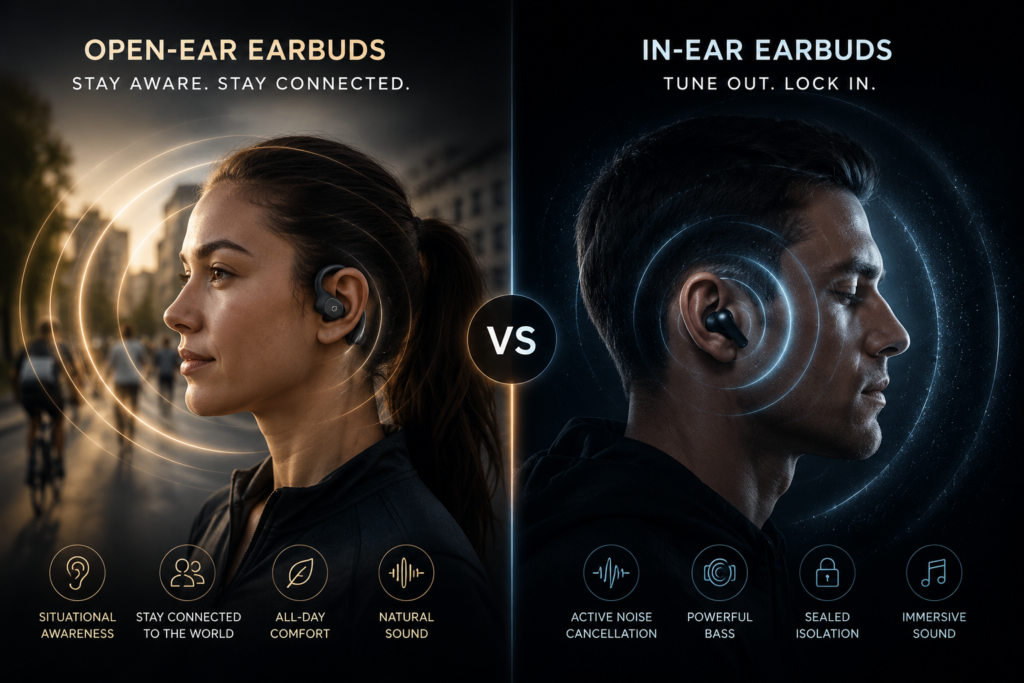
The debate around open ear vs in ear earbuds is no longer just about sound quality. It is about how you live with audio all day. Some people want deep bass, strong noise cancellation, and private listening. Others want comfort, awareness, less ear-canal pressure, and the ability to hear traffic, coworkers, children, pets, announcements, or their own surroundings.
In-ear earbuds seal the ear canal. Open-ear earbuds sit outside or near the ear canal and play audio without blocking it. That one design difference changes almost everything: bass, noise isolation, comfort, call clarity, workout safety, battery life, leakage, fit security, ear fatigue, hygiene, and how natural the listening experience feels.
This guide compares open-ear earbuds and in-ear earbuds from a practical buyer’s perspective: what each design does well, where each fails, who should choose which one, and how new technologies such as LE Audio, Auracast, air-conduction open-ear speakers, bone-conduction sensing, smart cases, and adaptive audio may change the category.
Quick Decision Matrix
| Requirement | Better Choice | Why |
|---|---|---|
| Deep bass | In-ear earbuds | Ear-canal seal improves low-end response |
| Strong noise cancellation | In-ear earbuds | ANC works best with a sealed or semi-sealed fit |
| Running outdoors | Open-ear earbuds | Better awareness of traffic and surroundings |
| Gym workouts | Depends | Open-ear for awareness; in-ear for isolation |
| Office calls | In-ear earbuds | Usually better mic isolation and noise control |
| All-day comfort | Open-ear earbuds | Less ear-canal pressure |
| Sleep listening | Usually in-ear/sleep-specific | Smaller profile and better passive isolation |
| Cycling | Open-ear earbuds | Safer environmental awareness |
| Air travel | In-ear earbuds | Better ANC and cabin noise reduction |
| Hearing surroundings | Open-ear earbuds | Ear canal stays open |
| Privacy | In-ear earbuds | Less sound leakage |
| Podcasts/audiobooks | Open-ear earbuds | Clear voice audio without ear fatigue |
| Music detail | In-ear earbuds | Better seal, bass, and controlled soundstage |
| Ear sensitivity | Open-ear earbuds | Avoids pressure inside the canal |
| Noisy commute | In-ear earbuds | Isolation and ANC matter more |
What Is This Guide For?
This guide is for readers deciding whether to buy open-ear earbuds or traditional in-ear wireless earbuds.
It covers:
- Open-ear vs in-ear earbuds
- Open-ear earbuds vs in-ear earbuds for sound quality
- Are open-ear earbuds better than in-ear?
- Best earbuds for comfort and awareness
- Open-ear earbuds for running vs in-ear earbuds
- In-ear earbuds for ANC and bass
- Open-ear earbuds for calls and workouts
- Battery life comparison
- Sound leakage comparison
- Safety and hearing awareness
- Costs, risks, and buying decisions
- Trends and upcoming earbud technology
This page belongs inside the earbud guides pillar and should connect naturally to your comparison, troubleshooting, battery and multipoint clusters.
Who Needs This Guide?
You need this guide if:
- In-ear earbuds feel uncomfortable after 30–60 minutes.
- You want earbuds for running, walking, cycling, or outdoor awareness.
- You want better noise cancellation for travel or work.
- You are unsure whether open-ear earbuds sound “good enough.”
- Your ears feel blocked, pressured, or irritated by silicone tips.
- You take many calls and need reliable microphones.
- You want earbuds for podcasts, audiobooks, or background listening.
- You want to understand why some earbuds leak sound.
- You are buying earbuds for fitness, commuting, office work, or daily carry.
- You are deciding between open-ear, bone-conduction, air-conduction, and in-ear designs.
This comparison is especially useful for people who already own one type and are wondering whether the other would solve their daily frustration.
Benefits of Choosing the Right Earbud Type
Choosing correctly can help you:
- Reduce ear fatigue
- Improve sound quality for your use case
- Improve awareness outdoors
- Get better noise isolation indoors
- Avoid overspending on the wrong design
- Improve workout comfort
- Reduce battery disappointment
- Improve call quality
- Avoid hygiene and fit problems
- Protect long-term listening habits
- Match earbuds to real daily behavior
The best earbuds design is not universal. It depends on where you listen, how long you listen, how noisy your environment is, whether you need awareness and whether you care more about bass, comfort, privacy or safety.
Open-Ear vs In-Ear Earbuds: The Basic Difference
What Are Open-Ear Earbuds?
Open-ear earbuds do not seal the ear canal. They sit outside the canal, hook around the ear, clip near the ear, rest above the canal or use bone-conduction or air-conduction methods to deliver sound while leaving the ear open.
Common open-ear designs include:
- Ear-hook open-ear earbuds
- Ear-clip earbuds
- Air-conduction open-ear earbuds
- Bone-conduction headphones
- Open-ear sport earbuds
- Smart-glasses audio
- Hybrid awareness earbuds
What Are In-Ear Earbuds?
In-ear earbuds use silicone, foam, or shaped tips that enter the ear canal and create a seal or semi-seal. This design improves bass, isolation, ANC performance and privacy.
Common in-ear designs include:
- True wireless in-ear earbuds
- ANC earbuds
- Silicone-tip earbuds
- Foam-tip earbuds
- Stem-style earbuds
- Sport in-ear earbuds
- Sleep earbuds
- High-resolution in-ear monitors
Open-Ear vs In-Ear Earbuds Comparison Chart
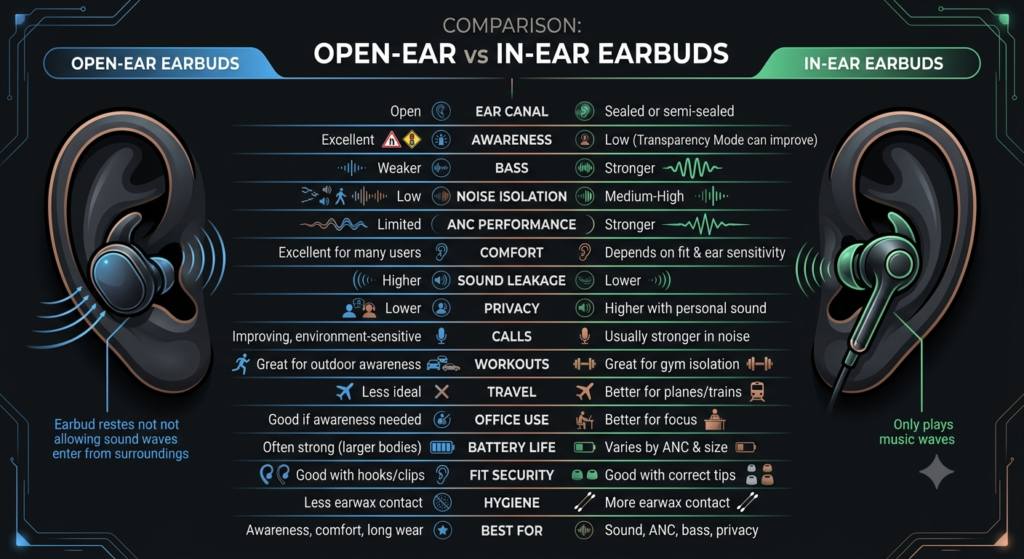
| Category | Open-Ear Earbuds | In-Ear Earbuds |
|---|---|---|
| Ear canal | Open | Sealed or semi-sealed |
| Awareness | Excellent | Low unless transparency mode is used |
| Bass | Weaker | Stronger |
| Noise isolation | Low | Medium–High |
| ANC performance | Limited | Stronger |
| Comfort | Excellent for many users | Depends on fit and ear sensitivity |
| Sound leakage | Higher | Lower |
| Privacy | Lower | Higher |
| Calls | Improving, but environment-sensitive | Usually stronger in noise |
| Workouts | Great for outdoor awareness | Great for gym isolation |
| Travel | Less ideal | Better for planes/trains |
| Office use | Good if awareness needed | Better for focus |
| Battery life | Often strong due to larger bodies | Varies by ANC and size |
| Fit security | Good with hooks/clips | Good with correct tips |
| Hygiene | Less earwax contact | More earwax contact |
| Best for | Awareness, comfort, long wear | Sound, ANC, bass, privacy |
Open-Ear Earbuds: Strengths and Weaknesses
Strengths of Open-Ear Earbuds
Open-ear earbuds are strongest when you want audio without shutting out the world.
They are useful for:
- Running outdoors
- Walking in traffic
- Cycling where legally and safely allowed
- Office awareness
- Parenting
- Podcasts and audiobooks
- Long listening sessions
- Ear sensitivity
- People who dislike ear-canal pressure
- Background music while working
- Home listening with awareness
The biggest advantage is comfort plus awareness. Many people who dislike silicone tips find open-ear earbuds easier to wear for hours because nothing is pressing into the ear canal.
Weaknesses of Open-Ear Earbuds
Open-ear earbuds usually struggle with:
- Deep bass
- Loud environments
- Sound privacy
- Airplane noise
- Subway or bus noise
- Strong ANC
- Wind noise
- High-volume music in public
- Critical listening
- Recording-style detail
Because they do not seal the canal, outside noise mixes with your audio. That means you may raise the volume in loud places, which can work against safe listening habits.
In-Ear Earbuds: Strengths and Weaknesses
Strengths of In-Ear Earbuds
In-ear earbuds are strongest when you want controlled sound.
They are useful for:
- Music detail
- Bass response
- ANC
- Commuting
- Travel
- Focus work
- Calls in noisy spaces
- Private listening
- Gaming
- Sleep-specific listening
- Loud gym environments
- Public transport
The seal does a lot of work. It helps bass, blocks external noise, improves ANC, and reduces leakage.
Weaknesses of In-Ear Earbuds
In-ear earbuds can cause:
- Ear pressure
- Ear fatigue
- Poor fit
- Earwax buildup on tips
- Occlusion effect, where your own voice or footsteps sound boomy
- Hygiene concerns
- Discomfort during long wear
- Reduced environmental awareness
- Tip sizing frustration
Transparency mode helps awareness, but it is still processed awareness. Open-ear listening feels more naturally aware because the ear canal is physically open.
Sound Quality: Which Sounds Better?
For pure music quality, in-ear earbuds usually win. The seal improves bass extension, dynamics, isolation, and perceived detail.
In-Ear Sound Advantages
- Stronger bass
- Better sub-bass
- More controlled sound
- Less outside noise interference
- Better detail at lower volume
- Better ANC support
- Better listening in noisy environments
Open-Ear Sound Advantages
- More natural awareness
- Less “inside the head” pressure
- Comfortable voice listening
- Good for podcasts and calls in quiet spaces
- Less occlusion effect
- Easier long-session listening
Sound Quality Comparison
| Sound Factor | Open-Ear | In-Ear |
|---|---|---|
| Bass depth | Medium–Low | High |
| Vocal clarity | Good | Very good |
| Detail | Medium | High |
| Soundstage feel | Open/natural | More isolated |
| Loud environment performance | Weak | Strong |
| Low-volume listening | Good in quiet places | Better in most places |
| Podcasts | Excellent | Excellent |
| Music immersion | Medium | High |
| Sound leakage control | Weak | Strong |
If music quality is your top priority, choose in-ear. If comfort and awareness are more important, choose open-ear.
Comfort: Which Is Better for Long Wear?
Open-ear earbuds often win for long-term comfort because they do not press into the ear canal.
Open-Ear Comfort Benefits
- No silicone tip inside the canal
- Less pressure
- Less blocked-ear feeling
- Better ventilation
- Less earwax contact
- Easier for casual all-day use
- Good for people with ear sensitivity
In-Ear Comfort Benefits
- Smaller designs can feel secure
- Many tip sizes available
- Foam tips can improve fit
- Some models are very ergonomic
- Better for lying down if designed for sleep
Comfort Scorecard
| Comfort Issue | Better Choice |
|---|---|
| Ear canal pressure | Open-ear |
| Long podcasts | Open-ear |
| Bass-heavy music | In-ear |
| Sleeping | Sleep-specific in-ear |
| Sweat ventilation | Open-ear |
| Secure seal | In-ear |
| Sensitive ears | Open-ear |
| Small ears | Depends on model |
| Glasses wearers | Depends on hook/clip design |
| Helmet use | Usually low-profile in-ear |
Open-ear earbuds are not automatically comfortable for everyone. Ear-hook and clip-style designs can conflict with glasses, helmets, masks, or ear shape.
Awareness and Safety
Open-ear earbuds are designed for awareness. They let outside sounds enter naturally, which is useful when you need to hear traffic, people, announcements, pets, children, alarms, or workplace cues.
Best Awareness Use Cases
- Running
- Walking
- Cycling
- Office work
- Home chores
- Parenting
- Outdoor fitness
- Dog walking
- Warehouse or shop environments where audio is permitted
- Low-volume background listening
In-Ear Awareness Limitations
In-ear earbuds block the canal. Transparency mode can help, but it depends on microphones and processing. It may amplify wind, sound artificial, or use more battery.
Hearing Safety Note
Safe listening depends on loudness and duration. CDC/NIOSH guidance explains that hazardous noise risk depends on how loud sound is, how long exposure lasts, and how often it repeats, with NIOSH recommending an 85 dBA exposure limit averaged over an eight-hour workday for occupational settings. (CDC)
That matters for both designs. Open-ear earbuds can tempt users to raise volume in loud environments because they do not block outside noise. In-ear earbuds can allow lower listening levels in noisy spaces because isolation helps you hear audio without turning it up.
Noise Cancellation: Can Open-Ear Earbuds Have ANC?
Traditional ANC works best when the earbud seals or closely controls the acoustic space near the ear canal. In-ear earbuds are naturally better suited to ANC because they can measure and cancel sound more effectively inside a sealed or semi-sealed environment.
Open-ear ANC is harder because the ear canal remains open. Recent research on open-ear smart glasses explains that conventional ANC depends on measuring residual sound near or inside the ear canal, which open-ear designs do not naturally support. That research demonstrated an experimental open-ear ANC approach using microphone arrays and open-ear speakers, achieving measured noise reduction in tested environments, but it also shows why open-ear ANC is technically difficult rather than simple. (arXiv)
ANC Comparison
| ANC Factor | Open-Ear | In-Ear |
|---|---|---|
| Passive isolation | Low | Medium–High |
| Strong ANC | Limited | Strong |
| Airplane use | Weak | Strong |
| Wind handling | Mixed | Mixed |
| Office noise control | Medium | Strong |
| Natural awareness | Excellent | Depends on transparency |
| Battery impact | Varies | Often high with ANC on |
For serious noise cancellation, choose in-ear earbuds.
Calls and Microphone Quality
Call quality depends on microphones, processing, wind reduction, fit, and environment.
Open-Ear Calls
Open-ear earbuds can work well for calls in quiet places, offices, and home environments. They may struggle more in loud spaces because they do not isolate your listening side, and their design may place microphones differently.
In-Ear Calls
In-ear earbuds often perform better for calls in noisy places because they combine microphone arrays, voice isolation, ANC, and a sealed listening experience. Premium earbuds increasingly use stronger voice-processing chips and AI noise reduction. Recent coverage of Anker’s Soundcore Liberty 5 Pro line highlights how newer earbuds are adding more advanced call noise-canceling and processing hardware, showing that call performance is now a major feature battleground. (The Verge)
Call Comparison
| Call Situation | Better Choice |
|---|---|
| Quiet home office | Either |
| Loud street | In-ear |
| Windy walk | Depends on mic processing |
| Long calls | Open-ear comfort or one-earbud in-ear |
| Video meetings | In-ear usually more focused |
| Awareness during calls | Open-ear |
| Noisy café | In-ear |
| Voice assistant | Either |
Workouts: Open-Ear vs In-Ear for Running, Gym, and Cycling
Running Outdoors
Open-ear earbuds are usually better for outdoor running because awareness matters. You can hear cars, bikes, people, dogs, announcements, and your own footstrike more naturally.
Gym Workouts
In-ear earbuds may be better in loud gyms because they block music, machines, and chatter. Open-ear earbuds can still work if you want awareness or dislike sweaty silicone tips.
Cycling
Open-ear designs are generally better for awareness, though local laws, road conditions, volume, and safe riding habits matter. Avoid high volume and avoid any setup that masks traffic or warnings.
Workout Comparison
| Workout Type | Better Choice | Reason |
|---|---|---|
| Outdoor running | Open-ear | Awareness and comfort |
| Treadmill | Either | Awareness less critical |
| Weightlifting | In-ear | Noise isolation and bass |
| Cycling | Open-ear | Environmental awareness |
| Hiking | Open-ear | Awareness and long wear |
| HIIT | Secure in-ear or hook open-ear | Fit stability |
| Yoga | Open-ear or low-profile in-ear | Comfort |
| Gym calls | In-ear | Better noise control |
Battery Life: Which Lasts Longer?
Battery life depends on form factor, battery size, ANC, volume, codec, call use, and case capacity.
Open-ear earbuds sometimes have larger outer housings or ear hooks that allow bigger batteries. In-ear earbuds may use more power with ANC, spatial audio, transparency mode, and high-resolution codecs.
Battery Life Comparison
| Battery Factor | Open-Ear | In-Ear |
|---|---|---|
| Per-charge runtime | Often strong | Varies widely |
| ANC drain | Usually less relevant | Major factor |
| Call drain | Medium–High | Medium–High |
| Case capacity | Varies | Varies |
| Fast charging | Common | Common |
| High-res codec drain | Less common | More common |
| Long background listening | Strong | Strong if ANC off |
For practical runtime improvements, connect to battery life tips for earbuds.
Sound Leakage and Privacy
Open-ear earbuds leak more sound because they are not sealed inside the ear canal. People nearby may hear your audio if volume is high or the room is quiet.
In-ear earbuds leak less because the sound is directed into a sealed or semi-sealed canal.
Privacy Comparison
| Situation | Open-Ear | In-Ear |
|---|---|---|
| Quiet office | May leak | Better |
| Library | Not ideal | Better |
| Gym | Usually acceptable | Strong |
| Outdoor walking | Fine | Fine |
| Bed partner nearby | May disturb | Better |
| Public transport | Weak | Strong |
| Work calls | Mixed | Better |
If privacy matters, in-ear is usually safer.
Hygiene and Ear Health
Open-ear earbuds touch less of the ear canal, so they may collect less earwax on tips. In-ear earbuds enter the canal and need more regular cleaning.
Open-Ear Hygiene
- Less earwax buildup
- Less canal moisture trapping
- Easier wipe-down
- Still needs cleaning around speaker openings
- Sweat can collect around hooks/clips
In-Ear Hygiene
- Tips collect earwax
- Mesh can clog
- Moisture can sit inside tips
- Needs more frequent cleaning
- Dirty tips can affect sound and charging case cleanliness
Open-Ear vs In-Ear Earbuds for Different Users
Best for Runners
Choose open-ear if awareness and comfort matter most. Choose in-ear if you run indoors or want bass and isolation.
Best for Commuters
Choose in-ear for trains, buses, planes, and noisy routes. ANC and passive isolation matter.
Best for Office Workers
Choose open-ear if you need to hear coworkers. Choose in-ear if you need focus and noise reduction.
Best for Students
Choose in-ear for libraries and study sessions. Choose open-ear for campus walking and casual listening.
Best for Parents
Open-ear can be useful because it lets you hear children, doorbells, alarms, and the home environment.
Best for Gamers
In-ear usually offers better isolation and low-latency modes. Open-ear can feel comfortable for long sessions but may lack impact and privacy.
Best for Calls
In-ear usually wins in noisy spaces. Open-ear may feel more natural for long, quiet calls.
Best for Sensitive Ears
Open-ear is often better if you dislike pressure, silicone tips, or blocked-ear feeling.
Comparison Section: Open-Ear vs In-Ear by Use Case
| Use Case | Open-Ear Score | In-Ear Score | Winner |
|---|---|---|---|
| Outdoor awareness | 10/10 | 5/10 | Open-ear |
| Bass impact | 5/10 | 9/10 | In-ear |
| ANC | 3/10 | 9/10 | In-ear |
| Comfort for long wear | 9/10 | 7/10 | Open-ear |
| Sound privacy | 4/10 | 9/10 | In-ear |
| Running | 9/10 | 7/10 | Open-ear |
| Air travel | 3/10 | 10/10 | In-ear |
| Office awareness | 9/10 | 6/10 | Open-ear |
| Noisy office focus | 5/10 | 9/10 | In-ear |
| Podcasts | 9/10 | 8/10 | Open-ear |
| Music detail | 6/10 | 9/10 | In-ear |
| Calls in noise | 6/10 | 8/10 | In-ear |
| Ear sensitivity | 9/10 | 5/10 | Open-ear |
| Hygiene simplicity | 8/10 | 6/10 | Open-ear |
Buying Decision Framework: Choose by Listening Environment
Choose Open-Ear Earbuds If You Want:
- Awareness
- Long-wear comfort
- Outdoor safety
- Less ear-canal pressure
- Better ventilation
- Casual listening
- Podcasts and audiobooks
- Running/walking earbuds
- Work-from-home awareness
- A less sealed feeling
Choose In-Ear Earbuds If You Want:
- Strong bass
- ANC
- Sound isolation
- Better privacy
- Better travel performance
- Immersive music
- Loud-environment listening
- Strong call focus
- Lower leakage
- More traditional premium sound
Costs: Open-Ear vs In-Ear Earbuds
| Price Range | Open-Ear Options | In-Ear Options | What to Expect |
|---|---|---|---|
| Under $50 | Basic open-ear/clip designs | Budget TWS earbuds | Basic sound, basic mics |
| $50–$100 | Better sport open-ear | Good budget ANC in-ear | Stronger daily value |
| $100–$200 | Premium open-ear sport models | Strong ANC/music earbuds | Best mainstream zone |
| $200–$300+ | High-end open-ear and sport systems | Premium ANC flagships | Better mics, apps, codecs |
| $300+ | Niche premium wearables | Luxury/high-end audio earbuds | Specialist features |
Cost Insight
Open-ear earbuds can feel expensive because their design is more specialized. In-ear earbuds have a larger market, so competition is stronger across all price points.
If you only need one pair, buy for your main use case. If you use earbuds all day in different settings, owning one open-ear pair and one in-ear ANC pair may make more sense than forcing one design to do everything.
Risks and Trade-Offs
Risks of Open-Ear Earbuds
- More sound leakage
- Weaker bass
- Poor performance in loud spaces
- Temptation to raise volume outdoors
- Fit may conflict with glasses
- Wind noise can affect calls
- Not ideal for travel isolation
- Limited ANC
Risks of In-Ear Earbuds
- Reduced awareness
- Ear pressure or fatigue
- Earwax buildup
- Tip fit problems
- Occlusion effect
- More cleaning needed
- ANC can make users less aware of surroundings
- Long wear may irritate sensitive ears
Safe Listening Reminder
Noise-induced hearing loss is preventable, and CDC guidance emphasizes turning down volume, moving away from loud noise when possible, and using hearing protection when exposure cannot be avoided. (CDC) This applies whether you use open-ear or in-ear earbuds.
Trends & Latest Tech
1. Open-Ear Is Becoming a Mainstream Category
Open-ear earbuds are no longer just bone-conduction sport headphones. The category now includes air-conduction hooks, ear cuffs, clip-on designs, smart-glasses audio, and fashion-forward wearables.
2. In-Ear Earbuds Are Becoming Smarter
In-ear earbuds continue to push ANC, adaptive transparency, high-resolution codecs, AI call processing, smart cases, and hearing-related features.
3. LE Audio and Auracast Are Changing Use Cases
Bluetooth LE Audio and Auracast are important because they can support new audio-sharing and broadcast experiences. The Bluetooth SIG describes LE Audio as a next-generation Bluetooth audio architecture that includes the LC3 codec and Auracast broadcast audio. (CDC)
For open-ear earbuds, Auracast could be especially useful in public spaces where awareness remains important. For in-ear earbuds, it could improve shared audio, TV listening, and assistive-style listening experiences.
4. Smart Wearables Are Blurring Categories
Open-ear audio is expanding into glasses and wearables. Research into open-ear smart glasses ANC shows that the industry is trying to solve the biggest weakness of open-ear designs: hearing clearly in noisy environments without sealing the ear canal. (arXiv)
5. Earbuds Are Becoming Sensors
Earables are increasingly being studied as sensing platforms. Recent research explored using commodity earbuds for chewing-related sensing and just-in-time intervention, showing how ear-worn devices may become broader health and behavior tools beyond music playback. (arXiv)
Upcoming Models: What to Look For Before Buying
Future earbuds will compete on more than sound.
Open-Ear Buyers Should Look For:
- Stronger directional audio
- Lower leakage
- Better bass without sealing
- Better wind reduction
- Secure ear-hook or clip design
- Glasses-friendly fit
- Long battery life
- Multipoint Bluetooth
- LE Audio support
- Auracast support
- Water resistance
- Lightweight comfort
In-Ear Buyers Should Look For:
- ANC strength
- Transparency naturalness
- Comfortable tip system
- Battery life with ANC on
- Call noise reduction
- Multipoint controls
- Low-latency mode
- Adaptive codec support
- LE Audio readiness
- App support
- Replacement tips
- Clean charging case design
Smart Case Features to Watch
- Case display
- Battery health dashboard
- Firmware update status
- Find earbuds feature
- EQ controls
- ANC mode switching
- Auracast selection
- Multipoint device manager
Charts & Tables: Decision Matrix
Open-Ear vs In-Ear Buyer Matrix
| Priority | Buy Open-Ear | Buy In-Ear |
|---|---|---|
| Hear surroundings | Yes | No, unless transparency mode is enough |
| Maximum bass | No | Yes |
| Strong ANC | No | Yes |
| No ear-canal pressure | Yes | No |
| Privacy in public | No | Yes |
| Running outdoors | Yes | Maybe |
| Airplane travel | No | Yes |
| All-day podcasts | Yes | Maybe |
| Music immersion | Maybe | Yes |
| Sensitive ears | Yes | Maybe |
| Loud workplace | Maybe | Yes |
| Awareness at home | Yes | Maybe |
| Minimal leakage | No | Yes |
| Best one-pair solution | Depends | Depends |
Practical Takeaway: The Two-Pair Strategy
Many users do best with two earbud types:
- Open-ear earbuds for walks, runs, home, office awareness, podcasts, and long casual listening.
- In-ear ANC earbuds for travel, focus work, bass-heavy music, calls, and noisy environments.
This is not overbuying if audio is part of your daily life. It is matching tools to environments. You would not use running shoes for every formal event, and you should not expect one earbud design to solve every listening problem.
FAQ: Open-Ear vs In-Ear Earbuds
Are open-ear earbuds better than in-ear earbuds?
Open-ear earbuds are better for awareness, comfort, running, walking, and long casual listening. In-ear earbuds are better for bass, ANC, privacy, travel, commuting, and noisy environments. Open-ear is not universally better; it solves a different problem. Choose open-ear if you want to hear your surroundings. Choose in-ear if you want stronger sound control.
Do open-ear earbuds have good sound quality?
Open-ear earbuds can sound good for podcasts, calls, audiobooks, casual music, and quiet environments. They usually do not match in-ear earbuds for deep bass, isolation, or detailed music listening because they do not seal the ear canal. The best open-ear models improve clarity and comfort, but physics still favors in-ear designs for bass and noise isolation.
Are open-ear earbuds safer for running?
Open-ear earbuds are often safer for running because they let environmental sounds reach your ears naturally. You can hear traffic, bikes, people, dogs, and announcements more easily. Safety still depends on volume, route, awareness, and local laws. Open-ear does not make unsafe listening safe if the volume is too loud.
Do in-ear earbuds damage hearing more than open-ear earbuds?
Neither design automatically damages hearing. Hearing risk depends mainly on volume, duration, and repeated exposure. In-ear earbuds can block outside noise, which may let you listen at lower volume in loud places. Open-ear earbuds may encourage higher volume in noisy environments because they do not isolate sound. Safe listening habits matter more than form factor.
Which earbuds are better for calls: open-ear or in-ear?
In-ear earbuds usually perform better for calls in noisy environments because they combine microphones, voice processing, and a more isolated listening experience. Open-ear earbuds can be comfortable for long calls in quiet spaces but may struggle with wind, traffic, and background noise depending on microphone quality.
People Also Ask
What is the difference between open-ear and in-ear earbuds?
Open-ear earbuds sit outside or near the ear canal and let outside sound remain audible. In-ear earbuds use tips that enter the ear canal and create a seal or semi-seal. Open-ear designs favor awareness and comfort. In-ear designs favor bass, noise isolation, ANC, and privacy.
Are open-ear earbuds good for the gym?
Open-ear earbuds can be good for the gym if you want awareness, ventilation, and comfort. In-ear earbuds may be better if the gym is loud and you want bass, focus, and isolation. For weightlifting in noisy gyms, in-ear often wins. For outdoor training or mixed awareness, open-ear can be better.
Do open-ear earbuds leak sound?
Yes, open-ear earbuds usually leak more sound than in-ear earbuds because they do not seal audio inside the ear canal. Leakage depends on volume, speaker direction, room quietness, and model design. In quiet offices, libraries, or shared bedrooms, in-ear earbuds are usually more private.
Can open-ear earbuds replace noise-canceling earbuds?
Open-ear earbuds usually cannot replace strong ANC in-ear earbuds for airplanes, trains, buses, loud offices, or noisy commutes. They are better as awareness and comfort earbuds. If you need serious noise reduction, use in-ear ANC earbuds. If you need to hear your environment, use open-ear earbuds.
Which is better for battery life: open-ear or in-ear earbuds?
Battery life varies by model, but open-ear earbuds can perform well because some designs have larger housings and fewer ANC demands. In-ear earbuds may drain faster when ANC, spatial audio, high-res codecs, or transparency mode are active. Compare real-world runtime with your preferred settings, not only the advertised maximum.
Conclusion: Choose the Earbud Design That Matches Your Environment
The open-ear vs in-ear earbuds decision is not about which design is “better” in every way. It is about the environment you are buying for.
Choose open-ear earbuds if you want comfort, awareness, ventilation, and safer outdoor listening. They are excellent for walking, running, home use, office awareness, podcasts, and long casual sessions.
Choose in-ear earbuds if you want bass, ANC, privacy, immersion, and better control in noisy environments. They are better for commuting, flights, focused work, loud gyms, music detail, and private listening.
The smartest approach is to match the tool to the situation. Open-ear keeps you connected to the world. In-ear helps you step away from it. For many users, the best answer is not one or the other — it is knowing when each one belongs in your ears.