
How Does Active Noise Cancellation Work?
Amazon Affiliate Disclosure
Earsbud participates in the Amazon Services LLC Associates Program and other affiliate programs. Some links on this page may earn a commission at no extra cost to readers.
Most people do not fully understand how does active noise cancelling work. Active Noise Cancellation, commonly called ANC, has become one of the defining technologies in modern earbuds. From airplane cabins and subway systems to offices and coffee shops, ANC is now considered a premium feature across wireless audio devices.
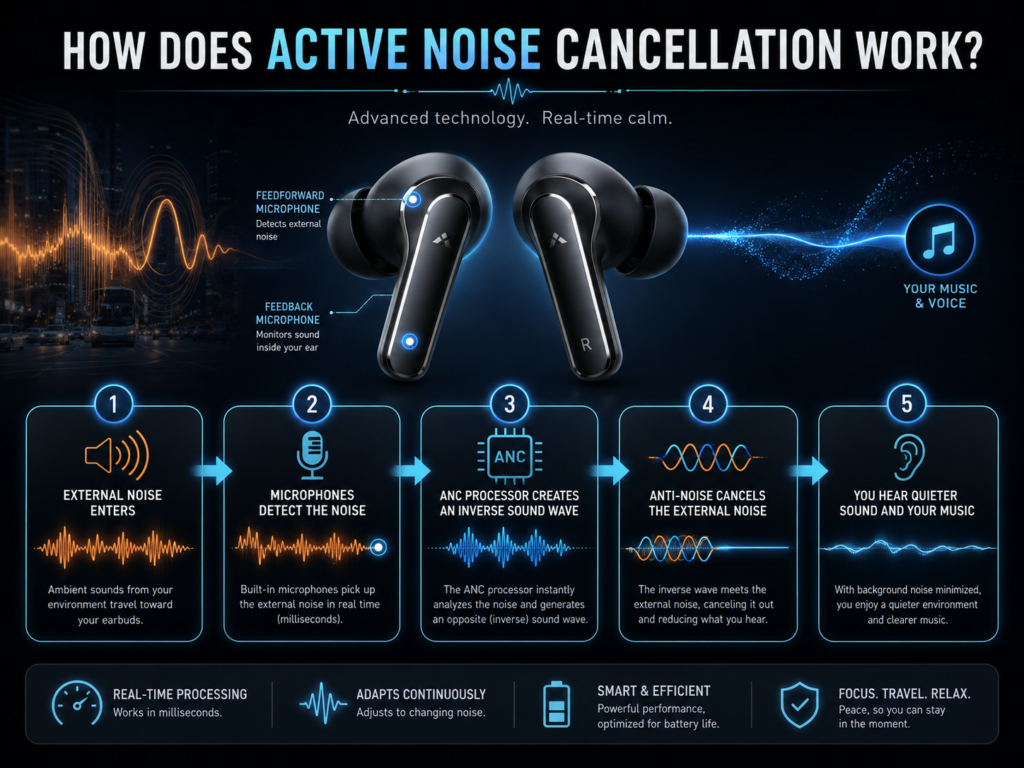
This guide explains the complete science behind ANC earbuds, including microphones, sound wave inversion, DSP processing, adaptive cancellation systems, hybrid ANC, transparency modes, and the newest AI-driven technologies shaping the future of audio.
For more related guides, visit the Earbuds Hub or explore the Earsbud homepage.
Quick Picks
| Looking For | Jump To |
|---|---|
| Simple ANC explanation | What Is Active Noise Cancellation |
| Technical breakdown | How ANC Works Step by Step |
| ANC microphone types | Feedforward vs Feedback ANC |
| Best ANC technology | Hybrid ANC Explained |
| Travel performance | Why ANC Works Best on Planes |
| Latest innovations | Trends & Latest ANC Tech |
| Future earbuds | Upcoming ANC Models |
| Downsides | Risks & Limitations |
| Buying help | Is ANC Worth It |
| Common questions | FAQs |
What Is This Active Noise Cancellation Guide For?
This guide is designed for anyone who wants to understand how active noise cancellation works in earbuds, from the basic acoustic principles to the increasingly intelligent systems used in modern premium models. Rather than treating ANC as a simple on-and-off feature, it explains how microphones, processors, algorithms and earbud design work together to reduce unwanted external sound.
It is particularly useful for readers researching active noise cancelling earbuds before making a purchase. ANC performance can vary considerably between products, even when manufacturers use similar marketing language. Some earbuds are highly effective at suppressing the steady rumble of aircraft engines, buses and air-conditioning systems, while others are better at adapting to changing sounds in offices, streets and crowded public spaces. Understanding these differences makes it easier to choose earbuds based on real listening needs rather than specifications alone.
The guide explains the science behind noise cancellation, including how earbuds detect ambient sound and generate an opposing audio signal—often called anti-noise—to reduce the sound reaching the eardrum. It also examines the role of ANC microphones, digital signal processing and the extremely small time intervals in which the system must analyse and respond to incoming noise.
Readers will also learn how the main ANC technologies differ. This includes feedforward ANC, feedback ANC and hybrid active noise cancellation. Feedforward systems use microphones positioned on the outside of the earbuds to detect environmental noise before it enters the ear canal. Feedback systems monitor sound from inside the earbud, while hybrid ANC combines both approaches to provide broader and more responsive noise reduction.
A major focus of the guide is hybrid ANC technology, which has become common in advanced wireless earbuds. By using both external and internal microphones, hybrid active noise cancelling earbuds can detect outside noise while also measuring the sound that remains inside the ear. This allows the processor to make continuous corrections based on ear shape, ear-tip seal, movement and changes in the surrounding environment.
The guide also explores how ANC microphones remove noise. Microphones do not physically block sound; instead, they capture acoustic information that is passed to the earbud’s processing system. The processor estimates the frequency, amplitude and timing of the unwanted sound before generating a counteracting waveform. Because this process must happen almost instantly, microphone quality, placement and processing speed can have a noticeable effect on ANC performance.
Another important distinction covered is ANC vs passive noise isolation. Passive isolation depends on the physical seal created by the ear tips and earbud housing. It is often most effective against higher-frequency sounds such as nearby speech, keyboard clicks and sharp environmental noise. Active noise cancellation electronically reduces sound and is generally more effective against continuous low-frequency noise. The strongest noise-blocking earbuds usually combine an effective ear-tip seal with a well-tuned ANC system.
For buyers comparing products, the guide explains what to look for beyond an “ANC included” label. Important considerations include noise-reduction consistency, ear-tip fit, transparency mode quality, wind-noise control, pressure sensation, microphone arrangement, battery life with ANC enabled and the ability to adjust noise cancellation through a companion app.
The guide also examines the latest developments in AI-powered ANC technology. Newer adaptive noise cancellation systems can classify environmental sounds, identify changes in earbud fit and automatically adjust the strength or frequency response of the ANC system. Some earbuds use machine-learning-based processing to distinguish between wind, traffic, conversation and mechanical noise, allowing the earbuds to respond more selectively instead of applying one fixed noise-cancelling profile.
By the end of this guide, readers should have a clear understanding of how ANC earbuds work, how different noise-cancellation systems compare and which features are most likely to improve real-world listening. It is intended to help users evaluate the best active noise cancelling earbuds with greater confidence while understanding both the capabilities and limitations of modern ANC technology.
Who Needs This Active Noise Cancellation Guide?
This guide is written for anyone trying to understand whether active noise cancelling earbuds are worth buying, how different ANC systems perform in real environments and which features matter for a particular listening routine. Although noise cancellation is often marketed as a premium convenience, its real value depends heavily on where the earbuds will be used, what type of noise needs to be reduced and how much importance the listener places on sound quality, comfort and awareness.
Frequent Travelers
Frequent flyers, rail passengers and daily commuters are among the users most likely to benefit from ANC earbuds. Aircraft cabins, buses, trains and underground transport systems produce persistent low-frequency sounds that can make listening tiring, even when the noise does not initially seem overwhelming.
The steady rumble of an engine, ventilation system or railway carriage forces many listeners to increase playback volume to hear music, podcasts or dialogue clearly. Effective active noise cancellation reduces much of this background energy, allowing content to remain intelligible at a more comfortable volume.
For long-distance travel, the best noise cancelling earbuds can also make the journey feel less mentally exhausting. ANC does not create complete silence, but it can soften the continuous mechanical noise that contributes to listening fatigue. Travelers should pay particular attention to low-frequency noise reduction, ear-tip comfort, battery life with ANC enabled, wind resistance and transparency modes for hearing boarding announcements or speaking with staff.
Remote Workers and Office Professionals
Remote workers, hybrid employees and people working in open-plan offices can use noise cancelling wireless earbuds to create a more controlled listening environment. Household conversations, office chatter, air conditioners, nearby traffic and repeated background activity can interrupt concentration, especially during tasks that require sustained attention.
ANC is most effective against stable environmental noise, while a secure ear-tip seal can help reduce voices and sharper sounds. Used together, active noise cancellation and passive isolation can make busy surroundings feel less intrusive.
For remote workers, ANC performance should not be judged in isolation. Call microphone quality, voice pickup, sidetone, multipoint Bluetooth connectivity and transparency mode are equally important. A strong pair of work-focused ANC earbuds should allow the user to move smoothly between focused listening, video meetings and brief conversations without repeatedly removing the earbuds.
Students and Researchers
Students studying in libraries, shared rooms, cafés, university halls or public spaces may find active noise cancelling earbuds for studying especially useful. Irregular background conversations and movement can make it difficult to maintain attention, while continuous sounds such as air-conditioning systems, traffic and building ventilation can gradually become distracting.
ANC can reduce the acoustic load of the environment, making it easier to focus on lectures, reading material, revision audio or instrumental study playlists. However, students should understand that active noise cancellation is generally better at reducing constant sounds than completely removing nearby speech.
For this reason, fit and passive noise isolation remain important. Earbuds with well-sized silicone or foam ear tips can physically reduce higher-frequency distractions, while ANC targets the lower-frequency noise that passes through the seal. Together, these systems provide more effective study isolation than either method alone.
Battery life, long-term comfort and adjustable ANC levels are also important for students who may wear their earbuds for several hours at a time.
Audiophiles and Sound-Focused Buyers
Audiophiles and critical listeners need this guide because active noise cancellation can affect more than background noise. The ANC system may also influence bass response, perceived soundstage, tonal balance and the way music changes when noise cancellation is switched on or off.
Premium audiophile ANC earbuds are designed to balance effective noise reduction with accurate sound reproduction, but not every model succeeds equally. Aggressive ANC tuning may create pressure sensation, alter low-frequency response or introduce subtle processing artifacts. Poorly integrated noise cancellation can also make music sound different across ANC, transparency and standard listening modes.
Understanding feedforward, feedback and hybrid ANC helps sound-focused buyers evaluate why one earbud may provide stronger noise reduction while another preserves a more natural presentation. Audiophiles should compare driver quality, codec support, equalizer controls and tuning consistency alongside ANC performance rather than treating noise cancellation as a separate specification.
For listeners who frequently use earbuds in noisy environments, effective ANC can also improve perceived sound quality. By lowering environmental noise, the listener can hear fine details, low-level textures and quiet passages without raising the volume excessively.
Tech Enthusiasts
Tech enthusiasts interested in acoustics, digital audio and wearable computing will find modern ANC systems particularly compelling. Current active noise cancellation technology combines miniature microphones, digital signal processing chips, acoustic chambers, motion sensors, adaptive algorithms and increasingly sophisticated artificial intelligence.
The system must detect incoming noise, estimate its acoustic characteristics and generate a precisely timed counter-signal before the unwanted sound reaches the listener in a perceptible way. This process occurs continuously and must adapt to changing earbud position, ear-canal shape, wind, movement and environmental sound.
Modern hybrid ANC earbuds may use several microphones on each side, with external microphones monitoring ambient noise and internal microphones measuring what remains inside the ear canal. Some systems also analyse leakage caused by an imperfect ear-tip seal and automatically adjust the noise-cancelling response.
For technology-focused readers, ANC provides a practical example of real-time signal processing operating under strict limits on power consumption, latency and physical space.
Buyers Comparing ANC Earbuds
Anyone planning to buy noise cancelling earbuds can benefit from understanding the technology before comparing products. Manufacturer claims such as “adaptive ANC,” “intelligent noise cancellation” and “up to 50 dB noise reduction” can sound impressive, but they do not always describe how the earbuds will perform during a flight, in an office or on a windy street.
This guide helps buyers look beyond headline specifications by examining microphone placement, ANC architecture, fit, passive isolation, pressure comfort, wind-noise control and consistency across different frequencies.
It is especially useful for shoppers comparing budget ANC earbuds with premium models. Less expensive earbuds may offer effective reduction of steady low-frequency noise, while more advanced systems may respond more smoothly to changing environments, movement and seal variations. Understanding these distinctions makes it easier to determine whether a higher price reflects meaningful improvements or additional features that may not be necessary.
People Sensitive to Background Noise
Some users are more easily distracted or fatigued by environmental sound than others. Repeated office noise, road traffic, appliance hum and crowded public spaces can make concentration or relaxation difficult.
For these listeners, adaptive noise cancelling earbuds may provide a more comfortable personal audio environment. Adjustable ANC is particularly useful because maximum noise cancellation is not always the most comfortable setting. Some users prefer a moderate reduction that softens the environment without creating a strong sense of acoustic pressure or disconnection.
Transparency mode is equally important for users who want relief from background noise while maintaining situational awareness. The ability to move quickly between ANC and ambient listening can make earbuds more practical in workplaces, transit stations and public areas.
Fitness and Outdoor Users
Runners, walkers and gym users may also benefit from ANC, although their requirements differ from those of travelers and office workers. Gym ventilation, equipment noise and repetitive background music can be reduced by active noise cancellation, helping users hear their own audio more clearly.
Outdoor use requires greater caution. Strong ANC can reduce awareness of vehicles, bicycles, announcements and nearby people. Fitness-focused buyers should therefore look for earbuds with effective transparency modes, wind-noise reduction, secure fit and sweat resistance.
Adaptive ANC can be useful in these situations because it may automatically reduce noise cancellation when movement or environmental changes are detected. However, users should never rely entirely on automated awareness features in traffic-heavy environments.
Early Adopters of AI-Powered ANC
Readers interested in the latest AI-powered noise cancellation will also benefit from this guide. Modern earbuds increasingly use machine-learning models and environmental classification to determine how ANC should respond.
An AI-assisted system may identify whether the listener is inside an aircraft, walking outdoors, sitting in an office or exposed to wind. It can then modify microphone sensitivity, noise-reduction intensity or transparency settings to suit the environment.
Some advanced earbuds also learn user preferences over time, automatically applying stronger ANC in locations where the listener usually wants more isolation. Others adjust their response based on jaw movement, earbud fit or changes in the acoustic seal.
AI does not replace the core principles of active noise cancellation, but it can make ANC more responsive, personalized and efficient. This guide explains where artificial intelligence provides a meaningful advantage and where it may simply be used as a marketing label.
Anyone Choosing Between ANC and Passive Isolation
This guide is also useful for readers deciding between active noise cancellation and passive noise isolation. ANC uses microphones and processing to electronically reduce environmental sound, while passive isolation depends on the physical barrier created by the ear tips and earbud housing.
Travelers exposed to engine rumble may benefit most from active noise cancellation. Listeners trying to reduce nearby conversation may notice that ear-tip fit and passive isolation are equally important. In many cases, the best solution is not ANC or passive isolation alone, but an earbud that combines both effectively.
Understanding this relationship helps users choose products based on the noise they actually encounter rather than assuming that the strongest advertised ANC will always provide the best overall isolation.
Whether the reader is a traveler, student, remote worker, audiophile or technology enthusiast, this guide provides the background needed to evaluate ANC earbuds more accurately. It explains not only who benefits from noise cancellation, but also why different users may require very different combinations of ANC strength, passive isolation, comfort, sound quality and environmental awareness.
What Is ANC?
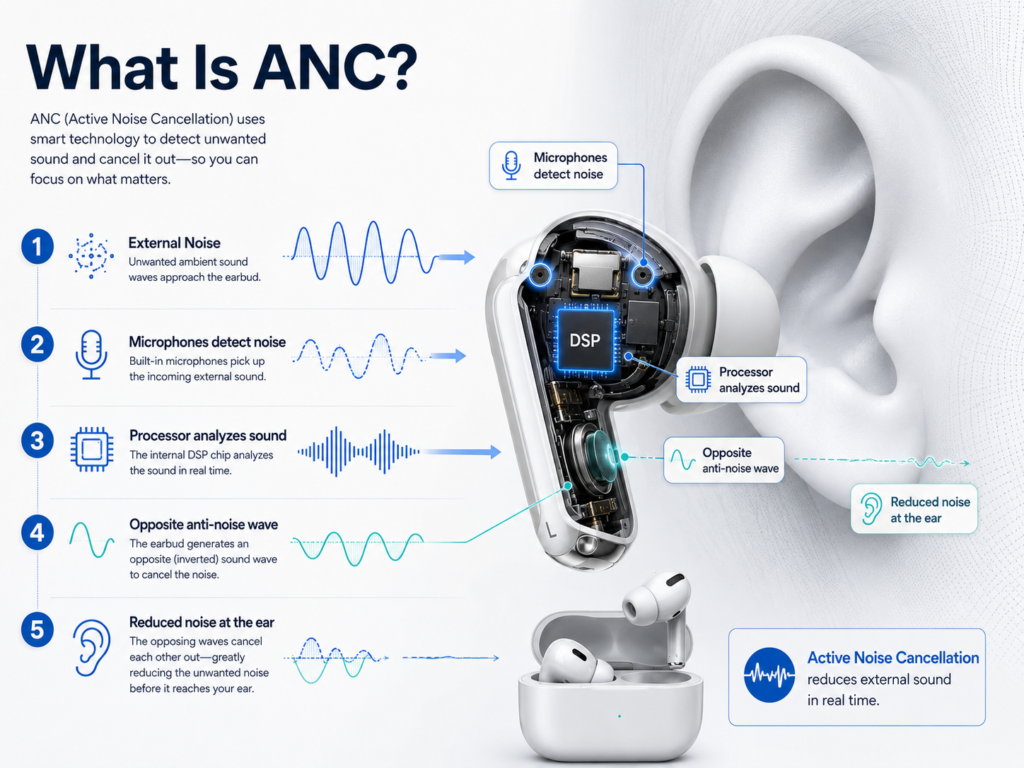
ANC stands for Active Noise Cancellation, an electronic audio technology designed to reduce unwanted external sound before it becomes clearly audible to the listener. It is one of the defining features of modern premium wireless earbuds, particularly for people who listen in aircraft cabins, public transport, offices, cafés and other environments with persistent background noise.
Unlike passive noise isolation, which relies mainly on the physical seal of the ear tips to block sound from entering the ear canal, active noise cancellation uses microphones, processors and specially generated sound waves to reduce environmental noise electronically.
In simple terms, ANC earbuds listen to the surrounding environment and create an opposing sound signal that weakens the unwanted noise reaching your ears.
How Does Active Noise Cancellation Work?
Sound travels through the air as changes in pressure. These pressure variations form waves with measurable properties, including frequency, amplitude and phase.
When external noise reaches an ANC earbud, miniature microphones capture the incoming sound. The earbud’s digital signal processor then examines the noise and calculates a corresponding waveform with the opposite phase.
This electronically generated signal is commonly known as anti-noise.
When the original noise wave and the opposing anti-noise wave meet, their pressure patterns partially cancel one another through a principle known as destructive interference. The unwanted sound is not removed from the environment itself; instead, its acoustic effect is reduced at or near the listener’s ear.
The process can be simplified into four stages:
Noise detection: Built-in microphones monitor sound inside or outside the earbuds.
Signal analysis: The earbud’s processor identifies important characteristics of the noise, including its frequency, intensity and timing.
Anti-noise generation: The processor creates a sound wave designed to oppose the detected environmental noise.
Real-time correction: The ANC system continually adjusts the anti-noise signal as the surrounding environment, earbud position or ear-tip seal changes.
Because environmental noise is constantly moving and changing, this entire sequence must happen with extremely low latency. Even a small delay can make the generated anti-noise less effective.
What Do ANC Microphones Detect?
The microphones inside active noise cancelling earbuds act as acoustic sensors. Their purpose is not simply to record sound for phone calls. Dedicated ANC microphones continuously monitor the noises that may interfere with the listening experience.
Depending on the ANC design, microphones may be placed on the outside of the earbud, inside the acoustic chamber or in both locations.
External microphones detect environmental sound before it passes through the earbud housing and ear tips. Internal microphones measure the sound that remains near the ear canal after passive isolation and active cancellation have already taken effect.
By comparing these acoustic signals, an advanced ANC system can estimate how much unwanted noise is still reaching the listener and modify its response accordingly.
This is particularly important because ANC performance is affected by more than the surrounding environment. It can also change according to:
- The shape of the listener’s ear canal
- The size and material of the ear tips
- The quality of the acoustic seal
- Movement while walking or exercising
- Wind passing across the microphones
- Changes in the position of the earbuds
- The frequency and intensity of the external sound
This is why the same pair of noise cancelling earbuds may perform differently for two people. The electronics may be identical, but the physical fit and acoustic conditions are not.
Why Is ANC Better at Cancelling Some Sounds?
Active noise cancellation is generally most effective against steady, low-frequency sounds. These noises are predictable enough for the processor to measure and counteract consistently.
Common examples include:
- Aircraft engine rumble
- Train and bus noise
- Air-conditioning systems
- Computer fans
- Low mechanical hum
- Road noise during a commute
These sounds usually change gradually, giving the ANC system enough time to generate a closely matched opposing waveform.
ANC is less capable of completely removing sudden or irregular sounds. Nearby conversations, keyboard clicks, clattering dishes, alarms and rapidly changing noises contain complex high-frequency information that is harder to predict and cancel in real time.
This does not mean ANC earbuds have no effect on voices or sharper sounds. The combination of active cancellation and a secure ear-tip seal can still make these noises less prominent. However, much of the reduction in higher-frequency sound usually comes from passive noise isolation rather than the electronic ANC system alone.
ANC Does Not Create Complete Silence
The phrase “noise cancelling earbuds” can give the impression that all external sound disappears. In practice, even the best ANC earbuds do not create absolute silence.
Active noise cancellation reduces selected parts of the surrounding sound spectrum. Low-frequency rumbles may become dramatically quieter, while nearby speech or sudden sounds may remain audible at a reduced level.
The result is better described as a calmer acoustic environment. Background noise becomes less dominant, allowing music, podcasts, audiobooks and calls to be heard more clearly without competing as heavily with external sound.
The effectiveness of ANC depends on several factors, including microphone quality, processor speed, algorithm design, earbud fit and the type of noise present.
How Fast Does ANC Process Sound?
Modern ANC systems operate continuously and process acoustic information at extremely high speed. Audio signals are commonly sampled many thousands of times per second, giving the processor a detailed digital representation of the surrounding noise.
The processor must then calculate the required anti-noise signal and send it through the earbud driver with minimal delay. This cycle is repeated continuously while ANC is active.
The process involves more than generating one fixed opposite waveform. Real-world sound is made up of many frequencies occurring at the same time. The ANC processor must respond to this mixture dynamically, strengthening cancellation in some frequency ranges while applying less correction in others.
Advanced systems also monitor whether their previous correction worked. When residual noise remains inside the ear, feedback microphones can detect it and instruct the processor to adjust the cancellation signal.
This rapid feedback loop is one reason hybrid ANC earbuds can provide more consistent performance than simpler designs.
What Is the Role of the DSP Chip in ANC Earbuds?
The digital signal processor, or DSP chip, functions as the computational center of an active noise cancellation system.
It receives acoustic data from the microphones, converts that information into a form that can be analyzed and determines what type of anti-noise should be produced. It may also handle equalization, transparency mode, voice processing, spatial audio and wind-noise reduction.
A capable DSP must perform these calculations quickly while consuming very little power. Wireless earbuds have limited battery capacity, so ANC processing must balance performance with energy efficiency.
More powerful processing does not automatically guarantee better noise cancellation. The effectiveness of ANC also depends on the quality of the algorithms, microphone placement, acoustic design and tuning performed by the manufacturer.
A well-engineered ANC system treats the earbud as a complete acoustic platform rather than relying on the processor alone.
What Is the Difference Between ANC and Passive Noise Isolation?
The difference between active noise cancellation and passive noise isolation lies in how each system reduces sound.
Passive noise isolation is physical. Silicone or foam ear tips create a seal inside the ear canal, while the earbud housing forms an additional barrier against external sound. No microphones, processors or electrical power are required.
ANC is electronic. It detects environmental noise and generates an opposing signal to reduce it.
Passive isolation tends to be particularly important for reducing mid- and high-frequency sounds, including speech and sharp environmental noises. ANC is generally strongest against continuous low-frequency sound.
The most effective noise cancelling earbuds use both methods together. A secure physical seal limits how much sound enters the ear canal, while the ANC system electronically suppresses the frequencies that remain.
Poorly fitting ear tips can therefore weaken overall ANC performance. If excessive sound leaks around the earbud, the processor must work under less predictable acoustic conditions.
What Is Hybrid ANC?
Hybrid active noise cancellation combines external feedforward microphones with internal feedback microphones.
The external microphones detect environmental noise before it reaches the ear canal. The internal microphones monitor what the listener is actually hearing after the cancellation signal has been applied.
Using both microphone positions gives the processor more information. It can respond to incoming noise while also checking whether the generated anti-noise is working effectively.
This arrangement can improve cancellation across a broader frequency range and compensate for changes in fit, movement or ear shape. It can also help reduce inconsistencies between the left and right earbuds.
Hybrid ANC has become common in premium wireless earbuds because it offers greater adaptability than systems relying on only one microphone arrangement. However, it is more complex to tune and may require additional processing power.
What Is Adaptive ANC?
Traditional ANC may apply a relatively fixed level of noise reduction. Adaptive ANC changes its response according to the listener’s environment and wearing conditions.
An adaptive system may increase cancellation when it detects the low-frequency rumble of an aircraft, reduce sensitivity when exposed to wind or alter its tuning when the ear-tip seal changes.
Some earbuds also allow users to choose between several ANC levels through a companion app. Others make these adjustments automatically.
Adaptive noise cancellation can improve comfort because maximum ANC is not always necessary. In a quiet office, moderate cancellation may feel more natural and use less battery power. During a flight or train journey, stronger cancellation may be more beneficial.
How Is AI Used in Active Noise Cancellation?
The latest AI-powered ANC earbuds use environmental classification and machine-learning-based processing to make noise cancellation more responsive.
Instead of treating every sound environment in the same way, an intelligent ANC system may distinguish between traffic, wind, conversation, machinery and indoor ambient noise. It can then modify its microphone behavior and cancellation profile according to the detected conditions.
Some systems can also account for personal variables, including ear shape, fit and commonly used locations. For example, the earbuds may automatically apply stronger ANC during a regular commute or switch to an awareness mode when the user begins speaking.
Artificial intelligence does not change the fundamental physics of active noise cancellation. The system still relies on microphones, signal processing and destructive interference. AI is used to decide how and when those components should respond.
Its real value lies in making ANC more context-aware, personalized and automatic.
Why ANC Matters in Wireless Earbuds
The purpose of ANC is not merely to make the environment quieter. By reducing competing background noise, active noise cancellation can improve the clarity of audio content and make extended listening more comfortable.
Listeners may be able to hear dialogue, instruments and low-level detail without raising playback volume as aggressively. ANC can also reduce the feeling that music must overpower the surrounding environment.
For travelers, this can make flights and commutes less tiring. For students and remote workers, it can create a more focused listening space. For audiophiles, lowering environmental noise can reveal details that would otherwise be masked.
The quality of the experience depends on how successfully the earbuds integrate ANC technology, passive isolation, microphone design, digital signal processing and acoustic tuning. Strong noise cancellation is not produced by one component; it is the result of the entire system working together in real time.
The Science Behind ANC
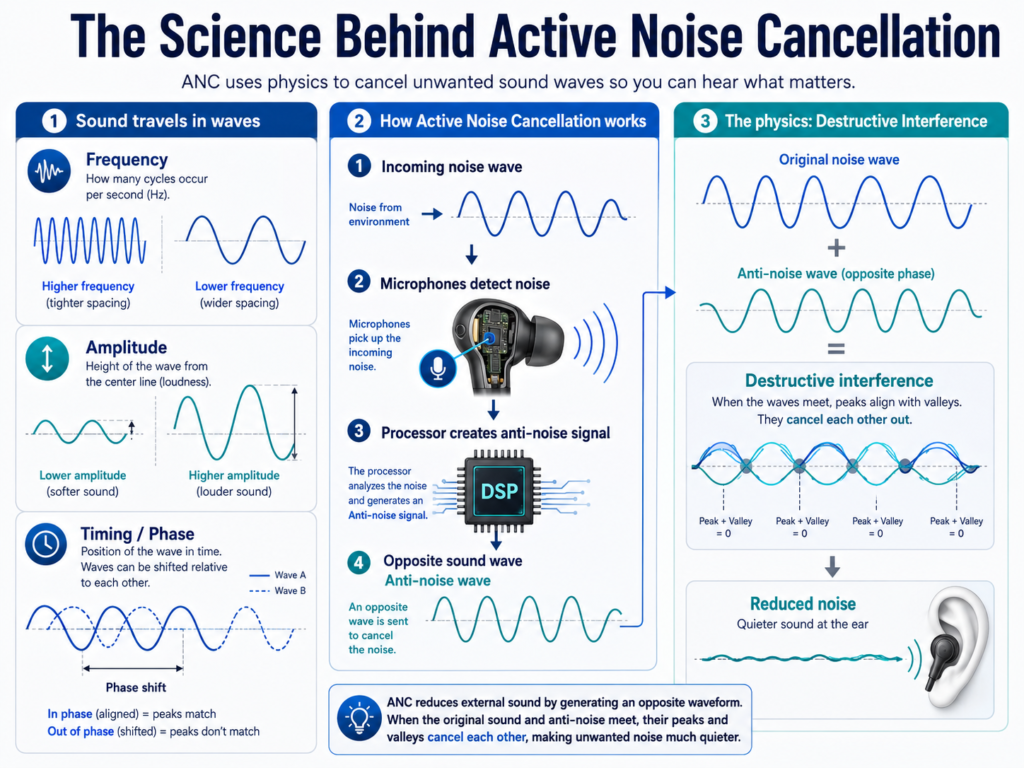
The science behind active noise cancellation, or ANC, begins with a basic principle of acoustics: sound travels through the air as a wave.
These waves are created when a source vibrates and pushes nearby air molecules back and forth. A loudspeaker, aircraft engine, human voice or air-conditioning unit all produce vibrations that move through the surrounding air as alternating areas of higher and lower pressure.
When those pressure changes reach the ear, they cause the eardrum to vibrate. The auditory system then converts those vibrations into the sounds we perceive.
ANC earbuds do not remove the original sound from the surrounding environment. Instead, they generate a carefully controlled second sound wave that reduces the effect of the unwanted noise near the listener’s ear.
What Is a Sound Wave?
A sound wave is a pattern of changing air pressure moving through a medium such as air, water or a solid material. In diagrams, sound is often represented as a smooth line with rising peaks and falling valleys.
The peaks represent areas of increased pressure, while the valleys represent areas of reduced pressure.
Real-world sound is more complicated than a single smooth wave. Most environmental noise contains many frequencies occurring simultaneously, each with its own intensity and timing. An aircraft cabin, for example, may contain low engine rumble, ventilation noise, vibration and higher-frequency mechanical sounds at the same time.
To reduce this complex mixture, an ANC system must continually measure the incoming sound and calculate an appropriate opposing response.
Three properties are especially important to understanding how ANC works:
- Frequency
- Amplitude
- Phase and timing
Frequency: The Pitch of the Sound
Frequency describes how many times a sound wave completes a full cycle each second. It is measured in hertz, or Hz.
A lower frequency means the wave cycles more slowly and is generally perceived as a deeper sound. A higher frequency cycles more rapidly and is usually perceived as a sharper or higher-pitched sound.
Low-frequency examples include aircraft engine rumble, bus vibration and the hum of an air-conditioning unit. Higher-frequency sounds include speech consonants, keyboard clicks, clattering dishes and alarms.
Active noise cancellation is usually most effective against steady low-frequency sound. These waves change relatively slowly and predictably, giving the ANC processor enough time to measure them and generate an accurate counter-signal.
Higher-frequency and sudden sounds are more difficult to cancel because their wave patterns change very quickly. Even a very small processing delay can prevent the anti-noise wave from aligning correctly with the incoming sound.
This is one reason the best noise cancelling earbuds combine electronic ANC with strong passive isolation from the ear tips.
Amplitude: The Strength of the Sound Wave
Amplitude refers to the size or intensity of a sound wave. In simple terms, greater amplitude usually corresponds to a louder sound.
On a waveform diagram, a loud noise has taller peaks and deeper valleys, while a quieter sound has smaller variations around the center line.
For active noise cancellation to work effectively, the generated anti-noise signal must have an amplitude that closely matches the unwanted sound. If the anti-noise wave is too weak, part of the original noise remains audible. If it is too strong, the ANC system may introduce an audible correction or alter the perceived sound inside the earbud.
The processor must therefore make constant adjustments as the environmental noise becomes louder or quieter.
For example, the rumble inside an aircraft cabin may change during takeoff, cruising and landing. A sophisticated adaptive ANC system monitors these changes and modifies the strength of the anti-noise signal in real time.
Phase: The Key to Noise Cancellation
The most important concept behind ANC is phase.
Phase describes where a sound wave is within its repeating cycle at a particular moment. Two waves can have the same frequency and amplitude but reach their peaks and valleys at different times.
For noise cancellation to occur, the ANC system attempts to generate a wave that is approximately 180 degrees out of phase with the unwanted noise.
This means that when the original noise wave reaches a positive peak, the anti-noise wave produces a corresponding negative valley. When the original sound moves downward, the anti-noise signal moves upward.
The two pressure patterns oppose each other.
This inverse relationship is what allows active noise cancellation to reduce the acoustic energy reaching the listener.
What Is an Anti-Noise Signal?
An anti-noise signal is the electronically generated sound wave used to counteract environmental noise.
The term can be misleading because anti-noise is still sound. It is not silence, and it does not erase a sound wave after it has already passed. It is a second waveform designed to interfere with the first one in a controlled way.
The ANC microphones capture incoming noise and send that information to the digital signal processor. The processor estimates the frequency, amplitude and phase of the unwanted sound, then calculates an opposing waveform.
The earbud driver plays this anti-noise signal alongside the listener’s music, podcast or call audio.
Because the original sound and anti-noise signal are designed to be out of phase, their pressure changes partially cancel when they meet near the ear.
This calculation must happen almost instantly. If the anti-noise arrives too early, too late or with the wrong amplitude, the cancellation becomes less effective.
What Is Destructive Interference?
The interaction between the unwanted sound and the anti-noise signal is known as destructive interference.
Interference occurs whenever two or more waves occupy the same space. Their amplitudes combine to produce a new resulting wave.
When two matching waves are in phase, their peaks and valleys align. This causes the waves to reinforce each other, producing a stronger sound. This is called constructive interference.
When two similar waves are out of phase, one wave’s peak meets the other wave’s valley. Their pressure changes oppose each other, reducing the amplitude of the resulting wave.
This is destructive interference.
In an idealized example, two waves with identical frequency and amplitude but perfectly opposite phase would cancel completely. The resulting waveform would have no remaining amplitude at that point.
Real-world ANC is less exact. Environmental sound contains many frequencies, reflections and rapidly changing wave patterns, so the cancellation is rarely perfect across the entire audible spectrum.
Instead, the ANC system reduces selected components of the noise, particularly steady low-frequency energy.
How Peaks and Valleys Cancel Each Other
A sound wave can be visualized as a sequence of peaks and valleys around a neutral pressure line.
The original environmental noise might produce a positive pressure peak. At that exact moment, the earbud generates a negative pressure change of similar size.
When these two pressure values combine, they move closer to the neutral line.
The same process occurs in reverse when the original noise reaches a valley. The anti-noise wave produces a corresponding peak, reducing the total pressure difference.
When this alignment is accurate, the final wave reaching the eardrum has a much smaller amplitude than the original environmental sound.
The listener therefore perceives the noise as quieter.
It is important to understand that the waves are not destroyed in every part of the room or surrounding space. The reduction is localized to the area where the original noise and anti-noise signal interact effectively, particularly near the ear canal.
Why Timing Is Critical in ANC
Timing is one of the greatest technical challenges in active noise cancellation.
Sound travels quickly, and the ANC system has only a very short period in which to detect the noise, analyze it, calculate an opposing waveform and play that waveform through the earbud driver.
If the anti-noise signal is delayed, its peaks and valleys may no longer align correctly with the original noise. Instead of cancelling the sound, the two waves may partially reinforce one another or produce an inconsistent result.
This delay is known as latency.
High-quality ANC earbuds reduce latency through efficient microphone placement, dedicated digital signal processors and optimized algorithms. The physical distance between the microphones, processor, driver and ear canal also affects how quickly the system can respond.
Feedforward, feedback and hybrid ANC systems approach this timing challenge differently.
Feedforward microphones detect noise from outside the earbud, giving the processor more time to respond before the sound reaches the ear canal. Feedback microphones measure the sound inside the ear and correct any remaining noise after cancellation has been applied.
Hybrid ANC combines both methods to improve accuracy and stability.
Why ANC Works Best With Predictable Noise
Active noise cancellation performs best when the incoming sound is relatively steady and repetitive.
An aircraft engine, train carriage or air-conditioning system produces a consistent acoustic pattern. The ANC processor can measure this pattern repeatedly and make small adjustments as it changes.
Sudden noises are more difficult to cancel because they may occur before the system has enough information to generate a matching anti-noise wave.
A dropped object, nearby clap or short spoken syllable changes too quickly for complete electronic cancellation. By the time the microphones detect the sound and the processor responds, part of the noise may already have reached the ear.
High-frequency sound is also more sensitive to timing errors. Because these waves complete their cycles very rapidly, even a tiny delay can shift the anti-noise signal out of the intended phase relationship.
This explains why ANC often makes engine rumble seem to disappear while nearby voices remain partially audible.
How ANC Handles Multiple Frequencies at Once
Real environmental noise is made up of many frequencies rather than one single tone.
An ANC processor must separate this complex sound into frequency components, estimate how each component is behaving and generate a combined anti-noise signal.
The system may apply strong cancellation to low frequencies, moderate correction to some midrange sounds and little or no correction to frequencies that are too unpredictable to control reliably.
This process is handled by digital signal-processing algorithms that operate continuously while ANC is enabled.
The processor may also change its response according to the earbud’s fit, ear-tip seal and movement. If the earbud shifts inside the ear, the acoustic path changes, meaning the previously calculated anti-noise signal may no longer be accurate.
Internal feedback microphones can detect this change and adjust the cancellation response.
Perfect Cancellation Is Theoretical
In theory, a perfectly matched anti-noise wave could cancel a simple sound completely at a specific point.
In practice, complete cancellation is extremely difficult.
Environmental noise reflects from walls, objects and the human body. The shape of the ear canal differs from person to person. Earbuds move slightly during walking, talking and chewing. Wind can disturb external microphones, while an imperfect ear-tip seal allows sound to leak unpredictably into the ear.
The ANC system must also avoid interfering with the audio the user actually wants to hear.
For these reasons, modern noise cancelling earbuds aim for controlled noise reduction rather than total silence.
The strongest systems significantly lower the most disruptive parts of the sound spectrum while preserving music, speech and natural tonal balance.
The Relationship Between ANC and Passive Isolation
The science of ANC does not operate independently from physical earbud design.
Passive noise isolation reduces sound by creating a barrier between the environment and the ear canal. A secure silicone or foam ear tip blocks a portion of the incoming noise before the microphones and processor need to address it.
This physical seal is especially important for higher-frequency sound, which is difficult to cancel electronically.
ANC then targets the lower-frequency noise that passes through the seal.
When passive isolation and active noise cancellation work together, the result is a broader and more effective reduction in external sound.
A poor seal can weaken ANC because it changes the acoustic conditions inside the ear canal. Sound leakage makes the incoming noise less predictable and reduces the accuracy of the anti-noise signal.
This is why selecting the correct ear-tip size can make a noticeable difference in noise cancelling performance.
Does Destructive Interference Affect Music Quality?
The ANC processor must distinguish between unwanted environmental sound and the audio being played through the earbuds.
In a well-designed system, the anti-noise signal is calculated to reduce external noise without cancelling the music, podcast or call audio.
However, ANC can still influence perceived sound quality.
The cancellation system may change bass response, alter pressure inside the ear canal or introduce subtle processing artifacts. Some earbuds sound slightly different when ANC is turned on because the manufacturer applies a separate equalization profile to compensate for these effects.
Premium earbuds attempt to integrate ANC and sound tuning so that tonal balance remains consistent across noise cancellation, transparency and standard listening modes.
For audiophiles, this integration is often as important as the strength of the noise reduction itself.
The Physics Behind a Quieter Listening Experience
At its core, active noise cancellation is a controlled application of wave physics.
Microphones capture the external sound. The processor measures its frequency, amplitude and phase. The earbud then generates an anti-noise signal designed to oppose the unwanted waveform.
When the two waves interact, destructive interference reduces the amplitude of the sound reaching the eardrum.
This process is repeated continuously, adapting to changing noise, movement and fit.
The result is not an empty absence of sound, but a carefully engineered reduction in acoustic pressure. By lowering the background noise floor, ANC earbuds make music, speech and other audio easier to hear without requiring the listener to overpower the environment with additional volume.
How Active Noise Cancelling Works Step by Step
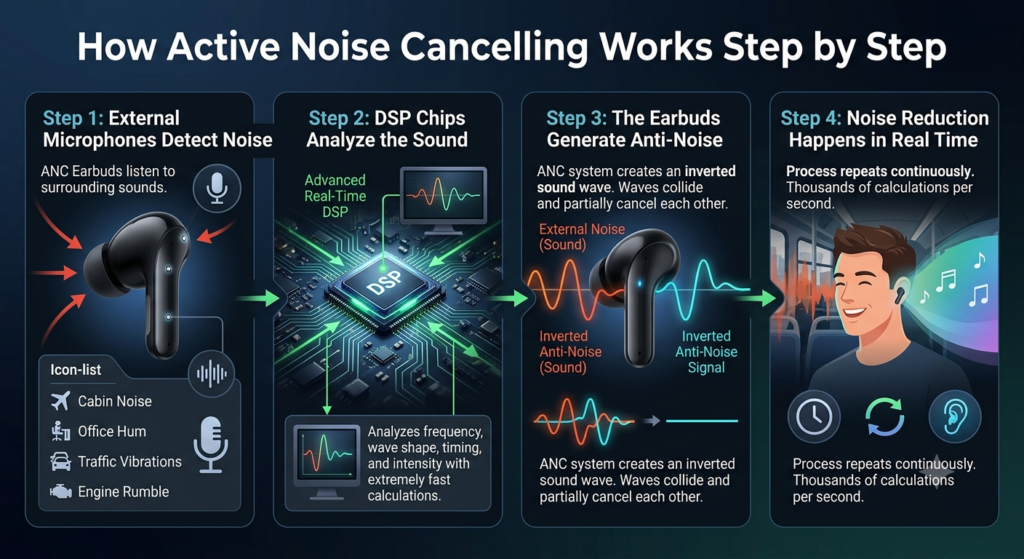
Understanding how active noise cancelling works requires looking at the rapid sequence of acoustic measurements and electronic calculations happening inside each earbud. ANC is not a single filtering action applied when the feature is switched on. It is a continuous feedback process in which microphones monitor the environment, a processor analyzes unwanted sound, and the earbud driver generates a precisely timed anti-noise signal.
A step-by-step active noise cancellation infographic typically illustrates this process in four stages: external microphones detect surrounding noise, a digital signal processor interprets the incoming waveform, the earbuds create an inverted sound signal, and the system continuously adjusts the cancellation response in real time.
Although these stages can be explained separately, they happen almost simultaneously. The entire system operates with extremely low latency because the anti-noise wave must reach the ear canal at nearly the same moment as the environmental sound it is designed to reduce.
Step 1: External Microphones Detect Environmental Noise
The first stage begins with the miniature microphones built into the active noise cancelling earbuds.
These microphones continuously monitor the surrounding acoustic environment while ANC is enabled. Their purpose is to capture unwanted ambient sound before, during or immediately after it enters the earbud’s acoustic space.
In a feedforward ANC system, microphones are positioned on the outer surface of the earbuds. This placement allows them to detect incoming sound before it passes through the ear tips and reaches the ear canal.
The microphones may detect steady background noises such as:
- Aircraft engine rumble
- Airplane cabin ventilation
- Train and bus vibrations
- Road and traffic noise
- Office air-conditioning systems
- Computer fans and mechanical hum
- Low-frequency household appliances
These sounds are particularly suitable for active cancellation because they tend to be continuous and relatively predictable. A stable aircraft-engine frequency, for example, gives the ANC processor repeated acoustic information that can be measured and counteracted.
The microphones do not remove the noise themselves. They convert air-pressure variations into electrical signals that can be examined by the earbud’s processing system.
Microphone placement is therefore critical to ANC performance. A microphone positioned too close to a turbulent airflow may be affected by wind noise. A poorly designed microphone opening may also introduce distortion or fail to capture certain frequencies accurately.
Premium earbuds often use more than one microphone on each side. External microphones detect ambient noise, while internal microphones monitor the sound remaining inside the ear canal. This combination forms the basis of hybrid active noise cancellation.
Why ANC Microphones Must Listen Continuously
The surrounding sound environment is never completely static.
A traveler may move from a quiet airport lounge into a noisy aircraft cabin. A commuter may walk beside traffic, enter a station and then board a train. Even inside one room, voices, ventilation systems and nearby movement can change from moment to moment.
For this reason, ANC microphones cannot capture one sample of noise and continue using the same correction indefinitely. They must listen continuously and send a constantly updated acoustic signal to the processor.
The quality of this microphone data determines how accurately the ANC system can respond. If the microphones capture the noise incorrectly, the processor cannot create an effective opposing waveform.
Modern earbuds may also use wind-detection algorithms to determine when airflow is overwhelming an external microphone. The system can then reduce that microphone’s sensitivity, alter the ANC profile or rely more heavily on internal feedback microphones.
Step 2: The DSP Chip Analyzes the Incoming Sound
Once the microphones detect external noise, the acoustic information is passed to a digital signal processor, commonly known as a DSP.
The DSP chip acts as the computational center of the active noise cancellation system. It converts the microphone signal into digital information and analyzes the characteristics of the incoming sound.
The processor examines factors such as:
- Frequency
- Amplitude
- Waveform shape
- Phase
- Timing
- Sound intensity
- Changes in the acoustic environment
Frequency tells the system how rapidly the sound wave is cycling. Amplitude indicates the strength or loudness of the noise. Phase and timing reveal where the wave is within its cycle and when the opposing signal must be generated.
This analysis must happen almost instantly. If the processor responds too slowly, the external noise may reach the eardrum before the anti-noise signal arrives.
A delayed cancellation signal may also be misaligned with the original sound wave. Instead of reducing the unwanted noise, it could provide little benefit or create unwanted acoustic artifacts.
How DSP Processing Makes ANC Possible
Real environmental noise is much more complicated than a single smooth waveform.
An aircraft cabin contains overlapping engine frequencies, airflow, structural vibration and passenger activity. A busy road may contain tire noise, low engine rumble, horns, voices and rapidly changing wind.
The DSP must separate this mixture into components and determine which parts can be reduced effectively.
It may apply strong cancellation to stable low-frequency noise, moderate correction to selected midrange frequencies and minimal correction to sudden high-frequency sounds that cannot be predicted reliably.
Modern premium earbuds use highly efficient real-time DSP systems capable of processing large amounts of acoustic information while consuming very little battery power.
The DSP may also handle several other audio functions, including:
- Music equalization
- Transparency or ambient mode
- Voice-call processing
- Wind-noise suppression
- Spatial audio
- Ear-detection features
- Personalized hearing profiles
This means the processor must manage active noise cancellation without disrupting the sound the listener actually wants to hear.
More processing power alone does not guarantee stronger ANC. Effective noise reduction also depends on the quality of the algorithms, microphone arrangement, driver response, earbud housing and acoustic tuning.
Step 3: The Earbuds Generate an Anti-Noise Signal
After analyzing the unwanted sound, the ANC processor calculates an opposing waveform known as an anti-noise signal.
Anti-noise is not silence. It is an electronically generated sound wave designed to oppose the pressure pattern of the environmental noise.
If the original sound wave produces an upward pressure peak, the ANC system attempts to produce a corresponding downward pressure valley. When the external wave moves downward, the anti-noise signal moves upward.
In acoustic terms, the generated waveform is approximately 180 degrees out of phase with the unwanted noise.
The earbud driver then plays this anti-noise waveform into the ear canal alongside the listener’s music, podcast or call audio.
When the original noise wave and the inverted anti-noise wave meet, their opposing pressure patterns partially cancel one another. This physical effect is known as destructive interference.
The result is a lower-amplitude sound wave reaching the eardrum, causing the unwanted environmental noise to be perceived as quieter.
Why the Anti-Noise Signal Must Be Precise
For cancellation to work effectively, the anti-noise wave must closely match the original noise in three important ways.
It must have the correct frequency, so its cycles correspond with the incoming sound. It must have an appropriate amplitude, so its pressure changes are strong enough to counteract the noise. It must also arrive at precisely the right time, with its peaks aligned against the original wave’s valleys.
If any of these elements are inaccurate, the cancellation will be incomplete.
An anti-noise signal with insufficient amplitude may leave much of the original sound audible. A signal that is too strong may introduce unwanted pressure or alter the earbud’s sound signature. Incorrect timing may prevent the two waves from opposing each other effectively.
The system must therefore generate a different anti-noise response for every changing combination of frequencies and intensities in the environment.
What Happens When the Waves Meet?
When the external noise and anti-noise signal occupy the same acoustic space, their amplitudes combine.
If the two waves are correctly aligned in opposite phase, one wave’s positive pressure peak meets the other wave’s negative pressure valley. The combined pressure moves closer to the neutral center line.
This does not eliminate the original sound throughout the surrounding environment. The noise still exists outside the earbuds. The cancellation effect is concentrated near the listener’s ear, where the original sound and anti-noise waveform interact.
ANC is therefore best understood as localized electronic noise reduction rather than the complete removal of sound.
Step 4: Noise Reduction Happens Continuously in Real Time
The final stage is not a single event. It is the continuous repetition of the entire ANC cycle.
While the earbuds are being worn, the microphones continue detecting environmental sound. The DSP continues analyzing the incoming waveform. The drivers continue producing updated anti-noise signals.
This process occurs thousands of times per second, with the system constantly correcting its response as conditions change.
If a train accelerates, the frequency and intensity of the mechanical noise may change. If the listener adjusts an earbud, the ear-tip seal and internal acoustic pressure may change. If wind begins passing over the microphones, the system may need to modify its noise-cancellation strategy.
A capable adaptive ANC system responds to these changes automatically.
Instead of applying one fixed cancellation profile, adaptive noise cancellation evaluates the current environment and adjusts the strength, frequency response or microphone configuration of the ANC system.
How Feedback Microphones Improve Real-Time ANC
Advanced earbuds often include microphones inside the earbud, close to the ear canal. These are known as feedback microphones.
An internal microphone measures the actual sound remaining after the first cancellation signal has been applied. It can detect whether environmental noise is still reaching the listener or whether the generated anti-noise signal requires adjustment.
The DSP then uses this information to refine its next response.
This creates a closed feedback loop:
The system detects incoming sound, generates anti-noise, measures the result and corrects any remaining error.
Feedback ANC can compensate for variations in ear shape, ear-tip size and earbud positioning. However, because the microphone detects sound after it has entered the earbud, the processor has less time to respond.
This is why many premium models use hybrid ANC, combining external feedforward microphones with internal feedback microphones.
How Hybrid ANC Completes the Process
Hybrid ANC earbuds use both microphone positions to achieve broader and more consistent noise reduction.
External microphones detect the noise before it reaches the ear canal, giving the processor time to prepare a cancellation signal. Internal microphones measure what remains near the eardrum and correct inaccuracies.
The external and internal microphone signals are analyzed together, allowing the system to respond to both the surrounding environment and the listener’s individual fit.
This is particularly useful when the earbud shifts during movement, when the seal changes or when different frequencies enter through the ear-tip opening and earbud housing.
Hybrid ANC is more complex to engineer because the processor must prevent the different microphones and correction signals from interfering with one another. When tuned properly, however, it can reduce a wider range of environmental noise than a simpler single-microphone system.
Why Some Sounds Remain Audible
Even when all four ANC stages operate correctly, active noise cancellation cannot remove every external sound.
Continuous low-frequency noise is comparatively easy to analyze and counteract. Sudden sounds, nearby speech and high-frequency noises change too rapidly for perfect real-time cancellation.
By the time the microphones detect a sharp sound and the processor calculates the required response, part of the noise may already have reached the ear.
Higher-frequency wavelengths are also shorter, making them extremely sensitive to small timing errors and changes in earbud position.
For these sounds, passive noise isolation becomes especially important. The silicone or foam ear tips physically block part of the incoming sound before the ANC electronics need to respond.
The strongest noise cancelling earbuds therefore combine a secure acoustic seal with advanced electronic cancellation.
What the Listener Actually Experiences
The listener does not hear each stage of the ANC process independently. Instead, the combined effect is perceived as a quieter, more controlled acoustic environment.
Aircraft rumble may fade into the background. Air-conditioning noise may become significantly less noticeable. Road and train vibrations may lose much of their low-frequency energy.
Nearby conversations and sudden sounds may remain audible, but they can feel less prominent when passive isolation and ANC work together.
By lowering the background noise floor, active noise cancellation allows music, spoken audio and calls to remain clearer without requiring the listener to raise the volume as aggressively.
The Complete ANC Cycle
The entire active noise cancellation process can be summarized as a continuous acoustic control loop.
External and internal microphones capture environmental sound. The DSP analyzes its frequency, amplitude, timing and phase. The earbud driver produces an inverted anti-noise waveform. Destructive interference reduces the amplitude of the noise reaching the eardrum. The microphones then measure the changing environment and repeat the calculation.
This continuous interaction between ANC microphones, digital signal processing, anti-noise generation and real-time acoustic correction is what makes modern noise cancelling earbuds effective.
The best ANC systems are not simply the ones that generate the strongest opposing wave. They are the systems that detect noise accurately, respond with minimal latency, preserve sound quality and adapt smoothly as the listening environment changes.
ANC Sound Wave Visualization
The original sound wave is matched with an inverted wave:
How ANC Sound Waves Cancel Noise
Active Noise Cancellation works by generating an inverted sound wave called anti-noise. When the original sound wave and the anti-noise wave combine, they cancel through destructive interference, dramatically reducing external sound before it reaches your ears.
Destructive Interference
The two opposite sound waves neutralize each other, reducing unwanted background noise such as airplane engines, train vibrations, traffic hum, and HVAC systems.
When combined, the waves cancel through destructive interference.
Feedforward vs Feedback ANC
| ANC Type | How It Works | Advantages | Weaknesses |
|---|---|---|---|
| Feedforward ANC | External microphones outside earbuds | Detects noise early | Sensitive to wind |
| Feedback ANC | Internal microphones inside ear canal | More accurate correction | Smaller cancellation range |
| Hybrid ANC | Combines both systems | Best overall performance | Higher cost |
What Is Hybrid ANC?
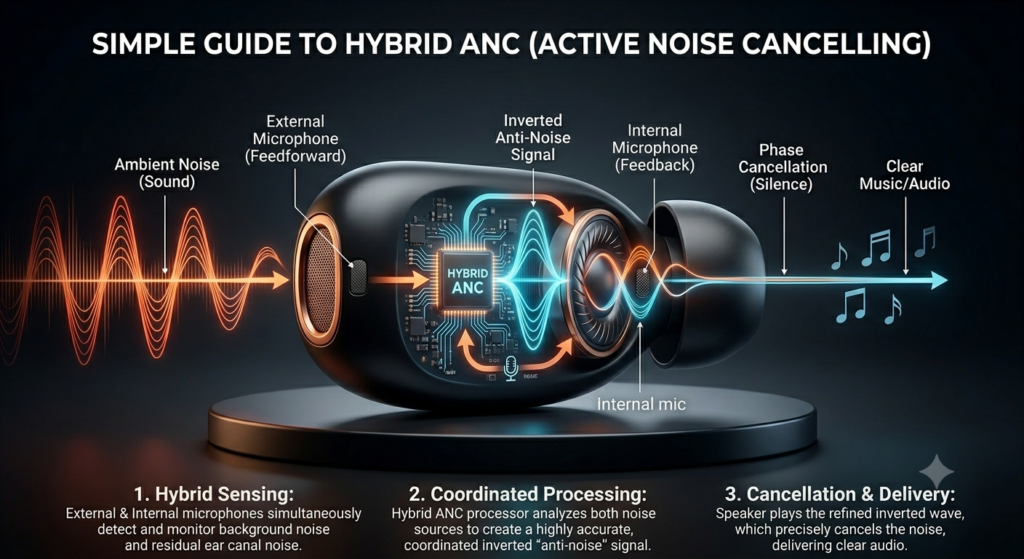
Hybrid ANC combines:
- External microphones
- Internal microphones
- Passive noise isolation
This creates stronger and more adaptive cancellation.
Most premium active noise cancelling earbuds now use hybrid ANC because it performs better across:
- Flights
- Offices
- Public transit
- Windy outdoor environments
Why ANC Works Better for Low Frequencies
ANC performs best against predictable low-frequency sounds like:
- Airplane engines
- AC systems
- Train vibrations
- Bus hum
Low-frequency noise is easier to analyze and invert electronically.
Why ANC Struggles With Voices
Human speech changes rapidly.
Voices contain:
- Variable frequencies
- Sudden timing changes
- Complex harmonics
Because of this, ANC alone cannot fully remove conversations.
That is why passive isolation still matters heavily.
Learn more here Passive vs Active Noise Cancellation
ANC vs Passive Noise Isolation
| Feature | Active Noise Cancellation | Passive Isolation |
|---|---|---|
| Uses Electronics | Yes | No |
| Uses Microphones | Yes | No |
| Best Against | Low-frequency hum | Voices & sharp sounds |
| Battery Usage | Higher | Minimal |
| Cost | Higher | Lower |
| Airplane Performance | Excellent | Moderate |
| Sleep Comfort | Moderate | Excellent |
Transparency Mode Explained
Most modern ANC earbuds include Transparency Mode.
Instead of blocking sound, transparency mode:
- Amplifies outside audio
- Improves environmental awareness
- Helps during conversations
- Improves safety outdoors
Advanced transparency systems now sound increasingly natural.
Adaptive ANC Technology
Adaptive ANC automatically changes noise cancellation levels based on surroundings.
Modern systems can detect:
- Airplanes
- Offices
- Wind
- Traffic
- Crowded public spaces
AI-driven ANC continuously adjusts performance without manual input.
Benefits of Active Noise Cancelling Earbuds
The main benefit of active noise cancelling earbuds is not simply that they make the surroundings feel quieter. A well-designed ANC system can change how comfortably and clearly audio is heard in noisy environments by reducing the amount of external sound competing with music, speech and other content.
This can be valuable during travel, focused work, study sessions and everyday commuting. By lowering persistent background noise, ANC earbuds can make listening feel less demanding and reduce the need to overpower the environment with higher playback volume.
The practical benefits depend on the quality of the noise cancellation, the fit of the ear tips and the type of sound being reduced. ANC is usually strongest against steady low-frequency noise such as engines, ventilation systems and road rumble, while passive isolation contributes more heavily to reducing voices and sharper sounds.
Better Focus During Work and Study
One of the most common reasons people buy noise cancelling earbuds for work or studying is to reduce environmental distractions.
Open-plan offices, shared homes, libraries, cafés and university spaces often contain continuous background activity. Air conditioners, computer fans, traffic, distant conversations and repeated movement can compete for attention even when none of those sounds is individually loud.
ANC reduces the acoustic presence of many persistent noises, creating a more controlled listening environment. This can make it easier to concentrate on reading, writing, research, coding or other tasks that require sustained attention.
The effect is especially useful when paired with instrumental music, white noise, brown noise or low-volume ambient audio. Because the surrounding environment is less prominent, the listener may not need to play masking sounds as loudly.
ANC does not guarantee better concentration, and it cannot completely remove nearby speech or sudden interruptions. However, it can reduce the number and intensity of background sounds competing for the listener’s attention.
For remote workers, the best ANC earbuds also include clear call microphones, multipoint Bluetooth and an effective transparency mode. These features allow users to move between focused work, online meetings and brief conversations without repeatedly removing the earbuds.
Less Need to Raise Listening Volume
In noisy environments, listeners often increase the volume to make music, podcasts or dialogue easier to hear. The audio must compete with aircraft noise, road rumble, public transport or workplace activity.
Active noise cancellation can reduce this competition, allowing content to remain clear at a lower playback level than might otherwise be needed.
This does not mean ANC earbuds automatically make listening safe. Hearing risk still depends on the actual volume, listening duration and individual sensitivity. However, reducing external noise may help users avoid repeatedly turning the volume up merely to overpower the environment.
The benefit is particularly noticeable with spoken content. Podcasts, audiobooks and video dialogue contain quieter details that can be masked by low-frequency background sound. When ANC reduces that noise, speech can become easier to understand without aggressive volume increases.
A secure ear-tip seal improves this effect. Passive isolation blocks some external sound physically, while ANC electronically reduces the low-frequency noise that remains. Together, these systems can create a clearer listening environment at more moderate playback levels.
Improved Comfort During Flights and Long Commutes
Frequent travelers are among the users who benefit most from active noise cancelling wireless earbuds.
Aircraft cabins produce continuous low-frequency engine and airflow noise. Trains, buses and cars create similar mechanical rumble and vibration. These sounds may not always seem painfully loud, but prolonged exposure can make listening feel tiring and mentally demanding.
ANC is particularly effective against this type of steady, predictable noise. By reducing the low-frequency background sound, noise cancelling earbuds can make flights and long commutes feel calmer.
Travelers may find it easier to hear movies, music and announcements without raising the volume as much. Even when no audio is playing, some users wear ANC earbuds simply to soften the constant cabin rumble.
Comfort still depends on more than cancellation strength. For long journeys, ear-tip pressure, earbud weight, battery life and ventilation matter just as much. Strong ANC is less useful if the earbuds become uncomfortable after an hour.
The best ANC earbuds for travel combine effective low-frequency noise reduction with a stable fit, long battery life and an accessible transparency mode for boarding announcements and conversations.
Greater Audio Detail and Immersion
Environmental noise can mask parts of a recording, especially quiet details and low-level textures.
Bass notes, room ambience, subtle instruments and soft dialogue may become difficult to hear when they compete with traffic, ventilation or crowd noise. Listeners may perceive this as a limitation of the earbuds when the real problem is acoustic masking from the environment.
By lowering the surrounding noise floor, ANC earbuds can improve perceived audio detail and immersion.
Music may feel fuller because bass is no longer competing as strongly with engine rumble. Podcasts and audiobooks may sound clearer because speech is not being masked by continuous background noise. Movies and games can feel more engaging because quieter effects become easier to hear.
ANC does not improve the quality of the original recording or increase the technical capability of the earbud driver. Instead, it creates conditions in which more of the existing audio can be perceived.
This distinction is important for audiophiles. Strong noise reduction can make music sound more detailed, but poorly tuned ANC may also alter bass response, tonal balance or perceived soundstage. The best sound-focused ANC earbuds maintain a consistent tuning whether noise cancellation is on or off.
Reduced Listening Fatigue
Constant background noise can become tiring over time, even when the listener is not consciously paying attention to it.
Aircraft engines, office ventilation, road noise and crowded environments create a continuous stream of acoustic information. The brain must repeatedly separate relevant sound from irrelevant sound, particularly when the listener is trying to follow speech or focus on detailed audio.
Reducing this background noise can make listening feel less effortful.
During a long flight, for example, the listener no longer has to mentally separate a podcast voice from the persistent cabin rumble. In an office, music does not need to compete as heavily with ventilation and distant conversations. Over several hours, this may contribute to a calmer and less fatiguing listening experience.
This benefit should not be interpreted as a medical treatment for stress, sensory sensitivity or fatigue. ANC is an environmental audio tool. Its role is to reduce some of the external sound that makes listening and concentration more demanding.
Clearer Podcasts, Audiobooks and Video Dialogue
Noise cancellation is often discussed in relation to music, but spoken-word content may benefit even more.
Human speech contains both strong and subtle frequency components. Background rumble can mask lower-frequency vocal information, while nearby conversations and environmental noise can make individual words harder to distinguish.
ANC reduces the steady noise beneath the speech signal, which can make podcasts, audiobooks, lectures and video dialogue easier to follow.
This can be particularly useful for commuters and travelers, who often listen in environments where the surrounding sound changes continuously. Instead of repeatedly adjusting the volume, listeners can allow the ANC system to reduce much of the persistent noise.
Earbuds with adaptive ANC may provide an additional advantage by changing the cancellation level as the user moves between a quiet room, a busy street and public transport.
A More Consistent Listening Experience
Without ANC, the perceived sound of earbuds can change dramatically according to the environment.
A pair of earbuds may sound balanced and detailed at home but thin or unclear on a train because low-frequency external noise masks the bass and quieter parts of the recording.
Active noise cancellation helps stabilize the listening environment. By reducing external sound, it allows the earbud’s tuning to remain more perceptible across different locations.
This creates a more consistent experience when moving between home, work, airports and public transport.
Adaptive and hybrid ANC systems strengthen this benefit by adjusting their response according to changes in background noise, earbud position and ear-tip seal.
Better Use of Quiet Audio Content
Some forms of content are naturally quieter or more dynamic than modern compressed music.
Classical recordings, film scores, acoustic performances, meditation audio and cinematic soundtracks may move between very quiet and very loud passages. In a noisy environment, subtle sections can disappear almost completely.
ANC makes these low-level passages easier to hear without requiring the user to increase the volume for the entire recording.
This preserves more of the intended dynamic contrast and can create a more natural listening experience.
Greater Privacy Without Extreme Volume
ANC does not provide complete audio privacy, but it can reduce the need to play content loudly enough to dominate the environment.
When background noise is lowered, the listener can often hear speech and music clearly at a more moderate level. This may reduce sound leakage from the earbuds, particularly in quiet offices, libraries and shared transport.
Actual leakage depends on the earbud design, ear-tip seal and playback volume, but ANC can indirectly support more private listening by making excessive volume less necessary.
Flexible Control Over Environmental Awareness
Modern ANC earbuds usually include several listening modes rather than one fixed noise-cancelling setting.
Users may switch between maximum ANC, adaptive noise cancellation, standard listening and transparency mode. This gives them more control over how much of the environment remains audible.
Strong ANC may be appropriate during a flight or focused work session. A moderate setting may feel more comfortable in a quiet office. Transparency mode is better suited to walking outdoors, listening for announcements or speaking with another person.
This flexibility makes ANC earbuds more practical across different daily situations.
Potential Benefits for Calls and Online Meetings
Active noise cancellation primarily affects what the wearer hears. It does not automatically improve the voice heard by the person on the other end of a call.
However, reducing environmental noise in the listener’s ears can make incoming speech easier to understand during online meetings and phone calls.
Some premium earbuds combine ANC with separate voice-isolation and call-noise-reduction systems. These technologies use additional microphones and processing to reduce background sound captured by the call microphone.
Buyers should distinguish between ANC for listening and microphone noise cancellation for calls. They are related but separate functions.
For remote work, the most capable earbuds perform both tasks well: they reduce the noise heard by the user while also transmitting a clear voice to other participants.
When the Benefits of ANC Are Most Noticeable
The benefits of active noise cancelling earbuds are strongest in environments dominated by continuous sound.
Flights, trains, buses, office ventilation, appliances and road noise give the ANC system relatively predictable wave patterns to analyze and counteract.
The improvement may be less dramatic in environments dominated by sudden voices, alarms, clattering objects or rapidly changing high-frequency sounds. These noises are more difficult to cancel electronically and depend more heavily on passive ear-tip isolation.
ANC should therefore be evaluated according to the user’s real environment rather than the expectation of complete silence.
The Combined Benefit of ANC and Passive Isolation
The strongest overall noise reduction comes from combining active noise cancellation with a secure physical seal.
ANC is highly effective against continuous low-frequency sound. Passive isolation blocks a broader range of mid- and high-frequency noise through the ear tips and earbud housing.
When both systems work properly, the listener experiences a quieter background, clearer audio and less need to compete with the surrounding environment.
This combination explains why correct ear-tip sizing remains essential even in advanced AI-powered or hybrid ANC earbuds. Sophisticated processing cannot fully compensate for a poor acoustic seal.
Why Active Noise Cancellation Is More Than a Convenience Feature
For many users, ANC begins as a premium feature but becomes part of the everyday listening experience.
It can improve concentration in busy environments, make long journeys more comfortable and reveal audio details that would otherwise be masked. It may also help reduce the urge to raise playback volume in noisy places, although responsible volume control remains necessary.
The most meaningful benefit is greater control over the acoustic environment.
Rather than forcing music or speech to overpower the world outside, active noise cancelling earbuds reduce the background noise first. This allows the desired audio to remain clearer, more comfortable and more consistent across work, study, travel and everyday listening.
Risks and Limitations of ANC
Ear Pressure Sensation
Some users experience:
- Pressure feeling
- Mild dizziness
- Fatigue
This is more common with aggressive ANC systems.
Battery Dependence
ANC requires continuous power for:
- Microphones
- DSP chips
- Signal processing
Battery life decreases when ANC is enabled.
Wind Interference
Strong outdoor wind can interfere with microphones.
Newer ANC systems now use advanced wind reduction algorithms.
Costs of Active Noise Cancelling Earbuds
| Earbud Category | Typical Price |
|---|---|
| Basic ANC Earbuds | $50–$100 |
| Mid-Range Hybrid ANC | $100–$180 |
| Premium Flagship ANC | $180–$350 |
Higher-end ANC earbuds typically include:
- Better microphones
- Stronger DSP processors
- Smarter adaptive ANC
- Better transparency modes
- Improved battery efficiency
Trends & Latest Active Noise Cancellation Technology
AI-Powered ANC
Machine learning is becoming central to modern ANC systems.
AI now helps:
- Detect environments
- Reduce wind noise
- Personalize cancellation
- Improve voice isolation
Spatial Audio + ANC
Premium earbuds now combine:
- Immersive 3D audio
- Head tracking
- Adaptive ANC
This creates more cinematic listening experiences.
Personalized Hearing Profiles
New ANC systems analyze:
- Ear canal shape
- Hearing sensitivity
- Fit quality
The earbuds then optimize cancellation accordingly.
Upcoming ANC Earbuds and Future Technology
Future ANC earbuds are expected to feature:
- Real-time AI sound mapping
- Smarter environmental prediction
- Ultra-low-power ANC chips
- Better transparency realism
- Improved sleep ANC modes
- Multi-device adaptive tuning
Industry trends suggest ANC will become standard even in affordable earbuds.
Real-World ANC Performance Examples
| Environment | ANC Effectiveness |
|---|---|
| Airplane cabin | Excellent |
| Train commute | Excellent |
| Office HVAC hum | Very Good |
| Coffee shop chatter | Moderate |
| Human conversations | Partial |
| Windy outdoors | Depends on earbuds |
Are Active Noise Cancelling Earbuds Worth It?
For many users, absolutely.
ANC earbuds provide:
- Better concentration
- Improved travel comfort
- Enhanced immersion
- Lower listening fatigue
However, casual listeners may still prefer simpler passive isolation earbuds.
Related reading: Are Noise Cancelling Earbuds Worth It?
Best Use Cases for ANC Earbuds
The value of active noise cancelling earbuds depends heavily on the environment in which they are used. ANC is most effective when the surrounding noise is continuous, repetitive and concentrated in the lower frequencies. Aircraft engines, train movement, ventilation systems and road rumble are therefore much easier to suppress than sudden voices, alarms or sharp impact sounds.
This makes ANC particularly useful for travelers, commuters, remote workers and students who regularly spend time in acoustically demanding environments. In these situations, noise cancellation can reduce the background sound competing with music, speech and concentration.
The best use case is not necessarily the setting with the loudest noise. It is the environment where the sound is predictable enough for the microphones and digital signal processor to analyze and counteract accurately.
Best ANC Earbuds for Flights
Flights are one of the strongest use cases for active noise cancelling earbuds.
Aircraft cabins contain a persistent mixture of engine rumble, airflow, ventilation noise and structural vibration. Much of this sound sits in the low-frequency range where ANC technology performs most effectively.
External microphones detect the steady cabin noise, while the processor generates an opposing anti-noise signal. Because the engine and ventilation sounds remain relatively consistent during cruising, the ANC system can repeatedly measure and reduce them with a high degree of accuracy.
The result is not complete silence, but a substantial reduction in the low-frequency background that dominates the cabin.
This can make movies, music, podcasts and audiobooks easier to hear without pushing the playback volume as high. Travelers may also find that the cabin feels less acoustically exhausting during long-haul flights.
Some passengers use ANC earbuds without playing any audio at all. Simply activating noise cancellation can soften the continuous mechanical rumble and create a calmer personal sound environment.
The best noise cancelling earbuds for flights should offer more than strong maximum ANC. Long-term comfort is essential because even lightweight earbuds can become uncomfortable during several hours of continuous use. Battery life with ANC switched on, pressure sensation, ear-tip stability and fast access to transparency mode should also be considered.
Transparency mode is particularly important in airports and aircraft cabins. Travelers need to hear boarding announcements, safety instructions and conversations with cabin staff without repeatedly removing their earbuds.
For international travel, a charging case with enough reserve power to support several full recharges can be more practical than a slightly stronger ANC system with limited battery endurance.
Best ANC Earbuds for Public Transit
Subways, trains, buses and commuter vehicles produce exactly the type of noise that ANC is designed to reduce.
Train wheels create sustained low-frequency vibration. Subway tunnels add mechanical rumble and reflected sound. Buses generate engine noise, road vibration and ventilation hum. Even inside a car, tire noise and steady road sound can mask speech and music.
Noise cancelling earbuds for commuting can reduce much of this persistent acoustic energy, making the journey feel less overwhelming.
The improvement is often most noticeable with spoken content. Podcasts, audiobooks and video dialogue can become difficult to follow when they compete with train or road noise. ANC lowers the background noise floor, allowing voices to remain clearer at a more comfortable volume.
Adaptive ANC is especially useful for commuters because public-transit environments change rapidly. A listener may walk along a windy street, enter a crowded station, board a quiet carriage and then move into a noisy tunnel.
An adaptive system can modify its cancellation response based on these changes rather than applying one fixed level throughout the journey.
Commuters should also consider wind-noise control. External ANC microphones can be disrupted by airflow while walking, cycling or standing near open platforms. Poor wind management may create buffeting or low-frequency interference that is more distracting than the original sound.
The strongest commuter earbuds combine stable ANC with secure fit, effective wind suppression and a transparency mode that makes platform announcements and nearby traffic easier to hear.
See the Best Earbuds for Travel and Work
Readers comparing earbuds for airports, commuting, offices and hybrid work can explore the Best Earbuds for Travel & Work → for models selected around noise cancellation, comfort, call quality, battery life and everyday portability.
This supporting guide should focus on the complete travel-and-productivity experience rather than ranking earbuds by ANC strength alone. The best model for a long flight may not be the best option for work calls, and the strongest office earbud may not provide enough battery life for international travel.
Best ANC Earbuds for Remote Work
Active noise cancellation can be valuable for remote workers who do not have complete control over their working environment.
Household appliances, traffic, air conditioners, nearby conversations and repeated movement can make sustained concentration difficult. In shared homes, coworking spaces and open-plan offices, these sounds may remain present throughout the working day.
ANC earbuds for remote work reduce the acoustic prominence of many continuous background noises. Air-conditioning hum, computer fans and distant road noise can become much less noticeable, allowing the user to focus more easily on writing, analysis, design, coding or administrative work.
ANC is not equally effective against every office distraction. Nearby voices and keyboard sounds contain mid- and high-frequency information that changes rapidly. These sounds may remain audible even with maximum noise cancellation enabled.
A secure ear-tip seal helps compensate for this limitation. Passive noise isolation blocks some voices and sharper sounds physically, while ANC reduces the steady low-frequency noise underneath them.
For remote workers, listening ANC is only one part of the buying decision. Call quality is equally important.
Standard ANC reduces the noise heard by the wearer. It does not necessarily remove the same background sound from the voice transmitted during a call. Clear online meetings require separate microphone noise reduction, voice-isolation algorithms and effective beamforming.
The best earbuds for remote work therefore need to perform two different tasks: create a quieter environment for the wearer and transmit a clear voice to colleagues or clients.
Multipoint Bluetooth is another important feature because it allows the earbuds to remain connected to a laptop and smartphone simultaneously. Users can move from a video meeting to a phone call without manually disconnecting and pairing devices.
Transparency mode, sidetone and long-term comfort also matter. Workers often need to hear their own voice naturally during calls, respond to someone nearby or wear the earbuds for several hours without excessive pressure.
ANC Earbuds for Open-Plan Offices
Open-plan offices create a different challenge from working at home.
The background may include ventilation, footsteps, printer noise, distant meetings and many overlapping conversations. ANC can reduce the continuous mechanical layer, but it will not completely remove speech.
This is why noise cancelling earbuds for office work should be evaluated as a combination of ANC, passive isolation and sound masking.
A strong ear-tip seal can soften nearby voices. ANC can lower air-conditioning and building noise. Low-volume instrumental music, brown noise or ambient audio can then mask what remains.
Used together, these tools create a more controlled workspace than ANC alone.
Office users should avoid becoming completely unaware of their surroundings. Adjustable ANC and a natural transparency mode make it easier to remain available when necessary without removing the earbuds every few minutes.
Best ANC Earbuds for Study Sessions
Students studying in libraries, dormitories, cafés or shared homes may benefit from noise cancelling earbuds for studying.
Concentration is often disrupted not by one extremely loud sound, but by a constant sequence of minor distractions. Nearby conversations, moving chairs, ventilation systems, traffic and repeated footsteps can repeatedly pull attention away from reading or revision.
ANC reduces the continuous portion of this environmental noise. Air conditioners, distant road sound and building hum can become less prominent, creating a calmer setting for study.
The effect may be especially useful during tasks requiring extended concentration, such as academic reading, exam preparation, writing or online coursework.
Noise cancellation can also improve the clarity of recorded lectures and educational videos. When persistent background sound is reduced, speech becomes easier to understand without increasing the volume as aggressively.
Students should not expect ANC to eliminate every nearby conversation. Human speech is variable and contains many higher-frequency components that are difficult to cancel electronically.
Foam or well-fitted silicone ear tips can improve passive isolation, while quiet instrumental audio or neutral masking noise can help cover the remaining voices.
For long study sessions, comfort becomes more important than maximum ANC strength. An aggressively sealed earbud may offer impressive isolation but become distracting after several hours.
Lightweight construction, multiple ear-tip sizes, pressure-relief vents and adjustable cancellation levels can provide a more sustainable study experience.
Best ANC Earbuds for Libraries and Cafés
Libraries are quieter than aircraft or trains, but they contain irregular sounds that may be especially distracting in an otherwise silent environment.
Page turning, chair movement, whispers and keyboard clicks can repeatedly interrupt concentration. ANC may have a limited effect on these sharp sounds, but it can reduce ventilation and distant ambient noise.
Cafés present the opposite challenge. They combine conversations, music, coffee equipment, dishes and street noise into a complex acoustic environment.
In cafés, strong passive isolation may be just as important as electronic noise cancellation. ANC reduces the low-frequency room and traffic noise, while the physical ear-tip seal softens voices and clattering sounds.
Adaptive ANC can be useful in both settings because it allows the earbuds to apply only as much cancellation as necessary. Maximum ANC may feel excessive in a quiet library, while stronger cancellation may be appropriate in a busy café.
Best ANC Earbuds for Focused Creative Work
Writers, designers, developers, video editors and other creative professionals often need long periods of uninterrupted concentration.
Repeated background noise can interfere with tasks that depend on working memory, language processing or close attention to detail. ANC earbuds can help create a more consistent acoustic environment when a private office is unavailable.
For creative work, the quality of the audio reproduction may matter as much as noise reduction. Poorly tuned ANC can alter bass, tonal balance or soundstage, which may be distracting during music-focused tasks or audio editing.
Professionals should look for earbuds that maintain a similar sound signature across ANC, transparency and standard modes. Adjustable equalization and the ability to reduce rather than maximize ANC can also create a more natural working environment.
Best ANC Earbuds for Long-Distance Train and Bus Travel
Long-distance rail and bus journeys combine several ANC-friendly sounds: engine rumble, air conditioning, vibration and consistent road or track noise.
These environments may be less intense than an aircraft cabin, but the exposure can last for many hours. The cumulative effect can make audio listening feel tiring.
ANC reduces the mechanical background and allows entertainment to remain clearer throughout the journey.
Battery life becomes particularly important on overnight buses and extended rail routes. Users should compare the advertised battery duration with ANC enabled rather than relying on the maximum figure, which may be measured with noise cancellation switched off.
A compact charging case, fast charging and comfortable ear tips can be more valuable during long journeys than small differences in maximum cancellation strength.
Best ANC Earbuds for Everyday Commuting
Daily commuters may gain more total value from ANC than occasional travelers because they use the feature repeatedly.
A thirty-minute journey twice a day can add up to hundreds of hours of exposure to traffic, trains and public spaces over a year. Reliable noise cancellation can make these routines feel calmer and allow audio to remain intelligible without constant volume adjustments.
The best everyday commuting earbuds should be easy to remove, secure enough for walking and quick to switch into transparency mode.
Touch controls must also be dependable. Commuters often need to pause audio, hear an announcement or speak to someone without opening a companion app.
When ANC Is Less Useful
Active noise cancellation is not equally valuable in every environment.
It may provide only a modest improvement in a quiet room where little low-frequency noise exists. It is also less effective against nearby voices, alarms, sudden impacts and other rapidly changing sounds.
Outdoor runners and cyclists should use strong ANC cautiously because reducing environmental awareness can make vehicles and other hazards harder to detect.
In these settings, transparency mode or reduced ANC may be more appropriate than maximum cancellation.
ANC can also produce a pressure-like sensation for some listeners. This is not actual cabin-pressure change, but the removal of low-frequency sound can create an unfamiliar sensory effect. Adjustable ANC levels can make the experience more comfortable.
Choosing ANC Earbuds for the Environment
The best ANC earbuds should be selected according to the sound environment they will encounter most often.
Frequent flyers need strong low-frequency cancellation, long battery life and lasting comfort. Commuters benefit from adaptive ANC, wind control and quick transparency access. Remote workers need call quality, multipoint connectivity and comfortable all-day wear. Students should prioritize fit, moderate pricing and comfort during extended study sessions.
A model with the strongest measured ANC is not automatically the best choice for every user.
The most practical earbuds combine effective noise reduction with passive isolation, stable connectivity, comfortable ear tips and controls that make it easy to move between isolation and environmental awareness.
Where Active Noise Cancellation Delivers the Most Value
ANC delivers its greatest benefit when the environment contains persistent sound that would otherwise compete with listening or concentration.
Flights, public transit, remote work and study spaces each present different acoustic challenges, but they share one feature: background sound that remains present long enough to become distracting or tiring.
By reducing that continuous noise, active noise cancelling earbuds can create a quieter listening space, improve the clarity of speech and music, and make extended travel or focused work more comfortable.
The technology is most effective when it is matched to the right environment and supported by a secure ear-tip seal. ANC should therefore be viewed not as a universal silence switch, but as a specialized tool for controlling the types of noise people encounter repeatedly during travel, work and study.
Frequently Asked Questions
These active noise cancellation FAQs answer the questions readers most commonly ask when researching ANC earbuds, hybrid noise cancellation, adaptive ANC technology, passive noise isolation and noise cancelling earbuds for travel, work and everyday listening.
ANC Effectiveness by Noise Type
| Environmental sound | Typical ANC effectiveness | Why ANC performs this way |
|---|---|---|
| Aircraft engine rumble | Very strong █████ | Continuous low-frequency sound is comparatively predictable |
| Train and subway vibration | Very strong █████ | Repetitive mechanical noise gives the processor time to respond |
| Bus and road noise | Strong ████░ | ANC can reduce engine and tire rumble, although conditions change |
| Air-conditioning hum | Strong ████░ | Stable fan and ventilation frequencies suit active cancellation |
| Office background noise | Moderate ███░░ | Mechanical hum is reduced more effectively than speech |
| Nearby conversation | Limited to moderate ██░░░ | Speech changes rapidly and contains complex mid- and high frequencies |
| Keyboard clicks and clattering | Limited █░░░░ | Short, sudden sounds are difficult to counter before they reach the ear |
| Alarms and sharp impact sounds | Limited █░░░░ | These sounds are intentionally noticeable and change too quickly |
ANC performance varies by product, ear-tip seal, microphone arrangement and environment. Noise cancelling earbuds are generally most effective against steady engine, ventilation and transportation noise, while passive isolation contributes more to blocking speech and sharp sounds.
Active Noise Cancellation Technology Comparison
| ANC technology | Microphone arrangement | Main advantage | Principal limitation |
|---|---|---|---|
| Feedforward ANC | Microphone outside the earbud | Detects noise before it enters the ear | More exposed to wind and fit-related variation |
| Feedback ANC | Microphone inside the earbud | Measures residual sound close to the ear | Has less time to correct incoming noise |
| Hybrid ANC | External and internal microphones | Broader, more accurate noise reduction | Requires more complex processing and tuning |
| Adaptive ANC | Sensors and algorithms adjust ANC strength | Responds to changing environments and fit | Performance depends heavily on software quality |
| AI-powered ANC | Uses environmental or fit classification | Can personalize ANC parameters automatically | “AI ANC” may describe very different capabilities between brands |
Feedforward, feedback and hybrid ANC describe microphone architecture. Adaptive and AI-powered ANC describe how the system modifies its response as wearing conditions, noise leakage or the surrounding environment changes.
How does active noise cancelling actually work?
Active noise cancellation works by using microphones to detect external noise and a digital processor to generate a corresponding anti-noise signal. The earbud driver plays this opposing waveform near the ear, where it reduces the amplitude of the unwanted sound through destructive interference.
This process is continuous rather than one-time. The microphones keep measuring the environment while the processor updates the cancellation signal as the noise changes.
Why does ANC work best on airplanes?
ANC works especially well on airplanes because aircraft cabins contain persistent low-frequency engine rumble, airflow and ventilation noise. These sounds remain relatively stable, making them easier for the ANC processor to analyze and counteract than rapidly changing voices or sharp impact sounds.
Noise cancelling earbuds can therefore make cabin noise substantially less prominent, although they will not completely eliminate announcements, conversations or sudden sounds.
Does ANC remove all external sound?
No. ANC reduces unwanted noise but does not create complete silence. It performs best against continuous low-frequency sounds such as engines, road rumble, fans and air-conditioning systems.
Nearby speech, alarms, keyboard clicks and sudden noises may remain audible because their wave patterns change too quickly for perfect electronic cancellation. A secure ear-tip seal helps reduce these higher-frequency sounds through passive isolation.
What is hybrid ANC in earbuds?
Hybrid ANC combines feedforward microphones on the outside of the earbuds with feedback microphones inside the acoustic chamber.
The external microphones detect environmental noise before it enters the ear, while the internal microphones measure the sound that remains after cancellation has been applied. The processor uses both signals to make continuous corrections, potentially improving noise reduction across a broader frequency range.
Do ANC earbuds use more battery?
Yes. Active noise cancellation requires microphones, digital signal processing and continuous anti-noise generation, all of which require electrical power.
The exact battery reduction depends on the earbuds, ANC strength, listening volume and other active features. Buyers should compare battery-life figures measured with ANC enabled rather than relying only on the manufacturer’s maximum playback claim.
What is adaptive ANC?
Adaptive ANC automatically changes the level or tuning of noise cancellation according to the surrounding environment, wearing conditions or sound leakage.
Instead of applying one fixed cancellation profile, an adaptive system may increase ANC during a flight, reduce it in a quiet room or compensate when the earbud seal changes. Apple describes Adaptive Audio as adjusting noise control according to changing environmental conditions, while Qualcomm and other audio-platform developers use adaptive ANC to account for fit and leakage.
What is AI-powered ANC?
AI-powered ANC uses intelligent classification or machine-learning-based processing to decide how the noise cancellation system should respond.
Depending on the implementation, the earbuds may analyze environmental noise, wearing position, ear shape or sound leakage and then modify ANC parameters automatically. AI does not replace the underlying anti-noise physics; it helps determine the most appropriate cancellation settings for the current conditions.
Is hybrid ANC better than standard ANC?
Hybrid ANC can offer broader and more consistent cancellation because it monitors noise both outside and inside the earbud. However, the word “hybrid” does not guarantee better performance.
Microphone quality, algorithm design, earbud acoustics, processing latency and ear-tip fit still determine how effectively the system works. A well-tuned feedforward or feedback design may outperform a poorly implemented hybrid ANC system.
Can ANC earbuds block human voices?
ANC can make voices less prominent, but it usually cannot remove them completely. Speech contains rapidly changing frequencies, consonants and short transients that are harder to predict than steady engine or ventilation noise.
Passive noise isolation from silicone or foam ear tips often contributes more to reducing nearby conversation. The strongest result comes from combining a secure seal with well-tuned ANC.
Does ear-tip fit affect active noise cancellation?
Yes. A good ear-tip seal helps prevent external sound from leaking into the ear canal and gives the ANC system a more stable acoustic environment.
Apple states that correctly fitting ear tips improve noise cancellation, while Sony similarly advises that correct wearing and ear-tip selection are important for intended noise cancelling performance. An earbud that feels loose, lacks bass or allows substantial outside sound may need a different tip size.
Does active noise cancellation work without music?
Yes. ANC can operate without music because the noise-control system works independently from media playback.
The microphones still monitor environmental sound, and the processor continues generating the anti-noise signal. This can be useful during flights, meditation, reading or focused work, although some users notice the ANC pressure sensation more clearly when no audio is playing.
Why do ANC earbuds feel like pressure?
Some users experience a pressure-like sensation when strong ANC reduces low-frequency environmental sound. Bose explains that the brain may interpret the sudden absence of low-frequency noise as a pressure difference, even though ANC is not changing atmospheric pressure in the way altitude does.
Reducing ANC intensity, improving the fit or taking short listening breaks may make the sensation less noticeable.
Can active noise cancellation damage hearing?
ANC itself is not inherently damaging at ordinary consumer listening levels. The more important hearing-safety factors are playback volume, exposure duration and the intensity of the surrounding environment.
Noise cancelling earbuds may help users avoid raising the volume excessively in noisy settings. The World Health Organization recommends well-fitted noise cancelling headphones as one way to reduce the need for higher listening levels, while still advising users to control volume and listening duration.
Can ANC earbuds be used as hearing protection?
Consumer ANC earbuds should not automatically be treated as certified hearing protection.
They may reduce perceived engine, transportation and environmental noise, but they do not reliably attenuate every frequency or sudden hazardous sound. For industrial machinery, shooting, concerts or other dangerously loud environments, use appropriately rated earplugs or hearing protectors rather than relying solely on consumer ANC. The WHO separately recommends ear protection in noisy places and noise cancelling headphones for reducing the need to increase personal listening volume.
Does ANC affect sound quality?
It can. Enabling ANC may change bass response, tonal balance or perceived pressure because the processor is adding a correction signal and the manufacturer may apply a separate equalization profile.
Premium earbuds are usually tuned to keep the sound consistent across ANC, transparency and off modes, but the result varies. Buyers who prioritize audio fidelity should compare the earbuds in every available listening mode. Samsung also notes that audio can sound different when active noise cancellation is enabled.
Is ANC good for sleeping?
ANC may help reduce steady sounds such as air conditioning, aircraft cabin rumble or distant traffic, but conventional wireless earbuds are not always comfortable or safe for overnight wear.
Side sleepers may experience physical pressure from the earbud housing, and alarms or important environmental sounds may become harder to hear. Purpose-built sleep earbuds often emphasize low-profile comfort and sound masking rather than maximum active noise cancellation.
People Also Ask About ANC Earbuds
The following PAA questions target related search intent around ANC vs ENC, adaptive noise cancellation, transparency mode, call noise reduction, one-ear ANC and common noise cancelling problems.
How do noise cancelling earbuds cancel sound?
Noise cancelling earbuds use microphones to capture environmental noise, analyze it through a DSP chip and play an opposing anti-noise signal through the driver. When the incoming and opposing waveforms interact near the ear, destructive interference reduces the unwanted sound’s amplitude.
What is the difference between ANC and passive noise cancellation?
ANC uses microphones, processors and anti-noise waves to electronically reduce external sound. Passive noise isolation uses the physical ear-tip seal or earcup structure to block sound without electronic processing.
ANC is generally strongest against continuous low-frequency noise. Passive isolation is especially important for speech, higher frequencies and sudden sounds.
What is the difference between ANC and ENC in earbuds?
ANC improves what the wearer hears, reducing environmental sound entering the ear. ENC, call noise suppression or voice noise reduction improves what the microphone transmits, attempting to separate the speaker’s voice from surrounding noise during calls.
An earbud can therefore have strong ANC but weak call microphones, or excellent voice noise suppression but limited listening ANC. Qualcomm’s cVc technology, for example, is designed around voice clarity during inbound and outgoing calls rather than listener-side active cancellation.
What is the difference between ANC and transparency mode?
ANC reduces external sound to create a quieter listening environment. Transparency or ambient mode uses the earbuds’ external microphones to reproduce surrounding sound so the wearer can hear conversations, traffic or announcements.
Modern earbuds may also offer adaptive modes that blend ANC and transparency according to environmental conditions.
Is adaptive ANC better than fixed ANC?
Adaptive ANC can be more convenient because it changes automatically as environmental noise, wearing position or leakage changes. Fixed ANC may feel more predictable because the user selects a consistent cancellation strength.
Neither approach is universally better. Adaptive performance depends on how accurately and smoothly the algorithm interprets the environment.
Can ANC earbuds cancel wind noise?
ANC can struggle with wind because airflow moving directly across an external microphone creates turbulent pressure that the system may interpret as environmental noise.
Some advanced earbuds use wind detection, microphone switching or adaptive filters to reduce this interference, but performance differs considerably. A sheltered microphone design and a secure fit are often more important outdoors than maximum indoor ANC strength.
Does ANC work during phone calls?
ANC can remain active during calls to reduce the environmental noise heard by the wearer. However, it does not automatically remove background noise from the voice transmitted to the other caller.
Clear outgoing speech requires separate microphone beamforming, voice isolation or call-noise-suppression processing. Buyers seeking earbuds for meetings should evaluate call quality independently from listening ANC.
Can active noise cancellation work with one earbud?
It depends on the product. Some earbuds require both sides for normal ANC operation, while others allow noise cancellation with one earbud through an accessibility or companion-app setting.
Apple, for example, provides an option to allow noise cancellation with one supported AirPod. Users should check the settings and documentation for their specific model.
Why is my ANC not working properly?
Weak ANC is commonly associated with poor ear-tip fit, blocked microphone openings, incorrect listening-mode settings, outdated firmware or debris around the acoustic vents.
Check that ANC—not adaptive or transparency mode—is selected, clean the earbuds according to the manufacturer’s instructions and test different ear-tip sizes. Apple notes that covered microphones can cause audio problems and that debris can affect noise-control performance.
Why does ANC sound stronger in one ear?
Uneven ANC may result from different ear-tip seals, ear-canal shapes, earbud positioning, blocked microphones or contamination around one earbud’s vents.
Try different tip sizes in each ear, reseat both earbuds and clean the microphone and mesh areas carefully. It is normal for a listener to require different ear-tip sizes for the left and right ears.
How much noise can ANC earbuds block?
There is no single reliable number that applies to every environment. ANC performance changes across frequencies, and manufacturer decibel claims may use different test methods, frequency bands and combinations of active and passive attenuation.
A more meaningful comparison examines how well the earbuds reduce aircraft rumble, road noise, office hum, speech and wind across the audible range rather than relying only on the largest advertised dB figure.
Does stronger ANC always mean better earbuds?
No. Maximum cancellation strength is only one part of the experience.
Strong ANC can be undermined by uncomfortable pressure, unstable fit, poor sound quality, wind interference, short battery life or unnatural transparency mode. The best ANC earbuds balance noise reduction with comfort, audio tuning, microphone quality and environmental awareness.
Can ANC reduce tinnitus?
ANC is not a treatment for tinnitus and should not be presented as one. It may make external environmental noise quieter, but this can sometimes make internal tinnitus more noticeable in very quiet conditions.
Anyone experiencing new, persistent or worsening tinnitus should seek evaluation from a qualified hearing professional rather than relying on earbuds to manage the symptom.
Is it safe to use ANC earbuds while walking or cycling?
Strong ANC can reduce awareness of vehicles, bicycles, announcements and nearby people. Transparency mode, adaptive audio or a reduced ANC setting is generally more appropriate where situational awareness matters.
Some current earbuds can automatically increase ambient sound when they detect the wearer speaking or when warning sounds are recognized, but automated features should not replace active attention to the surroundings.
Quick ANC Buyer Comparison Table
| Buyer priority | ANC feature to prioritize | Supporting features |
|---|---|---|
| Air travel | Strong low-frequency hybrid ANC | Long ANC battery life, comfort, fast transparency access |
| Daily commuting | Adaptive ANC | Wind control, secure fit, ambient mode |
| Remote work | Moderate adjustable ANC | Strong call microphones, multipoint Bluetooth, sidetone |
| Studying | Comfortable ANC for long sessions | Good passive seal, lightweight design, simple controls |
| Audio quality | Consistent tuning with ANC enabled | Custom EQ, codec support, low processing artifacts |
| Outdoor awareness | Adjustable ANC or transparency mode | Voice detection, warning-sound awareness, stable fit |
| Maximum isolation | Hybrid ANC plus secure ear tips | Multiple tip sizes, fit test, strong passive isolation |
Editorial Insights: How to Evaluate Modern ANC Earbuds
Do not judge ANC by one advertised decibel figure
A claim such as “up to 45 dB” or “up to 50 dB noise cancellation” does not reveal how evenly the earbuds reduce sound across different frequencies. One model may suppress a narrow low-frequency band extremely well while another provides less dramatic but broader reduction.
Editorial testing should therefore compare real-world performance against aircraft rumble, road noise, speech, office hum and wind rather than repeating the manufacturer’s maximum number.
Ear-tip fit is part of the ANC system
The ear tips are not a minor accessory. They establish the acoustic seal on which both passive isolation and electronic cancellation depend.
Before concluding that an earbud has weak ANC, test every included tip size, verify the seal in both ears and check whether the manufacturer offers an app-based fit test. A poorly sealed premium earbud may cancel less noise than a properly fitted midrange model.
Hybrid and AI-powered ANC are not automatic quality guarantees
Hybrid ANC describes the use of internal and external microphones. AI-powered ANC usually describes algorithms that analyze environmental or wearing conditions. Neither term proves that the finished system is well tuned.
The meaningful question is whether the earbuds reduce changing noise smoothly without pumping, instability, excessive pressure or audible effects on music.
Separate listening ANC from call noise cancellation
ANC controls the noise reaching the wearer’s ears. ENC, voice isolation and call noise suppression control the background sound captured by the communication microphones.
Editorial reviews should test these independently. A model may be outstanding on a flight but transmit substantial wind or office noise during calls.
The strongest ANC setting is not always the best setting
Maximum cancellation is valuable during flights and train travel, but moderate or adaptive ANC may feel more natural in offices and quiet rooms.
A complete ANC system should offer useful control rather than simply maximum attenuation. Adjustable ANC, transparency mode and adaptive environmental processing can make the earbuds more practical across an entire day.
Hearing safety still depends on listening behavior
Noise cancelling earbuds can reduce the need to overpower environmental sound, but they do not make unlimited volume or listening duration safe.
Responsible listening still requires controlled volume, breaks and appropriate protection in genuinely hazardous noise. WHO guidance recommends well-fitting noise cancelling headphones alongside keeping personal audio levels moderate and limiting unsafe sound exposure.