
Why Noise Cancelling Earbuds Create Pressure: Ear Fatigue, Cabin Sensation & ANC Effects Explained
Amazon Affiliate Disclosure: As an Amazon Associate, Earsbud may earn from qualifying purchases. This does not affect editorial direction, product judgment, or how comfort and ANC behavior are explained.
If you have ever switched on ANC and suddenly felt a soft inward pull, blocked-ear sensation, or airplane-cabin feeling, you are not alone. The reason why noise cancelling earbuds create pressure is not as simple as “the earbuds are pushing air into your ear.” In most cases, the sensation comes from a mix of acoustic cancellation, ear-tip sealing, low-frequency perception, occlusion, and how your brain interprets a sudden reduction in environmental sound.
The strange part is that active noise cancellation does not usually create the same kind of pressure change you feel during takeoff, landing, diving, or altitude shifts. Airplane pressure is physical air-pressure imbalance. ANC pressure is usually perceived pressure. It feels real because your ear and brain are reacting to altered sound cues, sealed ear canals, and missing low-frequency environmental information.
This guide explains the difference between ear fatigue, cabin sensation, ANC Earbuds side effects, real ear pressure, and fit-related discomfort. It also shows who is most likely to feel it, how to reduce it, and what new earbud technology is doing to make ANC feel more natural.
Quick Picks
What Noise Cancelling Earbuds Ear Pressure Actually Means
Noise cancelling earbuds ear pressure is the sensation of fullness, suction, heaviness, blocked hearing, or inward pull that appears when ANC is active. It may feel like:
| Sensation | What It Feels Like | Most Likely Cause |
|---|---|---|
| Ear fullness | “My ears feel blocked.” | Ear-tip seal, occlusion, reduced ambient sound |
| Suction effect | “The earbuds feel like they are pulling my eardrum.” | ANC perception, low-frequency cancellation |
| Cabin sensation | “It feels like being on a plane.” | Brain interpreting reduced low-frequency noise as pressure change |
| Ear fatigue | “My ears feel tired after wearing them.” | Fit pressure, ANC processing, volume, long sessions |
| Muffled head feeling | “My voice and footsteps sound strange.” | Occlusion effect from sealed ear canal |
The key point: pressure sensation is not always pressure injury. In many cases, ANC changes what the ear hears, not the actual air pressure inside the ear.
Still, the discomfort should not be dismissed. Perceived pressure can be strong enough to make a person remove the earbuds. The body responds to sensation, not technical explanations. If the ear feels loaded, blocked, or tense, the experience matters even if the mechanism is acoustic rather than medical.
How Active Noise Cancellation Creates a Pressure-Like Effect
Active noise cancellation works by using microphones to monitor noise and then producing an opposing sound signal that reduces unwanted sound before it dominates your listening experience. Modern systems often combine external microphones, internal microphones, signal processing, and adaptive algorithms. Apple describes Adaptive mode as blending Active Noise Cancellation and Transparency mode based on changing environmental noise, while Bose describes ActiveSense as automatically adjusting cancellation when sudden loud sounds occur nearby.
The pressure feeling comes from what happens when the ear loses familiar low-frequency environmental cues.
Your brain is used to hearing a baseline of air movement, traffic rumble, HVAC noise, engine hum, distant voices, and room tone. ANC removes a large part of that low-frequency bed. When the change happens quickly, the brain may interpret the sudden quiet as something happening inside the ear rather than outside the ear.
Think of it like walking from a noisy street into a heavily insulated studio. The air has not changed dramatically, but the silence can feel dense. Some people describe it as “thick quiet.” ANC creates a miniature version of that effect inside the ear canal.
At Earsbud.com, this topic matters because noise cancelling earbuds are no longer just travel accessories. They are used for work calls, gaming, commuting, studying, sleep routines, focus sessions, and everyday Bluetooth listening. That means comfort is no longer a small detail. If ANC feels like cabin pressure after ten minutes, even the most advanced earbuds can become hard to wear.
The Three-Part ANC Pressure Mechanism
| Layer | What Happens | Why It Can Feel Like Pressure |
|---|---|---|
| Acoustic layer | Low-frequency background sound is reduced | The brain loses familiar environmental reference points |
| Physical layer | Ear tips seal the canal | Self-generated sounds and canal resonance increase |
| Perceptual layer | The brain interprets sudden quiet | The missing sound can be felt as fullness or suction |
The strongest pressure complaints usually happen when all three layers occur together: deep in-ear seal, strong low-frequency ANC, and a person who is sensitive to blocked-ear sensations.
ANC Pressure vs Real Ear Pressure: The Important Difference
Real ear pressure usually involves pressure imbalance across the eardrum, often connected to altitude changes, congestion, fluid, inflammation, or Eustachian tube problems. Medical descriptions of Eustachian tube dysfunction commonly include symptoms such as ear fullness, muffled hearing, clicking or popping, dizziness, tinnitus, ear pain, and hearing changes.
ANC pressure is different. It usually starts when noise cancellation is switched on and often reduces when ANC is turned off, changed to transparency mode, or lowered in strength.
| Factor | ANC Pressure Sensation | Real Ear Pressure |
|---|---|---|
| Trigger | Switching on ANC, deep seal, strong isolation | Flying, congestion, sinus pressure, infection, altitude |
| Main feeling | Fullness, suction, inward pull, “cabin” effect | Pain, popping, blocked hearing, pressure imbalance |
| Improves when ANC turns off? | Often yes | Not necessarily |
| Related to ear-tip fit? | Often yes | Usually no |
| Medical concern? | Usually comfort-related | Can require medical attention if persistent or painful |
A simple way to test the difference is to remove the earbuds. If the pressure fades quickly after removing them or switching ANC off, the sensation is more likely related to ANC, fit, or occlusion. If fullness, pain, dizziness, ringing, or muffled hearing persists after the earbuds are removed, it should be treated as an ear-health issue rather than a normal ANC side effect.
Ear Fatigue Explained: Why ANC Can Feel Tiring Over Time
Ear fatigue is not one single problem. It is the combined load of physical fit, sound processing, listening volume, seal pressure, environmental contrast, and session length.
Noise cancelling earbuds can feel comfortable for the first 20 minutes and tiring after two hours because the ear is constantly adapting. The ear canal is small, flexible, sensitive, and not shaped the same for every person. A slightly wrong ear tip may not hurt immediately, but it can create a slow-building ache.
The Ear Fatigue Load Chart
| Fatigue Source | Low Risk | Medium Risk | High Risk |
|---|---|---|---|
| Ear-tip pressure | Soft tip, correct size | Slight stretch | Deep pressure or soreness |
| ANC strength | Low/adaptive | Medium | Maximum ANC all day |
| Listening volume | Moderate | Raised in noisy areas | Loud for long sessions |
| Session length | Under 60 minutes | 1–3 hours | 4+ hours without breaks |
| Ear sensitivity | Normal comfort | Occasional fullness | Frequent pressure/dizziness |
| Environment | Quiet office | Commute | Aircraft, subway, loud traffic |
Ear fatigue becomes more noticeable when a person uses earbuds as a shield from the world for long periods. The ears are receiving less outside information, the canal is physically sealed, and the brain is adapting to an altered acoustic environment. Even when the sound is pleasant, the system is working.
Cabin Sensation: Why ANC Can Feel Like Airplane Ear
Cabin sensation is one of the most common descriptions of ANC discomfort. A person switches on ANC and says, “It feels like I am on a plane,” even while sitting at a desk.
The comparison makes sense because aircraft cabins are full of low-frequency rumble. ANC is especially effective against steady low-frequency noise, so it can make the ear feel as though a deep pressure source has been removed from the environment. The brain associates that kind of low-frequency change with flight, altitude, elevators, tunnels, or enclosed transport.
But airplane ear and ANC cabin sensation are not the same.
| Experience | What Changes | Why It Feels Similar |
|---|---|---|
| Airplane ear | Physical air pressure changes around the eardrum | Fullness, popping, muffled sound |
| ANC cabin sensation | Low-frequency sound field changes | Brain interprets sudden quiet as internal pressure |
| Sealed earbud effect | Ear canal resonance changes | Voice, chewing, and footsteps sound more internal |
| Strong ANC mode | External rumble drops sharply | Silence feels “loaded” or compressed |
This is why some people feel the cabin effect most strongly in quiet rooms. There is less external noise for ANC to cancel, so the silence can feel artificial. The ear is not just hearing less noise; it is hearing a different kind of space.
What This Guide Is For
It helps answer five practical questions:
| Question | Why It Matters |
|---|---|
| Why do my earbuds feel like they create pressure? | Helps separate normal ANC sensation from fit or ear-health issues |
| Is ANC pressure dangerous? | Reduces unnecessary worry while identifying warning signs |
| Can ear tips make pressure worse? | Fit is one of the easiest problems to fix |
| Are some earbuds better for pressure-sensitive ears? | Comfort varies by design, venting, ANC tuning, and transparency behavior |
| Should I use open-ear, semi-open, or in-ear earbuds? | Earbud type affects isolation, pressure, and awareness |
The goal is not to make every person use maximum ANC. The goal is to help each person find the right level of isolation, comfort, and awareness.
Who Needs to Understand ANC Ear Pressure
Some individuals can wear strong ANC earbuds for a full workday without thinking about pressure. Others feel discomfort within minutes. That difference is not weakness or imagination. Ear anatomy, sound sensitivity, vestibular sensitivity, congestion, ear-tip fit, and listening habits all matter.
Who Is Most Likely to Feel ANC Pressure?
| User Type | Why ANC Pressure May Happen | Best Starting Approach |
|---|---|---|
| Frequent travelers | Aircraft rumble plus sealed fit can intensify cabin sensation | Use adaptive ANC or transparency during takeoff/landing |
| Office workers | Long sessions increase fatigue | Take short listening breaks |
| Students | Focus sessions can become multi-hour wear | Use lower ANC in quiet rooms |
| People with small ear canals | Tips may create physical pressure | Try smaller or foam tips |
| People sensitive to motion/pressure | Brain may react strongly to altered sound fields | Use mild ANC or semi-open designs |
| Call-heavy users | Own voice sounds internal with sealed tips | Use transparency or sidetone features |
| Sleep listeners | Side pressure and seal discomfort build quickly | Use low-profile earbuds or non-ANC alternatives |
People who already experience persistent ear fullness, tinnitus, dizziness, ear pain, or repeated ear infections should be more cautious. ANC may not be the root problem, but sealed earbuds can make existing discomfort more noticeable.
Benefits of Understanding ANC Pressure Before Choosing Earbuds
Understanding ANC pressure gives you better control over comfort, sound, and long-term usability.
| Benefit | Why It Helps |
|---|---|
| Better earbud selection | You can prioritize comfort, venting, adaptive ANC, and tip options |
| Less discomfort | You can adjust ANC strength before fatigue builds |
| Safer listening habits | ANC may help reduce the urge to raise volume in noisy places |
| Better travel experience | You can use the right mode at the right time |
| Fewer returns and regrets | You know whether the issue is fit, ANC tuning, or design type |
There is also a hearing-behavior benefit. Research on earphone listening in noisy transit environments has shown that canal earphones with noise cancelling can reduce preferred listening levels compared with noisy conditions without effective cancellation. In plain terms, good ANC may help some people listen at lower volume because they do not need to fight the environment.
The best experience is not the strongest ANC at all times. It is the lowest amount of isolation that solves the problem without making the ear feel trapped.
The Ear Tip Seal: Comfort, Isolation and Occlusion
The ear tip is where ANC comfort often wins or fails.
A tight seal improves bass, passive isolation, and ANC performance. But the same seal can also increase occlusion, which is the blocked-ear effect that makes internal sounds louder. The occlusion effect is commonly associated with covered or obstructed ear canals and is especially noticeable in low-frequency self-generated sounds such as speaking, chewing, swallowing, or walking.
Ear Tip Pressure Matrix
| Ear Tip Situation | ANC Performance | Comfort Risk | What You May Feel |
|---|---|---|---|
| Tip too small | Weak | Low to medium | Poor ANC, bass loss, unstable fit |
| Tip too large | Strong at first | High | Stretching, soreness, pressure |
| Tip too deep | Strong | Medium to high | Plugged-ear sensation |
| Foam tip | Strong passive isolation | Medium | More seal, more blocked feeling for some |
| Vented silicone tip | Moderate to strong | Lower | More breathable, less trapped sensation |
| Shallow-fit tip | Moderate | Lower | Less fatigue, slightly weaker isolation |
A perfect seal is not always the most comfortable seal. For pressure-sensitive ears, “slightly breathable but stable” can be better than “maximum blockage”.
Open Ear vs In Ear Earbuds Pressure: Which Design Feels Better?
The comparison between open ear vs in ear earbuds matters because pressure sensation is strongly tied to whether the ear canal is sealed.
In-ear ANC earbuds sit inside the ear canal and use both passive isolation and active cancellation. Open-ear earbuds sit outside or near the ear and do not create the same sealed canal effect. That makes them more breathable, but usually weaker for deep noise reduction.
Open Ear vs In Ear Earbuds Pressure Comparison
| Design | Pressure Risk | Noise Blocking | Best For | Trade-Off |
|---|---|---|---|---|
| In-ear ANC earbuds | Medium to high | Strong | Travel, commuting, focus, loud environments | Can create fullness or fatigue |
| Semi-open earbuds | Low to medium | Moderate | Casual listening, calls, lighter awareness | Less isolation |
| Open-ear earbuds | Low | Weak to moderate | Running, awareness, comfort-sensitive ears | Not ideal for aircraft or subways |
| Over-ear ANC headphones | Medium | Strong | Long travel, desk work | Headband heat and clamp pressure |
| Wired IEMs | Medium | Passive only unless specialized | Music detail, latency-sensitive use | Seal can still cause occlusion |
For a pressure-sensitive person, open-ear designs may feel more natural. For a frequent traveler, in-ear ANC may still be more useful because aircraft cabins and public transport require stronger low-frequency reduction. The right choice depends on whether the priority is silence, awareness, or comfort, which is why many travel-focused buyers compare fit, cabin noise control, and long-wear comfort before choosing the best noise cancelling earbuds for travel in 2026.
How to Choose the Best ANC Earbuds for Ear Pressure
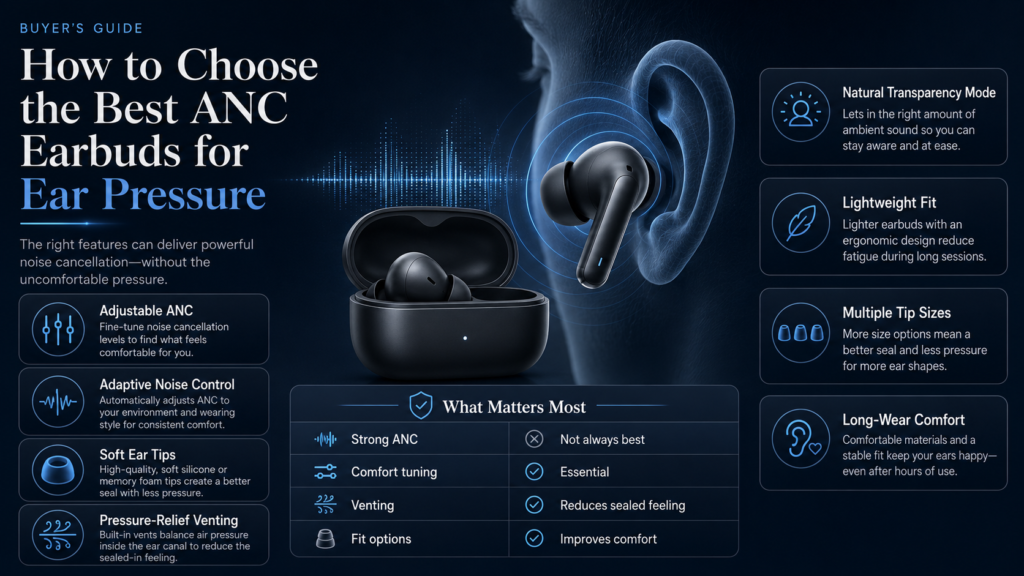
Choosing the Best ANC Earbuds for pressure-sensitive ears is not only about noise cancellation strength. It is about how gracefully the earbuds cancel noise without making the ear feel sealed, pulled, or overloaded.
Comfort-First ANC Checklist
| Feature | Why It Matters for Ear Pressure |
|---|---|
| Adjustable ANC strength | Lets you reduce intensity in quiet rooms |
| Adaptive ANC | Changes cancellation based on environment |
| Strong transparency mode | Gives the ear a more natural sound reference |
| Multiple ear-tip sizes | Helps avoid over-sealing or under-sealing |
| Venting or pressure relief design | Can reduce trapped sensation |
| Low earbud weight | Reduces physical fatigue |
| Stable but shallow fit | Improves comfort for long sessions |
| App-based fit test | Helps identify seal problems |
| Customizable controls | Makes it easy to switch modes quickly |
A pressure-friendly ANC earbud should not feel impressive only during a 30-second demo. It should remain wearable after a long call, a commute, or a focused writing session.
The Better Buying Logic
Do not ask only: “Which earbud cancels the most noise?”
Ask:
| Better Question | Why It Leads to a Smarter Choice |
|---|---|
| Can I adjust ANC strength? | Maximum ANC is not always comfortable |
| Does transparency sound natural? | Good transparency relieves the sealed feeling |
| Are tips easy to swap? | Fit changes pressure dramatically |
| Is the body bulky? | Heavy shells increase outer-ear fatigue |
| Does ANC hiss or pulse? | Poor tuning can increase listening strain |
| Is there wind control? | Wind noise can make ANC feel unstable |
| Can I wear them for two hours? | Real comfort appears over time |
The best ANC earbuds for ear pressure are not always the strongest ANC earbuds. They are the ones that balance silence, venting, fit, and mode control.
How Bluetooth Earbuds Add Another Layer to ANC Comfort
Modern Bluetooth Earbuds are not just tiny speakers. They are wearable computers with microphones, processors, sensors, batteries, antennas, and acoustic chambers inside a shell small enough to sit in the ear.
That creates a design challenge. Every internal component competes for space, and comfort depends on how well the brand balances battery size, microphone placement, nozzle angle, shell weight, venting, and ear-tip geometry.
Bluetooth ANC Comfort Stack
| Layer | What It Controls | Comfort Impact |
|---|---|---|
| Bluetooth chipset | Connection, codec, latency, power | Stable connection reduces glitches and fatigue |
| ANC processor | Cancellation speed and strength | Smoother ANC feels less aggressive |
| Microphones | Noise detection and voice pickup | Poor mic placement can make ANC unstable |
| Battery | Runtime | Larger batteries can create bulk |
| Acoustic venting | Pressure relief and bass behavior | Better venting can reduce sealed feeling |
| Ear-tip system | Fit and isolation | Biggest comfort variable for many people |
This is why two earbuds with similar ANC claims can feel completely different. One may feel open and smooth. Another may feel intense, plugged, or tiring even if it cancels slightly more noise.
Why Some People Feel ANC Pressure More Than Others
ANC sensitivity varies because ears and brains vary.
Some people are more sensitive to low-frequency sound changes. Some have narrow or sharply angled ear canals. Some notice internal body sounds more strongly when the canal is sealed. Some are prone to sinus congestion or Eustachian tube irritation. Some simply dislike the unnatural quiet created by strong ANC.
Personal Sensitivity Factors
| Factor | Effect on ANC Pressure |
|---|---|
| Narrow ear canal | Tips may press against canal walls |
| Deep insertion sensitivity | Ear canal nerves may react quickly |
| Sinus or allergy congestion | Fullness may already be present |
| Tinnitus | Silence can make internal ringing more noticeable |
| Motion sensitivity | Altered sound fields can feel disorienting |
| Strong awareness of body sounds | Occlusion becomes distracting |
| Long work sessions | Mild discomfort compounds over time |
This is why reviews can be confusing. One person calls a model “the most comfortable ANC earbud ever.” Another says the same model creates unbearable pressure. Both can be telling the truth.
Pressure, Fatigue, Pain and Dizziness: How to Read the Symptoms
Not every uncomfortable feeling should be treated the same way.
Symptom Decoder
| Symptom | Likely Category | What to Try First |
|---|---|---|
| Mild fullness only when ANC is on | ANC perception | Lower ANC or use adaptive mode |
| Soreness where tip touches canal | Fit pressure | Change tip size/material |
| Muffled own voice | Occlusion | Use transparency or vented tips |
| Dizziness when ANC is active | Sensory sensitivity | Stop using ANC and test in short sessions |
| Ear pain after removal | Possible irritation | Rest ears; avoid deep insertion |
| Ringing or hearing change | Ear-health concern | Stop use and seek professional advice if persistent |
| Pressure with congestion | Medical/physical pressure may be involved | Avoid sealing the ear until symptoms improve |
A useful rule: if discomfort disappears quickly when earbuds are removed, the cause is likely fit or ANC mode. If symptoms persist, worsen, or include pain, dizziness, ringing, drainage, or hearing loss, treat it as an ear-health issue.
How to Reduce ANC Ear Pressure and Ear Fatigue
Reducing ANC pressure is usually a process of lowering the total load on the ear.
The 7-Step Pressure Relief Method
| Step | Action | Why It Helps |
|---|---|---|
| 1 | Start with medium ANC instead of maximum | Reduces sudden acoustic contrast |
| 2 | Try a smaller ear tip | Reduces canal stretching |
| 3 | Try a vented or softer tip | Reduces sealed sensation |
| 4 | Use transparency mode for calls | Makes own voice feel less trapped |
| 5 | Take 5-minute breaks every hour | Prevents slow fatigue buildup |
| 6 | Lower volume after ANC is active | ANC may allow comfortable listening at lower levels |
| 7 | Avoid deep insertion during congestion | Prevents worsening fullness |
Practical Mode Strategy
| Situation | Best Mode |
|---|---|
| Quiet room | ANC off or low ANC |
| Office with chatter | Adaptive ANC |
| Airplane cruise | Medium to strong ANC |
| Walking outside | Transparency or awareness mode |
| Calls | Transparency, sidetone, or mild ANC |
| Gym | Stable fit with moderate ANC |
| Sleep | Low ANC or non-ANC low-profile earbuds |
The mistake many people make is using maximum ANC everywhere. Maximum ANC is useful in loud, steady environments. In quiet spaces, it can make the pressure sensation more noticeable because the brain is hearing an artificially quiet sound field.
Upcoming Trends and Latest Tech in Pressure-Friendly ANC Earbuds
The next stage of ANC is not only stronger cancellation. It is more natural cancellation.
The best new designs are moving toward adaptive listening, personalized fit calibration, transparency blending, improved venting, lower processing artifacts, and context-aware sound control. Bluetooth LE Audio and Auracast are also shaping how future earbuds handle shared listening, public audio, and more efficient wireless audio experiences. The Bluetooth SIG describes Auracast as a Bluetooth capability designed to change how people engage with audio in public and shared spaces.
Latest Tech Direction Chart
| Trend | What It Does | Why It May Reduce Pressure |
|---|---|---|
| Adaptive ANC | Changes cancellation based on surroundings | Avoids over-cancelling in quiet rooms |
| Personalized ANC | Tunes cancellation to ear shape and fit | Reduces harsh or uneven cancellation |
| Smarter transparency | Blends outside sound naturally | Gives the brain a realistic reference |
| Pressure-relief venting | Manages trapped-ear sensation | Makes sealed designs feel less closed |
| Better inward microphones | Measures in-ear sound more accurately | Improves cancellation smoothness |
| Wind-aware ANC | Reduces unstable outdoor noise | Prevents pulsing and pressure swings |
| Hearing-aware modes | Adjust attenuation by environment | Makes protection and awareness more balanced |
| Open-ear ANC research | Attempts cancellation without sealing | Could help comfort-sensitive users |
The future is not “total silence at any cost.” The future is controlled quiet that does not make the ear feel disconnected from the body.
Are Noise Cancelling Earbuds Bad for Your Ears?
Noise cancelling earbuds are not automatically bad for your ears. The bigger risks are excessive volume, poor fit, long sealed sessions without breaks, and ignoring persistent symptoms.
ANC can even support better listening habits when it reduces the need to raise volume in loud places. The problem begins when a person treats ANC as a license to listen loudly for hours, or when discomfort is ignored because the earbuds are expensive or highly rated.
Safe ANC Use Table
| Habit | Ear-Friendly? | Why |
|---|---|---|
| Moderate volume with ANC | Yes | Less need to overpower outside noise |
| Maximum ANC all day | Sometimes tiring | Can increase pressure sensation |
| Sleeping with bulky earbuds | Risky for comfort | Side pressure can irritate ear tissue |
| Using ANC during ear infection | Not ideal | Seal may worsen discomfort |
| Taking listening breaks | Yes | Reduces fatigue buildup |
| Ignoring pain or dizziness | No | Persistent symptoms need attention |
ANC should feel calming, not punishing. If a model repeatedly creates pressure, nausea, pain, or dizziness, it is not the right match for that person.
Editorial Insights: Comfort Is Becoming the New ANC Battlefield
For years, the earbud market treated ANC as a strength contest. More cancellation meant better earbuds. That thinking is becoming outdated.
Strong ANC is still valuable, especially for aircraft cabins, trains, buses, traffic, shared workspaces, and loud homes. But comfort is now the real test. A person does not live inside a lab graph. They wear earbuds while moving, chewing, talking, working, sweating, walking, and thinking. The ear is not a microphone stand. It is living tissue connected to balance, pressure, attention, and sensory comfort.
The best ANC earbuds of the next few years will not simply erase more noise. They will know when not to erase too much. They will cancel rumble without creating suction. They will blend transparency without hiss. They will fit securely without sealing the ear like a plug. They will protect attention without making silence feel artificial.
For pressure-sensitive listeners, the winning formula is simple: adjustable ANC, excellent transparency, soft fit, good venting, and enough intelligence to avoid maximum cancellation when maximum cancellation is not needed.
Return to the Homepage for more earbud guides, comparisons, and listening comfort explainers.
FAQs
Why do noise cancelling earbuds create pressure in my ears?
Noise cancelling earbuds create pressure-like sensations because ANC changes the low-frequency sound environment around your ears while the ear tips physically seal the canal. Your brain expects to hear room tone, traffic rumble, air movement, and other background cues. When ANC removes much of that information, the sudden quiet can feel like suction, fullness, or cabin pressure.
| Cause | What You Feel | Fix |
|---|---|---|
| Strong ANC | Inward pull | Lower ANC strength |
| Tight seal | Plugged ears | Try smaller tips |
| Occlusion | Loud voice/chewing | Use transparency mode |
| Long wear | Ear fatigue | Take breaks |
| Sensitivity | Dizziness/fullness | Use mild ANC or open-ear designs |
The pressure is usually not the same as airplane pressure. It is often a perception created by sound cancellation plus ear sealing. If it disappears when ANC is turned off, it is likely comfort-related rather than a true pressure imbalance.
Are noise cancelling earbuds bad for your ears if they cause pressure?
Noise cancelling earbuds are not automatically bad for your ears if they cause mild pressure. The sensation is often related to ANC perception, ear-tip fit, or occlusion. However, discomfort should be taken seriously if it becomes painful, lasts after removing the earbuds, or comes with dizziness, ringing, drainage, or hearing changes.
| Symptom | Usually Normal? | What to Do |
|---|---|---|
| Mild fullness only with ANC | Often | Reduce ANC or change tips |
| Plugged feeling from seal | Common | Try vented or smaller tips |
| Pain after use | Not ideal | Rest ears and adjust fit |
| Dizziness | Caution | Stop ANC and reassess |
| Persistent ringing | Caution | Seek professional advice if it continues |
The safest approach is moderate volume, proper fit, adjustable ANC, and regular breaks.
How do I stop ANC earbuds from feeling like airplane pressure?
To stop ANC earbuds from feeling like airplane pressure, reduce the strength of ANC, switch to adaptive mode, use transparency mode in quiet rooms, and experiment with ear-tip size. A smaller or softer tip can reduce canal pressure, while transparency mode restores some natural environmental sound.
| Situation | Better Setting |
|---|---|
| Quiet office | ANC off or low |
| Busy café | Adaptive ANC |
| Flight cruise | Medium to strong ANC |
| Outdoor walking | Transparency |
| Long work session | Low ANC with breaks |
The airplane feeling often becomes worse when maximum ANC is used in spaces that do not need maximum cancellation. The ear feels less trapped when the earbuds let in a controlled amount of outside sound.
Can ear tips cause noise cancelling earbuds ear pressure?
Yes. Ear tips can be a major cause of noise cancelling earbuds ear pressure. A tip that is too large stretches the ear canal. A tip that seals too deeply can create a blocked-ear feeling. Foam tips can improve isolation but may increase the sense of fullness for some individuals.
| Ear Tip Type | Pressure Risk | Best Use |
|---|---|---|
| Large silicone | High | Only if canal comfortably fits |
| Small silicone | Low | Comfort-sensitive ears |
| Foam | Medium | Strong passive isolation |
| Vented silicone | Lower | Balanced ANC comfort |
| Shallow-fit tip | Lower | Long sessions |
A secure fit should not feel like force. If the earbud needs pressure to stay in place, the tip or shell shape may not match your ear.
What are the best ANC earbuds for ear pressure-sensitive people?
The best ANC earbuds for ear pressure-sensitive people usually have adjustable ANC, natural transparency mode, multiple ear-tip sizes, lightweight shells, and a less aggressive sealed feeling. The right model should let you reduce cancellation strength instead of forcing maximum ANC at all times.
| Feature | Why It Matters |
|---|---|
| Adjustable ANC | Lets you soften the pressure effect |
| Adaptive mode | Prevents over-cancellation |
| Good transparency | Makes the ear feel less blocked |
| Fit test | Helps avoid poor sealing |
| Soft tips | Reduce canal soreness |
| Light shell | Reduces outer-ear fatigue |
For pressure-sensitive listeners, comfort should rank above raw ANC strength. The best earbud is the one you can actually wear.
PAA
Why does ANC feel like suction?
ANC can feel like suction because it removes low-frequency environmental noise while the earbud seal blocks the canal. The brain may interpret the sudden loss of external rumble as an inward pull, even when the earbud is not physically pulling on the eardrum.
| Layer | Suction-Like Effect |
|---|---|
| ANC | Removes low-frequency sound cues |
| Seal | Blocks natural air and sound exchange |
| Brain | Interprets the change as pressure |
| Fit | Can add real physical tightness |
This is why suction may stop immediately when ANC is turned off. The acoustic environment changes back, and the brain no longer reads the silence as pressure.
Why do my ears feel tired after using noise cancelling earbuds?
Your ears may feel tired after using noise cancelling earbuds because of seal pressure, long wear time, ANC intensity, volume level, and the constant sensory difference between natural sound and processed quiet. Ear fatigue is more likely when earbuds are worn for several hours without breaks.
| Fatigue Trigger | Better Habit |
|---|---|
| Long sessions | Remove earbuds briefly every hour |
| Strong ANC | Use medium or adaptive ANC |
| Tight tips | Try smaller or softer tips |
| Loud volume | Lower volume once ANC is active |
| Calls with sealed ears | Use transparency mode |
Ear fatigue usually improves when the total load is reduced.
Is cabin sensation from ANC the same as airplane ear?
No. Cabin sensation from ANC is not the same as airplane ear. Airplane ear involves real air-pressure changes around the eardrum. ANC cabin sensation usually comes from low-frequency cancellation, sealed ear canals, and the brain interpreting sudden quiet as internal pressure.
| Type | Main Cause | Typical Fix |
|---|---|---|
| Airplane ear | Pressure imbalance | Swallowing, yawning, pressure equalization |
| ANC cabin sensation | Acoustic change | Lower ANC or use transparency |
| Fit pressure | Ear-tip tightness | Change tips |
| Occlusion | Sealed canal | Use vented tips or transparency |
If the pressure continues after removing earbuds, it may not be ANC cabin sensation.
Why does transparency mode feel more comfortable than ANC?
Transparency mode often feels more comfortable because it lets outside sound back in. That gives the brain a more natural reference point and reduces the sealed, artificial quiet that can make ANC feel pressurized.
| Mode | Comfort Feel | Best Use |
|---|---|---|
| Full ANC | Quiet but sometimes intense | Travel, loud engines |
| Adaptive ANC | Balanced | Changing environments |
| Transparency | Natural and open | Calls, walking, quiet rooms |
| ANC off | Least processing | Safe quiet spaces |
For pressure-sensitive ears, transparency mode can act like an acoustic release valve.
Should I stop using ANC if I feel ear pressure?
You do not always need to stop using ANC if the pressure is mild and goes away when you turn ANC off. Start by lowering ANC strength, changing tips, using adaptive mode, and taking breaks. Stop using ANC if the sensation becomes painful, causes dizziness, or continues after removing the earbuds.
| Pressure Level | Action |
|---|---|
| Mild and temporary | Adjust ANC or fit |
| Noticeable but manageable | Use shorter sessions |
| Painful | Stop and rest ears |
| Dizzy or nauseous | Avoid ANC and reassess |
| Persistent after removal | Consider professional guidance |
ANC should improve listening comfort. If it repeatedly creates discomfort, the earbud design, fit, or ANC tuning is not a good match.