
How Earbud Ear Tips Block Noise: Seal, Fit and Passive Isolation Explained
Amazon Affiliate Disclosure
Earsbud.com participates in the Amazon Services LLC Associates Program, an affiliate advertising program designed to provide a means for websites to earn fees by linking to Amazon.com and related product pages. As an Amazon Associate, we may earn from qualifying purchases.
This does not increase the price paid by the individual or influence the technical analysis presented on this page. Product assessment remains focused on fit, acoustic performance, durability, comfort and real-world usability.
Updated: August 2026
Earbud noise isolation begins before a microphone listens to the room or a processor calculates an electronic correction. It begins at the point where the ear tip meets the ear canal.
That small ring of silicone, foam or hybrid material creates the physical boundary between the listener and the surrounding environment. When the boundary is complete, external sound loses energy before reaching the eardrum, bass remains contained inside the ear canal, and active noise cancellation operates within a more predictable acoustic space. When the boundary leaks, the entire listening system becomes less effective.
This explains one of the most common contradictions in personal audio: two individuals can use the same pair of earbuds and hear completely different levels of quiet. One experiences strong bass, stable isolation and convincing noise reduction. The other still hears nearby conversation, loses low-frequency impact and assumes the earbuds are defective.
The difference is often not the processor. It is the seal.
This guide examines how earbud ear tips block external noise, how to get a good earbud seal, why ear-tip material and size affect sound, and how passive isolation works alongside the electronics inside modern noise cancelling earbuds.

![[6 Pairs] Earphone Tips New bee 12pcs Replacement Earbud Tips](https://m.media-amazon.com/images/I/41ugOgjVjrL._AC_.jpg)
Quick Picks: Jump to the Relevant Section
What Earbud Ear Tips Are For
An ear tip appears to be a simple comfort accessory, but it performs several acoustic and mechanical jobs at once.
Its first responsibility is to create contact between the earbud nozzle and the entrance to the ear canal. This contact closes the gaps through which external sound can enter and internally generated sound can escape.
Its second responsibility is to stabilize the earbud. The tip must maintain its seal while the listener walks, speaks, chews, smiles or turns their head. A seal that works only while sitting perfectly still is not a reliable seal.
Its third responsibility is to manage pressure and comfort. The tip must distribute contact around the canal without creating sharp pressure points, collapsing inward or forcing the earbud housing against sensitive parts of the outer ear.
Its fourth responsibility is to preserve the acoustic tuning intended by the manufacturer. The tip’s bore, length, stiffness and material influence the sound leaving the earbud driver before it reaches the eardrum.
Ear Tips Form the Final Acoustic Chamber
The earbud driver does not reproduce sound into an open room. It plays into a small enclosed volume formed by:
- The driver and nozzle
- The ear tip
- The ear canal
- The eardrum
- Any vents built into the earbud
Changing the ear tip changes this chamber.
A secure fit helps the driver build controlled low-frequency pressure. A leak allows that pressure to escape. This is why poor isolation and weak bass often appear together.
Ear Tips Are Part of the Noise-Control System
Premium earbuds may contain advanced microphones, processors and adaptive software, but these components still depend on physical fit.
Manufacturers increasingly treat the seal as part of the product’s acoustic system. Apple, Sony, Samsung and Bose all provide fit-testing tools, specialized sizing systems or instructions connecting a proper seal with stronger sound and noise-control performance.
Who Needs Strong Earbud Noise Isolation?
Strong passive isolation is valuable whenever external sound competes with music, speech or concentration.
It is especially useful in environments containing unpredictable, mid-frequency and high-frequency noise—the types of sound that electronic cancellation may not remove completely.
Commuters
Public transport contains several categories of noise at once.
The vehicle produces low-frequency vibration and mechanical rumble. Nearby individuals produce speech. Doors, brakes, announcements and loose objects create intermittent sounds.
ANC can reduce much of the steady mechanical layer, while ear tips physically reduce conversation and sharper sounds. The commuter benefits most when both systems remain stable.
Air Travelers
Aircraft engines create the kind of continuous low-frequency noise that ANC handles effectively, but the cabin also contains speech, service equipment, children, ventilation hiss and movement.
A conforming ear tip helps block these higher and more irregular frequencies while preserving the seal required for consistent low-frequency cancellation.
Students and Remote Professionals
Shared offices, libraries and cafés are dominated by human speech, keyboards and intermittent movement.
These sounds do not behave like a steady engine. Passive noise isolation becomes particularly important because a secure ear tip can reduce the clarity and prominence of nearby voices even when it cannot remove them completely.
Individuals Who Listen at Moderate Volume
External noise often encourages listeners to raise playback volume. Better isolation reduces the amount of environmental sound competing with the audio.
The result can be clearer dialogue and more audible musical detail without relying entirely on additional volume.
Musicians and Stage Performers
In-ear monitors depend on a reliable seal for stable bass response, controlled monitoring and reduced intrusion from stage sound.
Professional applications may use deep-fitting universal tips or custom-molded earpieces because small changes in fit can alter both isolation and tonal balance.
People Whose Earbuds Sound Thin or Inconsistent
A weak seal can make an otherwise capable earbud sound:
- Bass-light
- Harsh
- Distant
- Unbalanced between the left and right ears
- Less effective with ANC enabled
Individuals experiencing these problems should evaluate fit before assuming that the earbud driver or software is inadequate.
When Strong Isolation Is Not Appropriate
Maximum isolation is not desirable in every setting.
Individuals walking near traffic, cycling, supervising children or working around moving equipment may need environmental awareness. Transparency mode can help, but an open or semi-open design may remain more appropriate when hearing the surroundings is essential.
How Earbud Ear Tips Block External Noise
Ear tips reduce external noise by obstructing the direct acoustic path into the ear canal.
Sound travels through the air as changing pressure. Without an earbud, these pressure variations enter the canal relatively freely. A correctly fitted tip places a flexible barrier in that path.
Some acoustic energy is reflected. Some is absorbed by the tip. Some travels through the material and housing but loses energy before reaching the eardrum.
This physical reduction is known as passive noise isolation.
The Seal Must Be Continuous
A tip does not need to press painfully against the ear, but it does need continuous contact around the canal entrance.
Even a narrow opening can become a meaningful leak. Low-frequency pressure escapes easily through that opening, and external sound gains a direct route inward.
A seal should therefore be understood as a complete ring rather than a point of contact.
Leakage Works in Both Directions
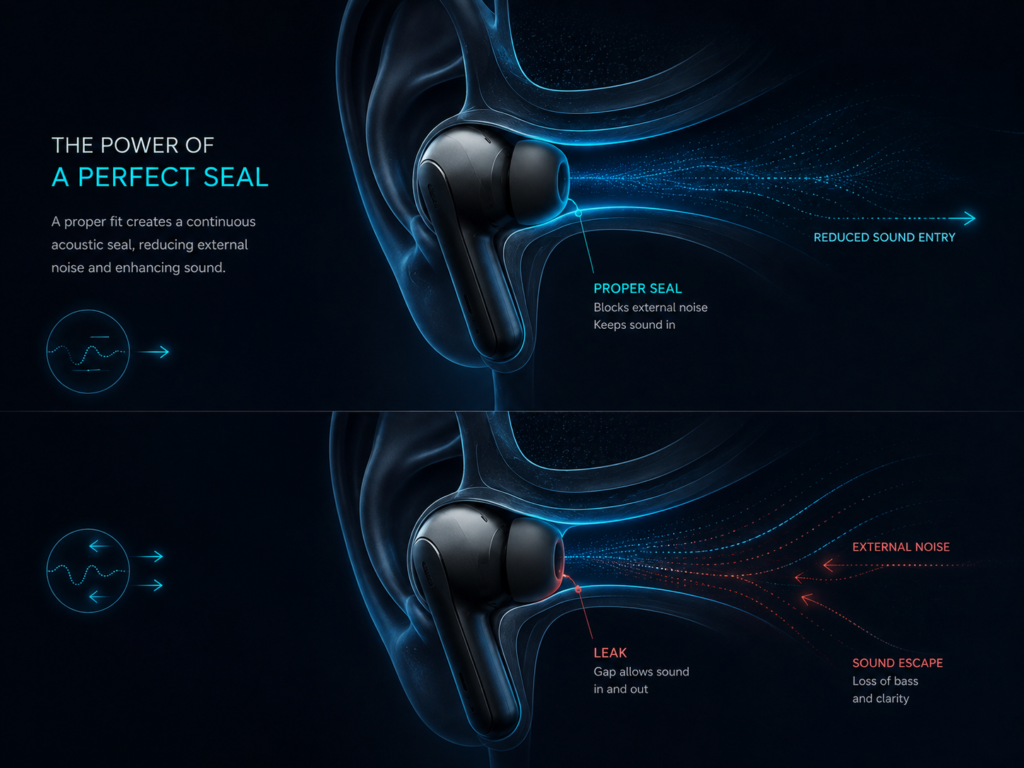
A gap does not only allow outside noise to enter. It also allows sound produced by the earbud to escape.
This creates two simultaneous effects:
- Environmental noise becomes more audible.
- Internally produced bass becomes weaker.
That is why bass response is one of the most useful indicators of seal quality.
Ear Tips Do Not Block Every Frequency Equally
Passive isolation is generally more effective against middle and upper frequencies than against deep bass.
Speech consonants, keyboard sounds, clinking objects and high-frequency environmental detail have shorter wavelengths and are easier to obstruct with a physical barrier.
Low-frequency engine rumble and structural vibration have longer wavelengths and can pass through or around physical materials more readily. These frequencies are where ANC usually contributes the greatest additional reduction.
Earbud Noise Isolation Chain
| Stage | Component | Function | Failure Result |
|---|---|---|---|
| Positioning | Earbud housing | Holds the nozzle at the intended angle | Tip sits unevenly or shifts |
| Contact | Ear-tip flange | Creates a continuous boundary | External noise enters through gaps |
| Stabilization | Tip friction, wing or stability band | Maintains the boundary during movement | Seal breaks while walking or speaking |
| Damping | Tip material and housing | Reduces transmitted acoustic energy | Voices and sharp sounds remain prominent |
| Pressure control | Tip, canal and vents | Supports consistent bass response | Bass becomes weak or variable |
| ANC support | Stable enclosed volume | Gives microphones a predictable acoustic environment | Cancellation fluctuates or weakens |
The effectiveness of earbud noise isolation therefore depends on the complete mechanical chain, not merely the material printed on the replacement-tip package.
Passive Noise Isolation Explained
Passive noise isolation is the reduction of external sound achieved through fit, materials and physical obstruction.
It requires no batteries, microphones or signal processing. It is present whenever the earbud is inserted and sealed correctly.
Passive Isolation Versus Silence
A well-sealed ear tip does not produce total silence. It lowers the intensity of selected frequencies and makes many sounds less distinct.
Nearby conversation may become muffled rather than disappearing. Keyboard strokes may sound softer. High-frequency room noise may lose sharpness.
The practical benefit is often not complete removal but reduced intelligibility. A conversation that can no longer be followed word for word is less likely to pull attention away from a task.
Passive Isolation Works Instantly
Electronic cancellation must detect sound and generate a response. Passive isolation does not calculate anything.
When a door closes, an object falls or a person speaks suddenly, the physical barrier is already present. This makes passive isolation particularly useful against short and unpredictable sounds.
Passive Isolation Continues Without Power
When an earbud battery becomes empty, ANC stops. The ear tip continues to reduce external sound as long as the seal remains intact.
This makes tip fit relevant even for individuals who use ANC only occasionally.
Passive Isolation Is Not Certified Hearing Protection
Ordinary consumer earbuds should not automatically be treated as industrial earplugs.
Their attenuation varies by frequency, anatomy, insertion and movement. A person may also receive a very different result on the left and right sides.
Hazardous workplaces, shooting environments, motorsport settings and other high-noise conditions require equipment rated for the relevant purpose.
Typical Relative Performance by Noise Type
The following chart represents general acoustic behavior rather than guaranteed laboratory attenuation for a particular product.
| Noise Type | Example | Passive Isolation Potential |
|---|---|---|
| Deep structural vibration | Heavy machinery or rail vibration | ██□□□ |
| Low engine noise | Aircraft or bus engine | ███□□ |
| Broad road noise | Tires and distant traffic | ███□□ |
| Human speech | Office or café conversation | ████□ |
| Keyboard and handling noise | Typing, utensils and desk movement | ████□ |
| High-frequency hiss | Ventilation and electronic hiss | █████ |
| Sudden sharp sounds | Clicks and light impacts | ████□ |
Passive isolation and active cancellation perform different roles. A detailed comparison is available in our guide to passive vs active noise cancellation.
How Ear-Tip Size Affects the Seal
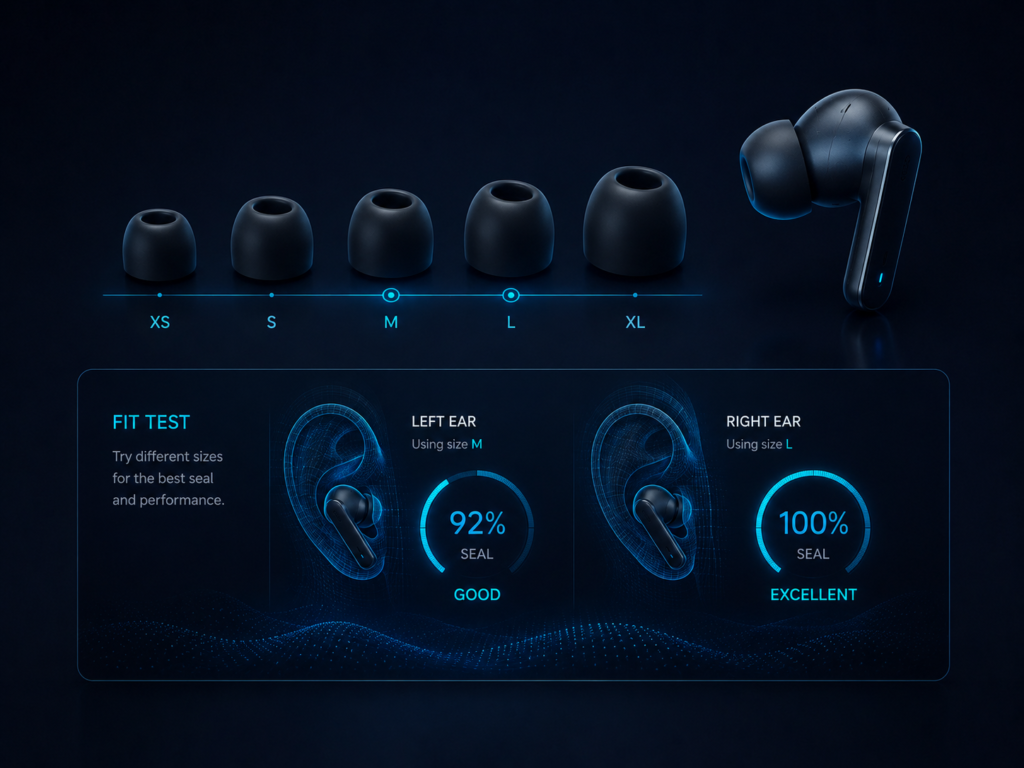
Ear-tip size is not simply a comfort choice. It determines where and how the flange contacts the ear canal.
The correct size should create continuous contact without folding, excessive compression or outward pressure that gradually pushes the earbud loose.
Signs an Ear Tip Is Too Small
A tip may be too small when:
- Bass sounds weak or disappears during movement.
- External sound remains unusually clear.
- ANC improves when the earbud is pressed inward.
- The earbud slides deeper than expected.
- The housing gradually becomes loose.
- A fit-test application repeatedly reports leakage.
- Isolation changes when the jaw moves.
- The tip feels present but does not grip the canal.
A smaller tip may initially feel comfortable because it creates little pressure, but comfort without a stable seal does not produce reliable isolation.
Signs an Ear Tip Is Too Large
A tip may be too large when:
- The flange folds during insertion.
- The earbud cannot reach its designed resting position.
- The tip creates pain or concentrated pressure.
- The earbud slowly moves outward.
- The seal feels strong initially but breaks after several minutes.
- The outer housing presses against the ear.
- The tip deforms asymmetrically.
- Insertion requires excessive force.
A larger tip can fail because the material is compressed beyond its intended shape. Instead of forming a smooth ring, the flange wrinkles or folds, creating hidden leakage paths.
Bigger Does Not Always Mean Better Isolation
The strongest seal is not necessarily created by the largest possible tip.
The objective is stable surface contact. An oversized tip may seal at one angle and leak at another. It can also prevent the nozzle from reaching the intended depth, changing both comfort and sound.
Shallow Versus Deep Sealing
Some earbuds are designed to seal near the entrance of the canal. Others place the tip slightly deeper.
A shallow, wider tip may feel less intrusive and distribute pressure over a larger area. A deeper, narrower tip may provide stronger stability for certain ears but can increase occlusion and sensitivity.
The correct depth depends on the nozzle geometry and the earbud’s intended fit. Forcing an earbud deeper than designed is not a reliable way to improve isolation.
Tip Diameter Is Only One Variable
Two tips labeled “medium” may differ substantially in:
- Outer diameter
- Flange height
- Wall thickness
- Material softness
- Stem length
- Bore diameter
- Oval or circular shape
- Rate of compression
- Amount of rebound force
Replacement tips should therefore be evaluated by actual fit rather than size label alone.
How to Test Your Earbud Seal
A proper seal should be evaluated through sound, stability and comfort rather than sensation alone.
A tip can feel secure while still leaking acoustically.
The Low-Frequency Test
Play a familiar recording containing a steady bass line at a moderate volume.
Listen for:
- Similar bass weight in both ears
- Stable bass when turning the head
- No major change when speaking or chewing
- No dramatic improvement when pressing the earbud inward
If bass becomes much stronger when the housing is held in place, the normal fit is not maintaining the intended seal.
The Gentle Pressure Test
Place a finger lightly against the outside of the earbud and apply minimal inward pressure.
Do not force the earbud deeper.
If environmental noise falls noticeably or bass becomes fuller, investigate:
- A larger tip
- A more conforming material
- A different insertion angle
- A stability band or wing
- A shallower but wider seal
- A tip with a different flange shape
The Left-Right Comparison
Test one ear at a time.
The same ear-tip size can produce different results because the left and right ear canals may differ in width, angle and shape.
Compare:
- Bass level
- External voice clarity
- Earbud stability
- Pressure sensation
- Result of any software fit test
The Movement Test
A seal that works while sitting may fail during normal activity.
After insertion:
- Turn the head from side to side.
- Look upward and downward.
- Speak several sentences.
- Chew or move the jaw.
- Walk around the room.
- Recheck bass and external noise.
The seal should remain reasonably consistent throughout these movements.
The Fan or Ventilation Test
A fan, air conditioner or ventilation system provides a stable noise source.
With ANC disabled, compare different ear tips and insertion positions. The best passive seal should lower the sound without creating pain or requiring constant adjustment.
Manufacturer Fit Tests
Some current earbuds play a short test signal and use internal microphones or sensors to estimate leakage.
Apple provides an Ear Tip Fit Test or Acoustic Seal Test on compatible AirPods Pro models. Sony can measure air-tightness and recommend optimal tips through its application. Samsung’s Earbud Fit Test evaluates seating and sound leakage, while Bose provides an Earbud Seal Test and multiple tip and stability-band sizes on supported models.
These tests are useful, but they should not be the only measurement. A seal that passes while the listener remains still may break during speech, exercise or prolonged use.
The SEAL Fit Framework
| Letter | Factor | Diagnostic Question |
|---|---|---|
| S — Size | Tip diameter and flange contact | Does the tip create continuous contact without folding? |
| E — Entry angle | Nozzle alignment with the canal | Is the earbud inserted at its natural angle? |
| A — Acoustic consistency | Bass and external-noise stability | Does the sound remain stable during movement? |
| L — Lock | Mechanical support | Does the housing stay in position without pressure or adjustment? |
A good fit satisfies all four conditions. Passing only one does not guarantee reliable earbud noise isolation.
Foam vs Silicone Ear Tips
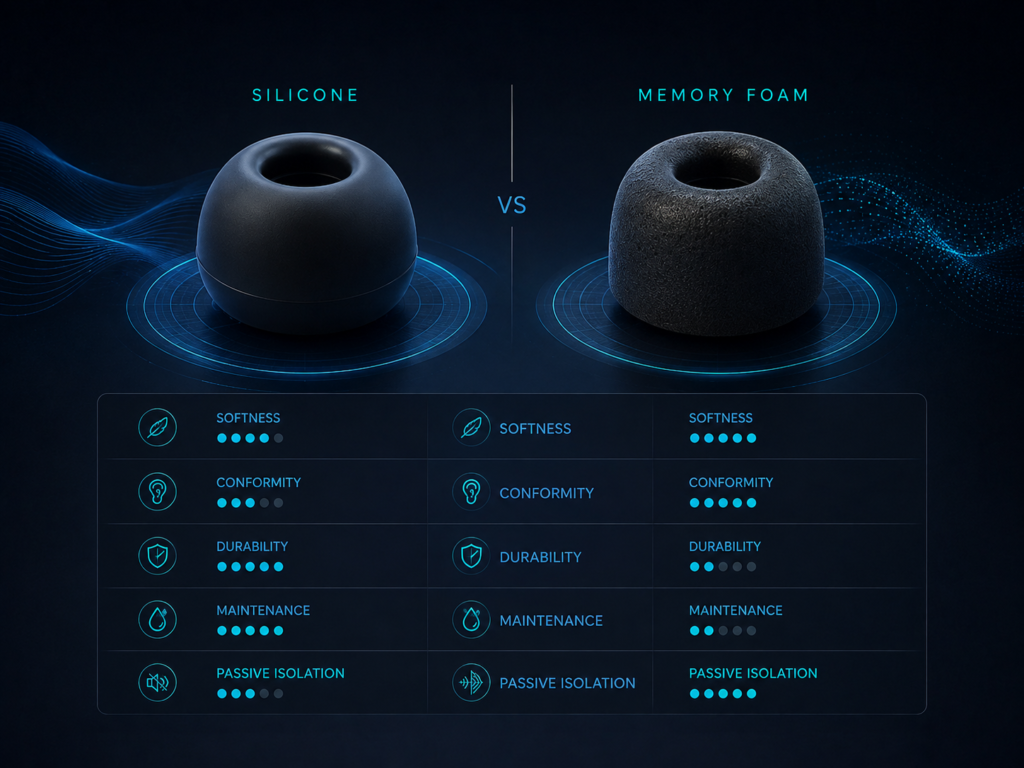
The comparison between foam vs silicone ear tips is not simply a contest between greater isolation and greater durability.
Each material behaves differently during insertion, movement, cleaning and extended wear.
Silicone Ear Tips
Silicone is the most common material supplied with wireless earbuds.
A silicone tip seals through the shape and tension of its flange. It does not need to expand after insertion, so it is quick to use and easy to reposition.
Advantages of Silicone Tips
Silicone tips generally offer:
- Fast insertion
- Easy cleaning
- Resistance to sweat and skin oils
- Long usable life
- Consistent shape
- Low maintenance
- Compatibility with compact charging cases
- Limited change to the manufacturer’s intended tuning
Limitations of Silicone Tips
Silicone may struggle when the ear canal does not match the available sizes or flange shape.
A smooth surface can also become slippery during exercise. Very soft silicone may collapse, while stiff silicone may create pressure or fail to conform to irregular canal geometry.
Memory Foam Ear Tips
Memory foam is compressed before insertion and gradually expands against the ear canal.
This allows it to fill spaces that a fixed silicone flange might leave open.
Advantages of Memory Foam Tips
Foam tips can provide:
- Strong passive isolation
- Better conformity to irregular ear canals
- Greater grip during movement
- Improved stability for loose-fitting earbuds
- Reduced clarity of nearby speech
- Less dependence on a perfectly matched flange diameter
Limitations of Memory Foam Tips
Foam requires more maintenance and usually wears faster than silicone.
It can absorb moisture and skin oils, making careful cleaning important. Repeated compression eventually reduces rebound. Foam may also alter sound if it changes the effective bore or insertion depth.
Foam-Infused Hybrid Tips
Hybrid tips combine a silicone exterior with an internal foam or multi-density structure.
The silicone surface provides easier cleaning and insertion, while the internal material improves conformity and support.
Apple’s AirPods Pro 3 introduced foam-infused ear tips in five sizes, including an XXS option, illustrating the industry’s movement toward materials that combine conforming fit with everyday durability.
Which Material Blocks More Noise?
Foam frequently provides stronger passive isolation when it creates a more complete seal. However, a correctly fitted silicone tip can outperform poorly sized foam.
Material does not override geometry.
The best ear tips for noise isolation are the tips that:
- Seal completely
- Remain sealed during movement
- Preserve comfort
- Do not fold
- Do not alter the intended nozzle position
- Maintain consistent left-right sound
Foam vs Silicone Ear-Tip Comparison
| Feature | Silicone Ear Tips | Memory Foam Ear Tips | Foam-Infused Hybrid Tips |
|---|---|---|---|
| Passive isolation potential | Moderate to high | High | Moderate to high |
| Speed of insertion | Excellent | Slower | Good |
| Adaptability to irregular canals | Moderate | Excellent | High |
| Cleaning convenience | Excellent | Limited | Good |
| Resistance to sweat | High | Moderate to low | Moderate to high |
| Typical durability | High | Lower | Moderate to high |
| Exercise grip | Variable | High | High |
| Sound consistency over time | High | Depends on foam condition | High |
| Charging-case compatibility | Usually excellent | Must be checked | Usually good |
| Pressure distribution | Depends on flange | Broad after expansion | Broad and controlled |
How to Insert Foam Tips Correctly
Foam should normally be compressed into a narrow cylinder before insertion.
Once placed, hold the earbud gently in position while the material expands. Releasing it immediately may allow the earbud to move outward before the seal stabilizes.
Sony advises allowing its conforming Noise Isolation Earbud Tips several seconds to change shape and settle before evaluating fit or noise-cancellation performance.
Ear-Tip Shapes and Flange Designs
Material is only one part of ear-tip engineering. The shape of the flange controls where the tip contacts the ear and how it responds to movement.
Single-Flange Ear Tips
Single-flange tips use one flexible skirt to form the seal.
They are widely used because they are easy to insert, compact and compatible with most charging cases.
Their effectiveness depends heavily on matching the canal diameter and angle.
Double-Flange Ear Tips
Double-flange tips create two potential contact points.
The first flange may seal nearer the canal entrance, while the second extends slightly deeper. This can improve isolation for some individuals and provide greater stability when a single flange leaks.
The additional depth can feel intrusive, and compatibility with short nozzles may be limited.
Triple-Flange Ear Tips
Triple-flange tips create several sealing surfaces and generally extend deeper into the canal.
They can provide strong passive isolation when correctly fitted, but they are less common on mainstream wireless earbuds because:
- They require greater insertion depth.
- They may increase occlusion.
- They can interfere with compact charging cases.
- They may place the earbud housing farther from its intended position.
- Some individuals find them uncomfortable.
Oval Ear Tips
Not every ear canal entrance is circular.
Oval tips attempt to follow a wider horizontal or vertical geometry. They may create a better seal with less pressure than a round tip of similar area.
However, orientation matters. An oval tip attached at the wrong angle may feel secure while leaving an acoustic gap.
Shallow Wide-Flange Tips
A shallow wide-flange tip seals closer to the canal entrance.
This design can distribute pressure over a larger area and reduce the sensation of deep insertion. It often works well with larger earbud housings designed to rest in the outer ear.
Long Narrow Tips
Longer tips extend the nozzle farther toward the canal.
They may improve isolation when the earbud housing prevents a standard tip from reaching the correct position. They may also change sound by altering insertion depth and canal resonance.
Stabilizing Wings and Bands
Ear tips create the acoustic seal, but they do not always provide enough mechanical support.
Wings and stability bands contact the outer ear to prevent rotation or outward movement. This separates two functions:
- The ear tip creates the seal.
- The band keeps the housing positioned so the seal does not break.
Bose’s current fit system allows individuals to mix different tip and stability-band sizes for each ear, including alternate extra-small and extra-large options. Bose explicitly connects a proper, non-leaking fit with stronger audio and noise-cancellation performance.
Custom-Molded Ear Tips
Custom tips are produced from a physical impression or digital scan of the ear.
They can provide:
- Highly repeatable positioning
- Consistent passive isolation
- Reduced dependence on generic sizes
- Greater stability for professional monitoring
- Personalized pressure distribution
Their limitations include cost, production time, reduced interchangeability and possible changes to the earbud’s tuning or charging-case fit.
A custom seal can also be excessive for an earbud designed around controlled venting. Compatibility should be evaluated rather than assumed.
How Ear-Tip Bore Size Changes Sound
The bore is the central opening through which audio travels from the earbud nozzle into the ear canal.
Changing its diameter, length or internal structure can affect the sound even when the outer seal remains identical.
Wide-Bore Ear Tips
A wider bore creates a less restricted acoustic path.
Depending on the earbud and insertion depth, it may preserve more upper-midrange and treble energy, producing a more open or direct presentation.
A wide bore does not automatically create better sound. If it exposes the nozzle differently or reduces acoustic damping, the result may become brighter or sharper.
Narrow-Bore Ear Tips
A narrower bore can create greater acoustic resistance.
It may soften upper-frequency energy or shift the perceived balance toward bass and lower midrange. However, an excessively narrow bore can make sound feel congested or alter the intended tuning.
Bore Length
A longer sound channel changes the distance between the driver outlet and the ear canal.
This can alter resonance, perceived treble and insertion depth. Two tips with the same outer diameter may therefore sound different because one uses a longer stem.
Wax Guards and Acoustic Mesh
Some tips contain protective mesh or filters.
These structures help prevent debris from reaching the nozzle but also introduce acoustic resistance. A clogged mesh can reduce volume, treble and channel balance.
Replacement tips should not remove a protective component without understanding how the original earbud was designed.
Why Tip Rolling Changes Sound
“Tip rolling” refers to testing several ear-tip designs with the same earbuds.
The listener may hear changes caused by:
- A stronger or weaker seal
- Different insertion depth
- Bore diameter
- Flange stiffness
- Tip length
- Internal damping
- Ear-canal resonance
- Driver-to-eardrum distance
The largest perceived improvement often comes from correcting leakage rather than from the material’s tonal character.
Sound-Change Diagnostic Table
| Sound Change | Likely Ear-Tip Cause |
|---|---|
| Bass becomes much stronger | Improved seal or deeper stable insertion |
| Bass becomes boomy | Excessively closed seal or altered vent behavior |
| Treble becomes softer | Narrower bore, longer channel or added damping |
| Treble becomes sharper | Wider bore or shallower insertion |
| Sound shifts when moving | Seal instability |
| One side sounds darker | Unequal insertion, blocked mesh or different seal |
| Soundstage feels smaller | Stronger occlusion or deeper insertion |
| Vocals become clearer | Reduced leakage or more direct bore alignment |
How Ear Tips Affect Noise Cancellation
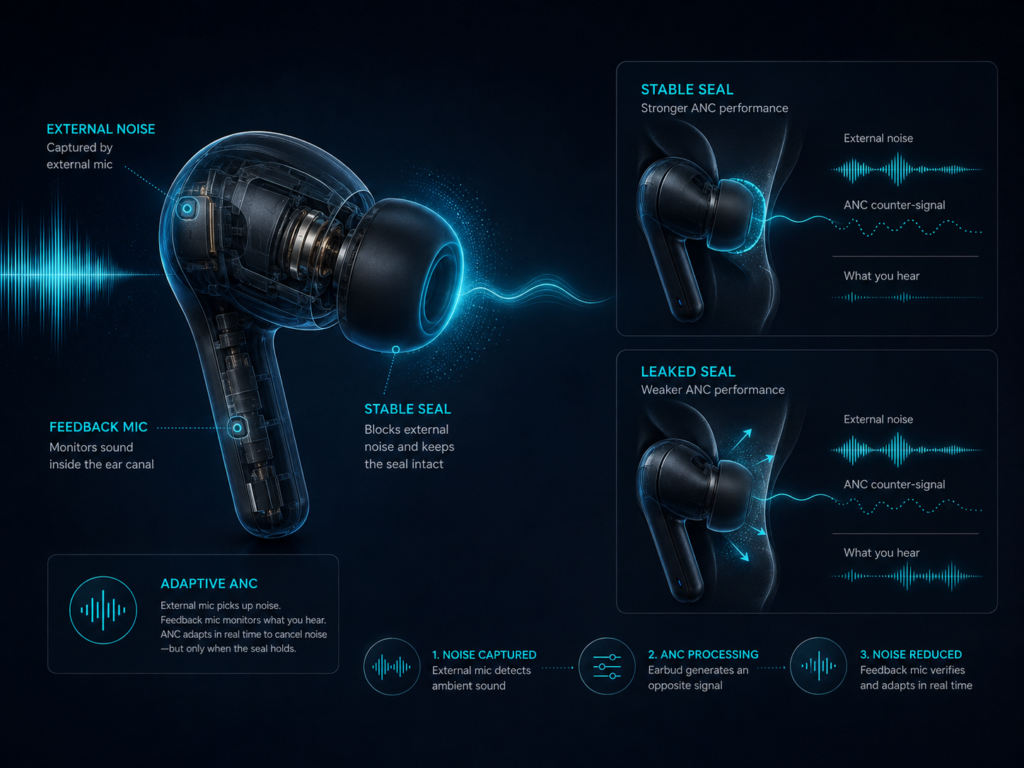
Ear tips do not generate active noise cancellation, but they determine the acoustic conditions in which ANC operates.
The electronic system expects a reasonably stable relationship among:
- External noise
- Microphone measurements
- Driver output
- Ear-canal volume
- Sound leakage
- Residual noise near the eardrum
When the seal changes, those relationships change.
A Leak Introduces Uncontrolled Sound
External sound entering through a gap may reach the ear differently from sound passing through the housing and vents.
The ANC processor can adapt to some leakage, but it cannot guarantee complete correction when the physical boundary is unstable.
The Internal Microphone Hears the Result of the Fit
In feedback or hybrid ANC systems, an internal microphone monitors residual sound inside the ear.
A changing seal changes what that microphone detects. The processor must then revise its response while music and environmental sound continue.
Why ANC Improves When You Push the Earbud Inward
When inward pressure improves ANC, the pressure is usually closing a leak or repositioning the nozzle.
The improvement does not mean that earbuds should be held deeply or forcefully. It indicates that a different tip size, material or stability system may be needed.
Adaptive ANC Can Compensate—but Only Within Limits
Current adaptive ANC platforms can adjust cancellation according to fit, leak-through and environmental conditions. Qualcomm describes its adaptive system as responding dynamically to earbud fit and leakage, while Sony combines adaptive optimization with a snug sealing fit in its current flagship design.
Software can reduce the consequences of a changing seal, but it cannot transform a visibly loose earbud into a consistently sealed one.
The complete microphone, anti-noise and processing sequence is covered separately in our guide to how active noise cancellation works.
Ear Tips and ANC Relationship Chart
| Seal Condition | Passive Isolation | Bass Response | ANC Consistency |
|---|---|---|---|
| Complete and stable | High | Full and controlled | High |
| Complete but uncomfortable | High | Full | High initially, poor usability |
| Slight leak | Moderate | Reduced | Variable |
| Seal breaks during movement | Variable | Fluctuating | Fluctuating |
| Tip folded during insertion | Low | Weak or uneven | Low |
| Different seal in each ear | Unequal | Unequal | Unequal |
| Tip or mesh obstructed | Unpredictable | Reduced or imbalanced | May be degraded |
This is why lists of the Best noise cancelling earbuds should be treated as starting points rather than guarantees. The strongest laboratory performer may not be the strongest real-world performer for an ear shape it cannot seal properly.
Benefits of a Proper Earbud Seal
A correct seal improves more than the amount of external sound blocked.
It stabilizes the entire listening experience.
Stronger Passive Noise Isolation
The most direct benefit is lower environmental intrusion.
Nearby speech becomes less clear, sharp room sounds lose intensity and steady noise becomes easier to manage.
More Consistent Bass
Bass depends on controlled pressure inside the ear canal.
A stable seal prevents low-frequency energy from escaping, allowing the earbud to reproduce its intended bass response without excessive equalization or volume.
Better ANC Performance
A stable acoustic chamber gives the ANC system more predictable conditions.
This can improve consistency across walking, commuting and extended listening.
Reduced Need for High Volume
When external noise is lowered, audio does not need to compete as aggressively with the environment.
Speech can remain intelligible and quieter musical detail can remain audible at a more moderate setting.
Better Left-Right Balance
Equal seals help the two earbuds deliver similar bass, tonal balance and noise reduction.
Channel imbalance is not always an electronics problem. It may be an acoustic-fit problem.
Greater Physical Stability
A correctly sized tip helps prevent the housing from rotating or falling outward.
This is especially important during exercise and telephone calls, when jaw movement can disturb a marginal seal.
More Predictable Sound Across Environments
An earbud with a reliable seal sounds more similar in a quiet room, on a train and in an office.
Without isolation, environmental noise masks different parts of the frequency range and changes the perceived tonal balance.
Improved Product Evaluation
A person cannot evaluate an earbud fairly until the fit is correct.
Testing several models with inconsistent seals may produce conclusions based more on anatomy than driver or processor quality.
Why Your Earbuds Still Let Noise In
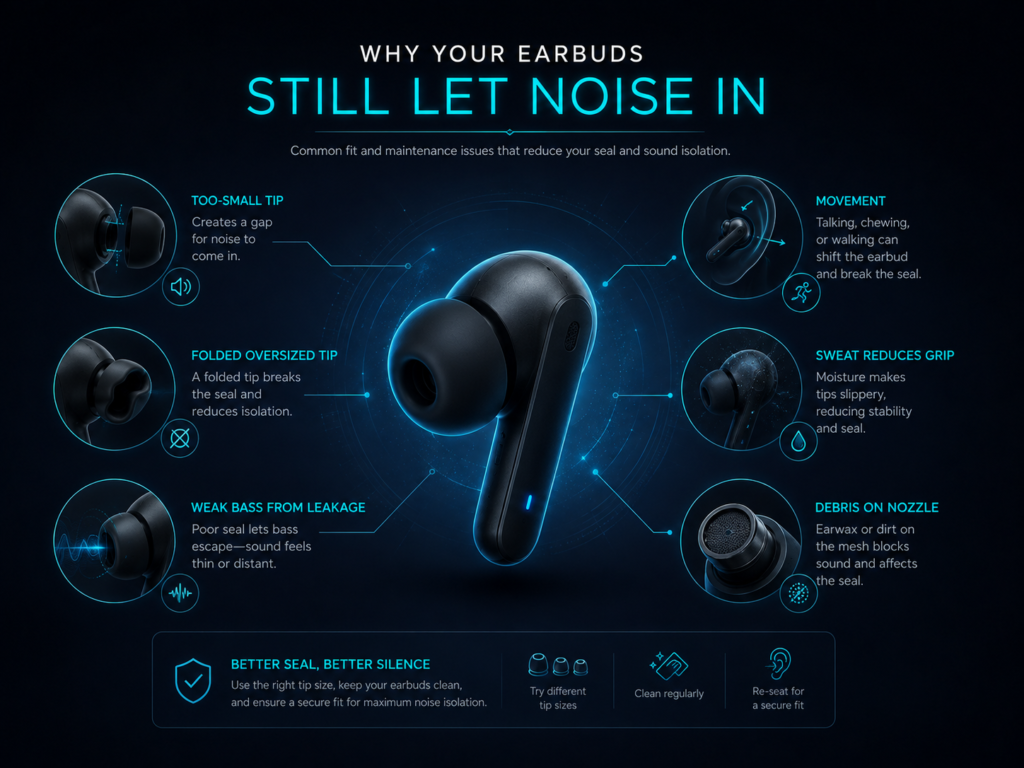
Weak earbud noise isolation usually has a physical explanation.
A structured diagnosis is more useful than immediately changing equalizer settings or replacing the earbuds.
The Tip Is Too Small
A small tip may enter the canal easily but fail to create continuous contact.
Common symptoms include weak bass, strong external speech and improved sound when the earbud is pressed inward.
The Tip Is Too Large
An oversized flange may fold or prevent the housing from reaching its correct position.
The tip can appear tightly fitted while an unseen wrinkle creates leakage.
The Insertion Angle Is Incorrect
Ear canals are angled rather than perfectly straight.
Rotating the housing slightly backward or forward may align the nozzle more effectively. Some designs require the housing to rest against the outer ear before the tip can seal.
Sony recommends inserting and rotating compatible earbuds into position and provides application-based checks for tip air-tightness on supported models.
The Earbud Housing Is Destabilizing the Tip
A tip may fit the canal, but the outer housing may press against cartilage and lever the nozzle outward.
This is common when the earbud body is too large or the nozzle angle does not match the person’s anatomy.
A longer tip, alternate shape or different earbud design may be more effective than a larger diameter.
Sweat or Skin Oil Is Reducing Grip
Silicone can become slippery during exercise.
The seal may be strong at insertion and gradually weaken as the tip moves. Foam, textured silicone or a stability band may provide better mechanical retention.
The Tip Is Not Fully Attached
Some ear tips snap, latch or lock into a groove around the nozzle.
An incompletely attached tip may sit crooked, leak or detach during removal. It may also obstruct a vent or microphone port.
Samsung identifies incorrect wear, undersized tips and improperly installed ear tips as conditions that can reduce noise-control performance.
The Ear Tip Is Worn Out
Silicone can lose shape, tear or become permanently stretched. Foam can stop expanding fully.
A worn tip may look usable while no longer producing its original seal.
The Nozzle or Mesh Is Blocked
Earwax and debris can reduce output and create apparent left-right imbalance.
A blocked vent may also change pressure and bass response. Cleaning must follow the manufacturer’s instructions because sharp objects can damage mesh, microphones and filters.
The Earbud Is Moving During Jaw Activity
The ear canal changes shape slightly when the jaw moves.
Speaking, eating and chewing can disturb a seal that is already marginal. A more flexible tip may maintain contact better than a rigid flange.
Symptom-to-Solution Table
| Symptom | Probable Cause | Recommended First Action |
|---|---|---|
| Weak bass in both ears | Tips too small or shallow | Test one size larger |
| Weak bass in one ear | Unequal seal or obstruction | Test ears separately and inspect the mesh |
| ANC improves when pressed inward | Seal or housing instability | Change tip material or size |
| Earbuds slowly move outward | Oversized tip or housing pressure | Try a smaller or shallower tip |
| Tip folds during insertion | Tip too large or flange too soft | Reduce size or change shape |
| Isolation weakens during exercise | Sweat or movement | Use foam, textured silicone or stability wings |
| Voices remain clear but rumble is reduced | Passive isolation is insufficient | Improve the physical seal |
| One ear becomes painful | Unequal anatomy or excessive pressure | Use different sizes for each ear |
| Sound becomes dull over time | Debris or degraded foam | Clean or replace the tips |
| Fit test passes but seal fails while walking | Static test did not capture movement | Repeat a manual movement test |
Why Each Ear May Need a Different Tip
Human ears are not perfectly symmetrical.
One ear canal may be:
- Wider
- Narrower
- More oval
- More angled
- More sensitive
- Shallower
- Better supported by the outer ear
- More affected by jaw movement
Using matching tips may look orderly, but it is not an acoustic requirement.
Left and Right Tip Sizes Can Differ
A medium tip on one side and a large tip on the other may create better balance than two medium tips.
The goal is not visual symmetry. It is equal acoustic performance.
Material Can Differ Between Ears
In unusual cases, one ear may seal reliably with silicone while the other benefits from foam.
This arrangement may feel unconventional, but there is no technical reason both ears must use identical materials if compatibility and sound remain acceptable.
Evaluate Each Ear Independently
For each side, assess:
- Passive reduction
- Bass strength
- Stability
- Comfort after 20–30 minutes
- Seal during speech
- Fit-test result
- Pressure sensation
Only after each side is fitted independently should the left-right balance be evaluated.
Stability Bands May Also Differ
Systems with separate wings or stability bands allow the outer-ear support to be adjusted independently from the canal seal.
One ear may need a larger stability band but the same tip diameter. This prevents the common mistake of increasing tip size when the actual problem is housing movement.
Occlusion, Pressure and Ear Fatigue
Strong isolation can introduce sensations that are absent with open earbuds.
The objective is not to tolerate discomfort for the sake of maximum quiet. A usable seal must remain comfortable.
The Occlusion Effect
When the ear canal is sealed, internally generated vibrations can become more noticeable.
The listener may hear:
- Their own voice as unusually deep
- Footsteps as thumps
- Chewing more prominently
- Breathing inside the head
- Cable or clothing contact
- Touches on the earbud housing
This is known as the occlusion effect.
Low-frequency energy produced through bone and tissue cannot escape the sealed canal as easily, so it becomes more prominent.
Ear Pressure From the Tip
A tip that is too large or stiff can create genuine physical pressure against the canal.
This usually feels localized and may worsen over time.
Reducing tip size, changing material or using a shallower flange can help.
Perceived ANC Pressure
Some individuals experience a separate pressure-like sensation when ANC is active.
This does not necessarily mean the ear tip is physically pressing too hard. The reduction of low-frequency environmental energy can create an unusual sensory impression.
The distinction can be tested by switching ANC off while leaving the earbuds inserted.
Heat and Moisture
Sealed earbuds reduce ventilation.
During long sessions, moisture and warmth may accumulate around the tip. This can reduce grip, irritate sensitive skin and make the seal feel more intrusive.
Regular breaks and clean, dry tips improve long-session comfort.
Excessive Insertion Depth
Pushing an earbud deeper may temporarily improve isolation but can create pain and alter the intended acoustic response.
The housing and nozzle should rest in their designed positions. Isolation should be achieved through appropriate tip geometry rather than force.
When to Stop Using the Earbuds
Remove the earbuds when experiencing:
- Pain
- Persistent pressure
- Skin irritation
- Dizziness
- Unusual ringing
- Sudden hearing changes
- Discharge
- A tip that becomes lodged or damaged
Persistent symptoms warrant appropriate medical evaluation rather than continued experimentation with fit.
Best Ear Tips for Different Environments
The best ear tips for noise isolation depend on the sound environment, movement level and expected wearing time.
The wider Earbuds center covers different earbud formats and use cases, while the recommendations below focus specifically on tip behavior.
Best Ear Tips for Air Travel
Prioritize:
- Strong passive isolation
- Stable long-session comfort
- Gradual pressure distribution
- Reliable seal during eating and speaking
- Compatibility with ANC
- Easy removal during announcements
Memory foam or foam-infused hybrid tips often suit aircraft use because they conform to the canal and reduce cabin speech and high-frequency noise.
Best Ear Tips for Commuting
A commuter needs isolation and rapid awareness control.
Silicone or hybrid tips may be more convenient than slow-expanding foam when earbuds are inserted and removed frequently.
The fit should remain stable during walking and stair movement.
Best Ear Tips for Studying
Speech reduction is often the priority.
Conforming foam or multi-flange tips may reduce the intelligibility of nearby voices more effectively than a thin, loosely fitted silicone flange.
Comfort remains essential because study sessions can last several hours.
Best Ear Tips for Exercise
Exercise tips should resist:
- Sweat
- Repeated movement
- Jaw motion
- Impact from running
- Gradual outward migration
Textured silicone, hybrid tips or foam can improve grip. Stability wings may be more important than increasing the canal-tip diameter.
Best Ear Tips for Telephone Calls
A strong seal improves incoming speech, but excessive occlusion can make the wearer’s own voice sound unnatural.
Vented silicone or a moderate-depth hybrid tip may offer a better balance than maximum-isolation foam.
Best Ear Tips for Small Ear Canals
Look for:
- Extra-small or XXS sizing
- Thin flanges
- Short stems
- Compact outer housings
- Shallow-fit options
- Flexible silicone
- Independent stability components
Current products are expanding beyond the traditional small-medium-large set. Apple now offers five sizes on AirPods Pro 3, while Bose provides alternate fit kits extending beyond its standard sizes.
Best Ear Tips for Uneven Ear Canals
Use independent sizing.
Do not discard a tip because it fails in one ear if it performs correctly in the other.
Use-Case Selection Matrix
| Environment | Primary Noise | Recommended Tip Characteristic |
|---|---|---|
| Aircraft | Engine rumble, speech and cabin hiss | Conforming foam or hybrid seal |
| Train or bus | Mechanical noise and conversation | Stable silicone, foam or hybrid |
| Shared office | Speech and keyboard sounds | Strong passive isolation |
| Home working | Moderate speech and appliances | Comfortable silicone or hybrid |
| Gym | Music, equipment and movement | Sweat-resistant grip with stability support |
| Running outdoors | Wind and traffic awareness | Secure fit with controlled isolation |
| Telephone calls | Speech and self-voice | Moderate seal with controlled occlusion |
| Long listening sessions | Mixed low-level noise | Soft, low-pressure material |
| Professional monitoring | Stage and instrument sound | Deep universal or custom fit |
| Sleeping | Low-level household noise | Low-profile soft tips, where safe and comfortable |
How to Clean and Replace Ear Tips
Ear tips contact skin, earwax, moisture and cosmetic products. Their condition directly affects hygiene, grip and acoustic performance. Regular maintenance also prevents debris from spreading from the tips to the nozzle, acoustic mesh and microphone openings. Our complete guide on how to clean your earbuds explains how to clean the earbud body, charging contacts, speaker mesh and case without damaging sensitive components.
Cleaning Silicone Ear Tips
When permitted by the manufacturer:
- Remove the tip from the earbud.
- Inspect it for tears or stretching.
- Clean it using the recommended method.
- Allow it to dry completely.
- Inspect the nozzle and protective mesh without pushing debris inward.
- Reattach the tip securely.
- Confirm that the flange is not folded.
Do not expose the earbud body to water unless the manufacturer specifically allows it.
Cleaning Foam Ear Tips
Foam requires gentler treatment because saturation, rubbing and chemicals can damage its cellular structure.
Follow the tip manufacturer’s instructions. Avoid reinstalling foam while damp.
A foam tip that no longer expands evenly should be replaced rather than aggressively cleaned.
Inspect the Attachment Mechanism
Replacement tips may use:
- Friction fit
- Internal collar
- Locking groove
- Snap mechanism
- Oval connector
- Model-specific adapter
A tip that appears physically similar may not attach securely or may cover a vent.
When Silicone Tips Need Replacement
Replace silicone when it becomes:
- Torn
- Permanently stretched
- Misshapen
- Sticky
- Hardened
- Discolored in a way cleaning does not resolve
- Loose around the nozzle
- Unable to maintain its previous seal
When Foam Tips Need Replacement
Replace foam when it:
- Stops expanding
- Expands unevenly
- Remains permanently compressed
- Cracks
- Becomes rough
- Loses grip
- No longer seals despite correct insertion
- Develops damage that cannot be cleaned safely
Do Not Replace Tips Only by Calendar
Usage conditions differ too widely for one universal schedule.
An individual using foam tips daily during exercise may need replacement much sooner than someone using the same material occasionally indoors.
Condition and seal performance are more useful indicators than age alone.
Recheck Sound After Replacement
A new tip may require:
- A different equalizer setting
- A different insertion depth
- Another fit test
- Independent left-right sizing
- A short adaptation period
Replacement tips that improve isolation can make bass sound substantially stronger. This may reflect the restored seal rather than a change in the earbud electronics.
The Earsbud.com Homepage provides access to additional listening guides, device comparisons and specialist earbud categories.
Upcoming Ear-Tip and Fit Technology
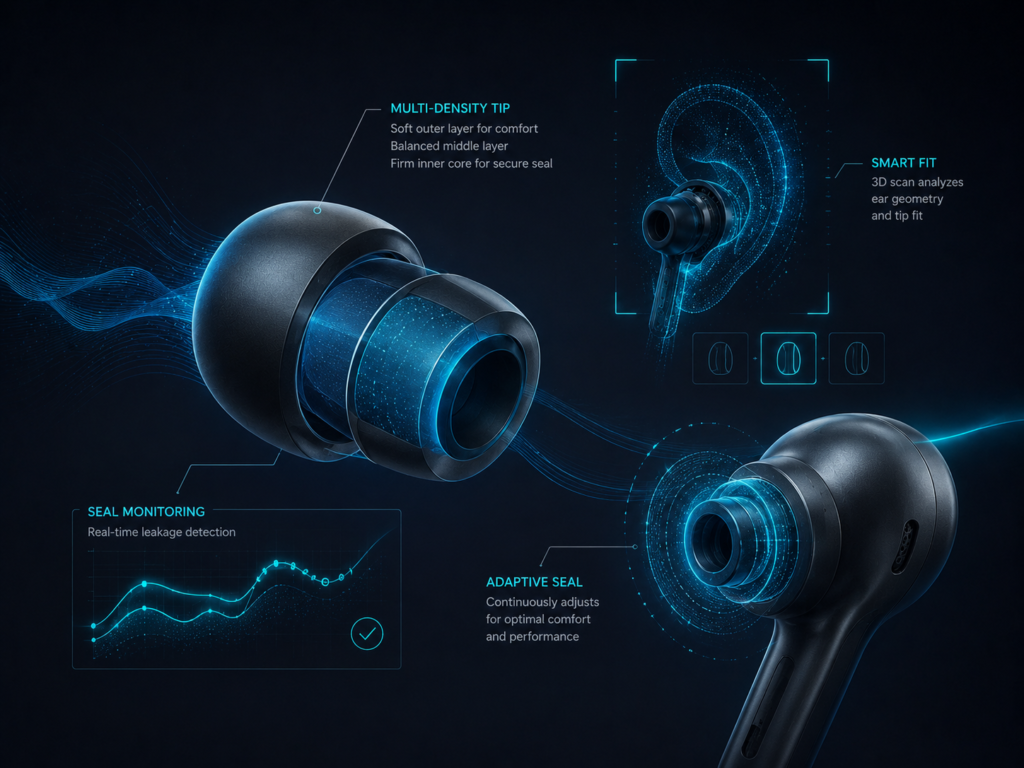
Ear-tip development is moving beyond generic pieces of silicone supplied in three sizes.
The emerging direction combines material engineering, digital fit measurement and adaptive acoustics.
More Granular Sizing
Small, medium and large do not represent the full range of human ear anatomy.
Manufacturers are increasingly adding:
- XXS sizing
- Extra-large sizing
- Alternate flange shapes
- Independent stability bands
- More precise left-right fitting
- Model-specific acoustic seal tests
Apple’s five-size AirPods Pro 3 system and Bose’s alternate sizing kits illustrate the move toward broader fit coverage.
Foam-Infused Silicone
Foam-infused tips attempt to resolve the main compromise between foam and silicone.
The objective is a tip that:
- Conforms to irregular anatomy
- Resists sweat
- Cleans more easily than exposed foam
- Maintains shape longer
- Inserts quickly
- Preserves the intended acoustic bore
- Fits inside a compact charging case
The material itself will increasingly be treated as part of the acoustic design rather than an interchangeable accessory.
Software-Based Acoustic Seal Testing
Current fit tests already play test signals and analyze sound leakage.
Future systems are likely to evaluate fit continuously rather than only during setup.
They may detect:
- Gradual leakage during movement
- Unequal left-right seals
- A worn or damaged tip
- Changes caused by sweat
- Incorrect insertion angle
- Seal failure during speech
- Reduced performance caused by debris
Sony, Samsung, Apple and Bose already provide different forms of fit, air-tightness or seal testing on supported models.
Dynamic Leakage Compensation
Adaptive ANC can already respond to fit and leak-through.
Future earbuds may combine internal microphone data with motion sensors to distinguish between:
- Environmental noise changes
- Earbud movement
- Jaw motion
- Wind
- A partially broken seal
- Physical contact with the microphone
Qualcomm’s adaptive ANC framework explicitly treats earbud fit and noise leak-through as variables that can be monitored and corrected dynamically.
Personalized Ear Scanning
Phone-based imaging and compact ear-scanning systems may make personalized tips more accessible.
Instead of creating a physical impression, an individual may eventually generate a digital fit profile that can be used for:
- Custom tips
- Recommended universal-tip geometry
- Personalized stability bands
- Ear-specific ANC calibration
- Left-right acoustic compensation
The challenge will be capturing internal geometry accurately without professional equipment.
Multi-Density Ear Tips
Future tips may use several material densities in one structure.
A softer outer flange could conform to the canal, while a firmer inner core maintains the bore and prevents collapse.
This would allow engineers to tune comfort, grip and sound independently.
Shape-Memory Materials
Shape-memory polymers may allow tips to soften or adapt after reaching body temperature.
The tip could remain firm enough for easy insertion and then become more conforming during use.
Durability, hygiene and predictable expansion will determine whether these materials become practical at scale.
Sensor-Integrated Ear Tips
The ear tip may become a mounting surface for health and fit sensors.
Potential measurements include:
- Heart rate
- Temperature
- Motion
- Contact quality
- Seal integrity
- Wearing detection
- Pressure changes
Any sensor integrated into the tip must remain accurate while surviving sweat, cleaning and repeated compression.
Physically Adjustable Seals
A future earbud may alter its sealing pressure mechanically.
The tip could expand for travel, relax for conversation and partially open for awareness. This would provide a physical alternative to relying entirely on transparency microphones.
The technical difficulty is creating a mechanism that remains small, quiet, reliable and comfortable.
Sustainable Replacement Materials
Ear tips are consumable components.
Manufacturers may place greater emphasis on:
- Recyclable silicone
- Replaceable rather than bonded components
- Longer-lasting foam structures
- Reduced packaging
- Standardized attachment systems
- Material traceability
Universal standards would make replacement easier, but manufacturers may continue using proprietary connectors to preserve acoustic tuning and accessory control.
More coverage of new acoustic systems and listening technologies is available through the Earsbud.com Guides center.
Ear-Tip Technology Outlook
| Developing Technology | Main Objective | Expected Benefit |
|---|---|---|
| Expanded XXS-to-XL sizing | Cover more ear anatomies | Fewer leaks and pressure points |
| Foam-infused silicone | Combine conformity and durability | Strong isolation with easier maintenance |
| Continuous seal monitoring | Detect fit changes during use | More consistent sound and ANC |
| Dynamic leakage correction | Compensate for movement | Fewer cancellation fluctuations |
| Digital ear scanning | Personalize fit remotely | More accessible custom tips |
| Multi-density flanges | Separate support from comfort | Stable bore with softer canal contact |
| Shape-memory materials | Adapt after insertion | Easier insertion and individualized sealing |
| Sensor-integrated tips | Measure contact and biometrics | Better fit data and health functions |
| Adjustable physical seals | Switch between isolation and awareness | More natural environmental control |
| Sustainable materials | Reduce accessory waste | Longer service life and easier recycling |
Frequently Asked Questions
How do earbud ear tips block noise?
Earbud ear tips block noise by forming a physical seal around the ear canal. The seal obstructs the direct path of external sound, reflects or absorbs part of its acoustic energy and reduces leakage into the canal. This process is known as passive noise isolation.
What are the best ear tips for noise isolation?
The best ear tips for noise isolation are those that create a complete, stable and comfortable seal. Memory foam often conforms well to irregular canals, while silicone offers easier cleaning and greater durability. Hybrid and multi-flange tips may provide a balance of conformity, grip and convenience.
How do I know whether my earbuds have a good seal?
A good earbud seal produces stable bass, reduced external sound and consistent performance during speech and movement. If bass or isolation improves dramatically when the earbud is pressed inward, the normal fit is probably leaking.
Are memory foam ear tips better than silicone?
Memory foam can provide stronger passive isolation when it fills gaps that silicone leaves open. Silicone is usually easier to clean, quicker to insert and more durable. The better material depends on ear shape, comfort, movement and the design of the earbuds.
Can ear tips improve active noise cancellation?
Yes. Ear tips improve ANC indirectly by creating a stable acoustic chamber and reducing uncontrolled sound leakage. A poor seal can weaken bass and make noise-cancellation performance inconsistent even when the electronic system is functioning correctly.
FAQ Summary Table
| Question | Concise Answer |
|---|---|
| How do tips block noise? | They create a physical barrier around the ear canal. |
| Which tips isolate best? | The tips that maintain the most complete comfortable seal. |
| How can a seal be tested? | Check bass, isolation, movement stability and fit-test results. |
| Is foam better than silicone? | Foam often conforms better; silicone is generally more durable. |
| Do tips affect ANC? | Yes, because leakage changes the acoustic environment ANC must control. |
People Also Ask
Why do my earbuds sound better when I push them in?
Pressing the earbuds inward may temporarily close an acoustic leak or align the nozzle more effectively. If bass and isolation improve, try a different tip size, material or stability system rather than repeatedly forcing the earbuds deeper.
Why can I still hear people through my earbuds?
Human speech contains rapidly changing midrange and high-frequency information. Ear tips can make voices quieter and less intelligible, but they rarely erase nearby conversation completely. A weak seal allows even more vocal detail to enter.
Why does one earbud block more noise than the other?
The left and right ear canals may differ in size, shape or angle. Unequal tips, insertion depth, debris or a damaged flange can also create different seals. Each ear should be fitted and tested independently.
Do larger ear tips block more noise?
Not necessarily. A larger tip can improve isolation when the existing tip is too small, but an oversized tip may fold, create pressure or push the earbud outward. Continuous contact matters more than maximum diameter.
How often should earbud tips be replaced?
Replace tips when they tear, stretch, harden, lose grip, stop expanding or can no longer maintain their previous seal. Foam generally wears faster than silicone, but usage and maintenance matter more than a fixed calendar interval.
PAA Diagnostic Chart
| Search Question | Primary Cause or Principle | Practical Answer |
|---|---|---|
| Why does inward pressure improve sound? | The normal seal is leaking | Change size, shape or stability |
| Why are voices still audible? | Speech is broad and rapidly changing | Improve passive isolation, but expect some residual sound |
| Why is one side quieter? | Unequal fit or obstruction | Test and clean each earbud independently |
| Are larger tips better? | Only when current tips are undersized | Avoid folding and excessive pressure |
| When should tips be replaced? | Material degradation or lost seal | Replace according to condition |
Editorial Insights: The Seal Is the System
Ear tips are often treated as packaging accessories: three pairs placed beneath the charging cable, tested briefly and then forgotten.
Acoustically, they are far more important.
The ear tip determines how external sound enters, how internal sound remains contained and how securely the earbud stays aligned. It affects bass response, tonal balance, passive isolation, ANC stability, comfort and even whether the left and right earbuds sound like a matched pair.
This is why stronger processing cannot always rescue a poor fit. A sophisticated earbud may recognize leakage and adjust its response, but it still performs best when the physical boundary remains intact. The processor can compensate for variation; it cannot make anatomy irrelevant.
The most useful way to approach earbud fit is not to search for the universally best material or largest tip. It is to evaluate the entire interface:
- Does the flange form continuous contact?
- Does the housing support or disturb that contact?
- Does bass remain stable during movement?
- Do both ears require the same size?
- Does the tip remain comfortable after extended use?
- Does the bore preserve the intended sound?
- Does the seal support awareness and safety in the intended environment?
When these conditions are met, passive noise isolation stops feeling like a secondary feature. It becomes the foundation of the complete listening system.
A good earbud seal does not merely block outside noise. It allows the driver, tuning and noise-control technology to perform as they were designed to perform.